Overview
The Department of History at the University of Mississippi
offers programs of graduate study leading to the masters
and doctoral degrees. The core of the program is, of course,
the faculty; current members are listed in this brochure.
The faculty offers a wide variety of graduate courses
in United States, European, and Latin American history,
with additional work available in African and Asian history.
The department includes faculty members from all over
the United States and from Europe, and their interests
span the full chronological sweep of American and European
history, as well as much of the histories of Africa, Latin
America, and East Asia.
The Department of History maintains close relationships
with several interdisciplinary programs at the University,
including the Afro-American Studies Program, the Center
for the Study of Southern Culture, the Croft Institute
for International Studies and the Sarah Isom Center for
Gender Studies.. It also engages in many activities to
enhance its regular research and teaching programs and
to enrich the intellectual lives of its students and faculty.
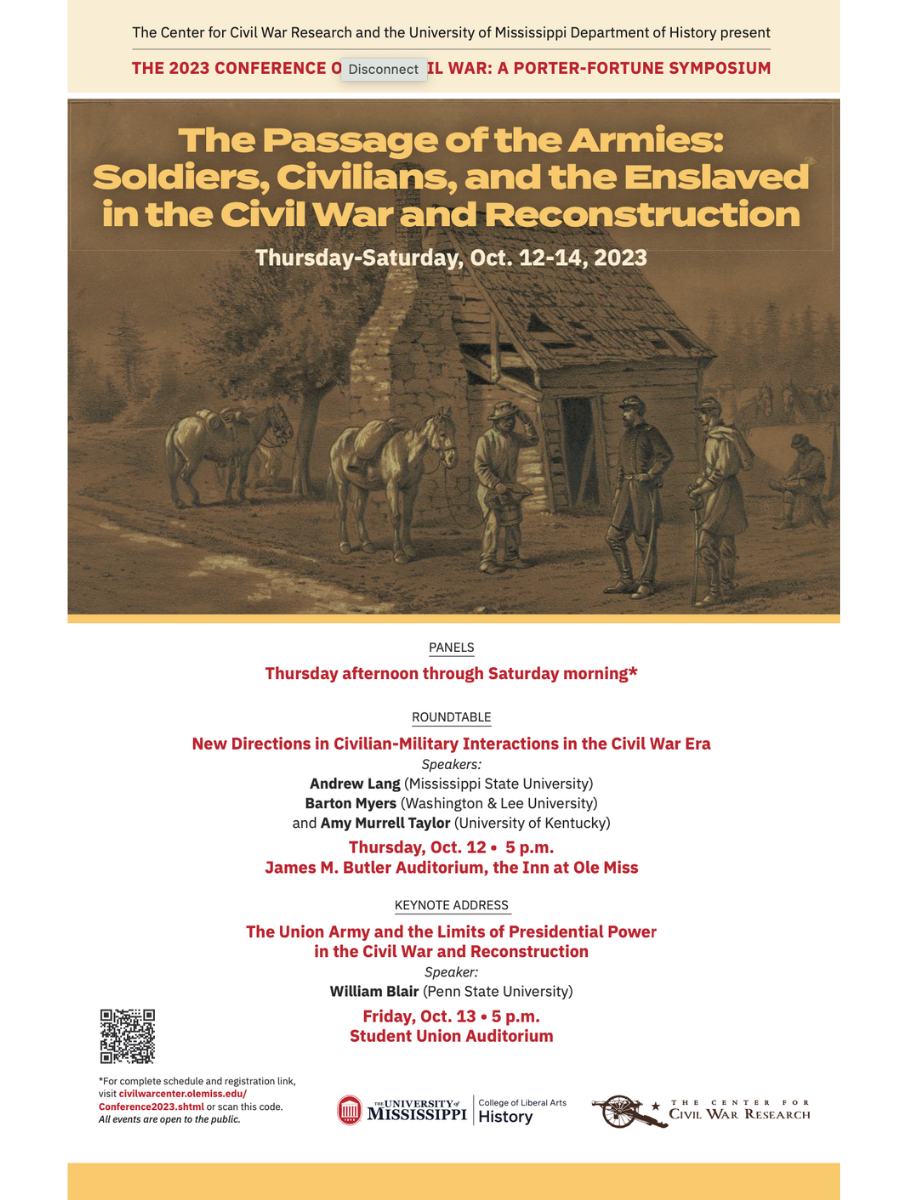
Each year the Department co-sponsors the Porter L. Fortune,
Jr., History Symposium. Held every fall since 1975, this
three-day conference brings well-known scholars to campus
to discuss their research and interpretations on various
issues relating to Southern History. Recent symposium
topics have included Gender and the Southern Body Politic,
the Civil Rights Movement, Religion in Southern History,
and Britain and the South.
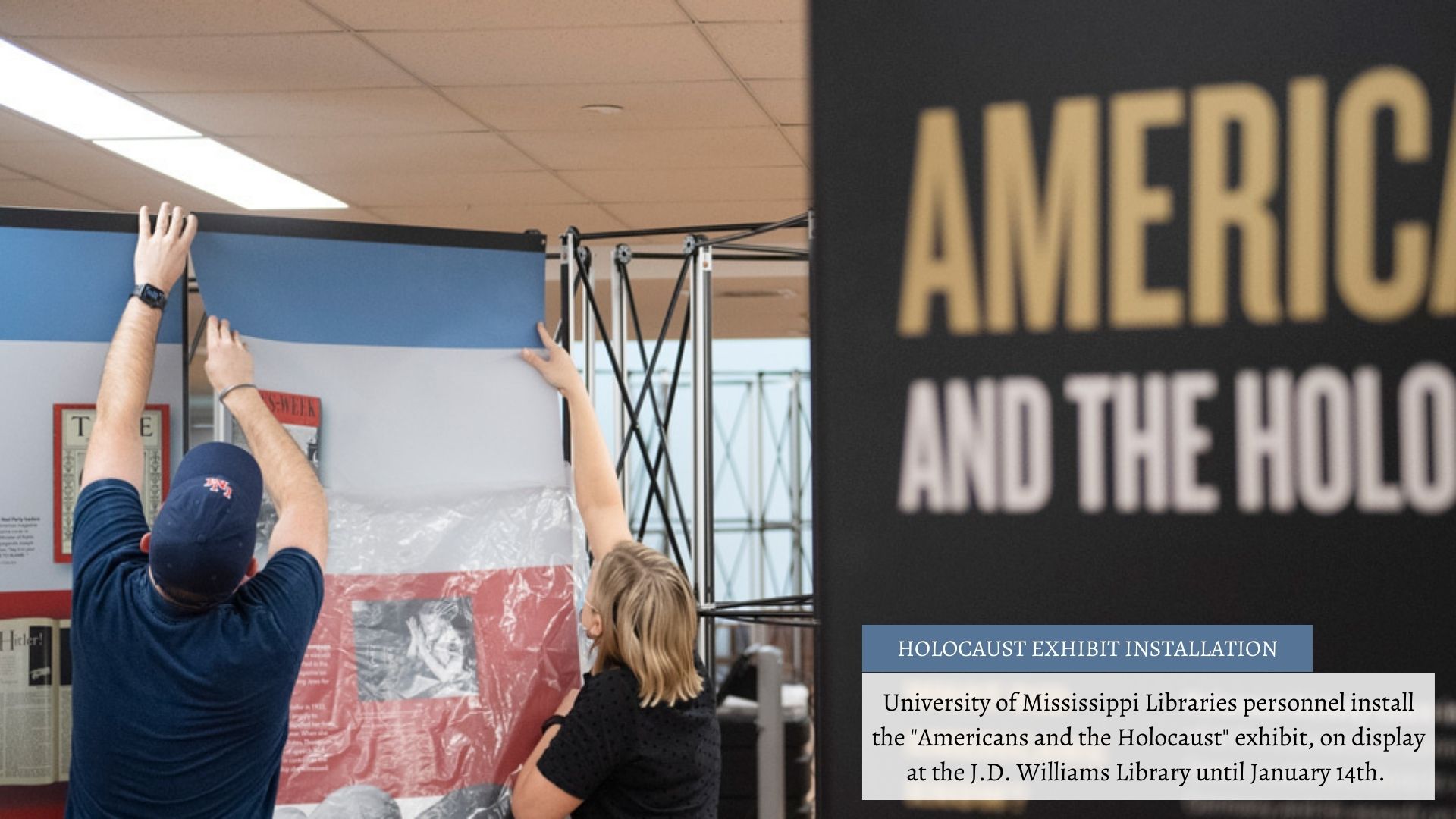
Within the University, the history department also has
close ties with the John Davis Williams Library, which
contains more than 800,000 volumes. Of particular importance
to history graduate students are the Mississippi Collection
of books and manuscripts pertaining to the state, the
Blues Archive, and the depository of federal government
documents.
Graduate
Programs
In its masters and doctoral programs, the department
emphasizes both rigor and flexibility in designing a
course of study to fit the individual interests of each
graduate student. The Graduate Advisory Committee administers
the program. Each graduate student designs a program
of study in consultation with the Graduate Advisory
Committee and other faculty members of the department.
Approximately sixty students from a wide variety of
backgrounds are currently pursuing graduate degrees
in the department.
Master of Arts
To gain admission to the graduate program, an applicant
should have at least a B average as an undergraduate,
should have majored in history (or have taken a significant
number of history courses), and should have achieved
an acceptable score on the Graduate Record Exam.
All M.A. students must take the following courses: Historical
Methods and Philosophy of History, and three of the
four courses the department offers in the historiography
of United State history and the historiography of European
history, and a research seminar. Students specializing
in Latin American, Asian, or African history may take
a historiography course in one of these areas to fulfill
one of the three required historiography courses. Moreover,
an M.A. student may with prior approval from the Graduate
Advisory Committee take for credit up to two graduate-level
courses outside the department.
Students pursuing the Master of Arts must choose between
two different programs of study. The thesis option requires
24 hours of courses and at least 6 hours of thesis credit.
The student will write the thesis under the direction
of a faculty adviser and evaluated by a committee consisting
of the adviser and two other faculty members. A thesis
director may require a student to have a facility in
a foreign language or in quantitative skills relevant
to the thesis. To complete the thesis, the student must
pass an oral defense before the thesis committee. The
non-thesis option consists of 36 hours of course work.
To complete the non-thesis M.A., a student must pass
an oral exam in the candidates field of study
that a three-member faculty committee will administer.
The student will choose which option to pursue in consultation
with faculty members familiar with his or her research
interests and career goals.
Doctor
of Philosophy
To gain admission to the doctoral program, an applicant
must have earned an M.A. in history or its equivalent,
have demonstrated distinct promise of success in advanced
graduate study, and achieved an acceptable score on
the Graduate Record Exam.
Additional course work required beyond the M.A. will
include a minimum of 12 hours of work in the major field,
at least 6 hours of work in each of two minor fields,
and one research seminar. Doctoral students concentrate
on a major field in which they must pass oral and written
exams and two minor fields in which they must pass written
exams. The major fields are:
*United States History through Reconstruction
* United States History since the Civil War
* Medieval Europe
* Early Modern Europe to 1815
* Modern Europe since 1789
* Latin America
Minor fields include the five major fields as well as
African, Afro-American, East Asian, Gender, Southern,
and Twentieth-Century World history. Other minor fields
inside or outside the department may be selected and
designed by the student in consultation with the Graduate
Advisory Committee and the students dissertation
director.
Doctoral students must demonstrate proficiency in one
foreign language. This requirement may be met in one
of two ways: by attaining a grade of B or higher in
a fourth-semester language course (202) at the University
of Mississippi, or in an equivalent course which has
been completed within three calendar years prior to
enrollment; by attaining a passing grade on a departmentally
administered translation exam. In certain fields, more
than one language may be required by the Graduate Advisory
Committee. After completing the required coursework
and fulfilling the foreign language requirement, a doctoral
student must pass final written comprehensive examinations
in the major and minor fields and an oral exam in the
major field before beginning work on a dissertation.
The student will undertake a dissertation on a topic
in one of the major fields by mutual agreement of the
student and the dissertation director. The dissertation
will be evaluated by a committee consisting of three
history faculty members and a member of another department.
This committee will administer a final oral examination
on the dissertation.
Course
Work
Students should pursue a rationally structured course
program to be designed on an individual basis in close
consultation with the Graduate Advisory Committee. As
part of this program, MA students must take a course
on historical methods, three of the four historiography
courses that cover various periods of the histories
of the United States and European, and at least one
700-level research seminar. Doctoral students who have
not previously taken a graduate-level historical methods
must do so as part of their course work, and they must
also complete at least one 700-level research seminar,
at least two 600-level courses, and at least 6 hours
of graduate course work in each of the minor fields
for their comprehensive examination. Also, prior to
taking their comprehensive examination doctoral students
must demonstrate proficiency in one foreign language.
All graduate students may, with the approval of the
Graduate Advisory Committee, include as part of their
program a limited number of graduate courses in other
departments. More information about specific graduate
course offerings may be found on the History Departments
website.
Admissions
Applications for admission to the graduate program
may be obtained by writing or calling the Graduate School
at (662) 915-7474, or through its website at http://www.olemiss.edu/gradschool/.
Applicants must submit a completed application form,
Graduate Record Exam scores, and official transcripts
of post-secondary study to the Graduate School. In addition,
applicants should submit three letters of recommendation
from people who can speak with authority about their
potential as a graduate student in History, a statement
of purpose that describes their intellectual background
and future goals, and a sample of their written work
directly to the Department of History. The department's
Graduate Advisory Committee makes it decision regarding
each application after assessing all of the application
materials together, and not by applying any rigid standard
or mathematical formula.
Financial
Aid
The department offers several graduate assistantships
every year; each pays as much as $9,000 per year and
automatically includes a tuition scholarship. The assistantships
are competitive and based on merit, and all applicants
to our program are automatically considered for these
assistantships. The Graduate School has Underrepresented
Minority Graduate Scholarships that pay $2,500 each
year and include a tuition scholarship. Also from the
Graduate School, Honors Fellowships for students of
exceptional ability provide $2,000 per year. A graduate
student may combine any of the above awards. The Graduate
School also provides, on a competitive basis, Dissertation
Fellowships to a limited number of students nearing
the completion of their doctoral studies. More information
on graduate fellowships and aid may be found at the
Graduate School website listed above.
Faculty
Nancy Bercaw, Ph.D., Pennsylvania, 19th-Century South,
women, intellectual, social
Erin D. Chapman, Ph.D., Yale, African American, gender
Oliver Dinius, Ph.D., Harvard, Modern South America
Charles W. Eagles, Ph.D., North Carolina, 20th-century
U.S., race relations, South
Chiarella Esposito, Ph.D., SUNY Stony Brook, Modern
Europe, diplomatic
Lester Field, Ph.D., UCLA, Medieval Europe, religion
Robert L. Fleegler, Ph.D., Brown, United States
Peter K. Frost, Ph.D., Harvard, Visiting , Japan, Vietnam
War
Kees Gispen, Ph.D., California-Berkeley, Germany, social
and economic
Jeanne E. Grant, Ph.D., California-Berkeley, European
Susan Grayzel, Ph.D., California-Berkeley, Modern Europe,
Women
Robert J. Haws, Ph.D., Nebraska, U.S. Legal and constitutional
Angela M. Hornsby-Gutting, Ph.D., UNC, Chapel Hill,
African
American Gender
Joshua H. Howard, PhD., California-Berkeley, East Asia
Marc H. Lerner, Ph.D., Columbia, Early Modern Europe
Theresa H. Levitt, Ph.D., Harvard, Science, France
Michael F. Metcalf, Filosofie doktor, Stockholm, 18th-century
Scandanavia
Michael Namorato, Ph.D., Michigan State, 20th-century
U.S., economic
John R. Neff, Ph.D., California- Riverside, U.S. Civil
War Era, cultural
Ted M. Ownby, Ph.D., Johns Hopkins, South, religion,
popular culture
Elizabeth A. Payne, Ph.D., Illinois-Chicago, U.S. and
Intellectual, Womens History
Charles K. Ross, Ph.D., Ohio State, Afro-American
Mohammed Bashir Salau, Ph.D., York University, Canada,
Sub Saharan Africa
Sheila L. Skemp, Ph.D., Iowa, Colonial and revolutionary
America, intellectual, women
Douglass Sullivan-Gonzalez, Ph.D., Texas-Austin, Latin
America
Joseph P. Ward, Ph.D., Stanford, Early Modern Britain,
social, cultural
Jeffrey Watt, Ph.D., Wisconsin, Early Modern Europe,
family, social
Charles R. Wilson, Ph.D., Texas-Austin, South, American
religion
Noell Howell Wilson, Ph.D., Harvard, Early modern Japan
Admissions
Prospective applicants may learn more about the History
Department by visiting its website at www.olemiss.edu/depts/history/
and by contacting the department at the address below.
Both as a department and individually, the faculty welcomes
inquiries from prospective graduate students, and encourages
them to visit the campus.
Mail inquiries to:
Dr. Lester Field
Chair, Graduate Advisory Committee
The University of Mississippi
Department of History
Bishop 310
College of Liberal Arts
PO Box 1848
University, MS 38677-1848
telephone: (662) 915-5667
email: hsfield@olemiss.edu
|