
Shakespeare
in Love
| Stoppard’s best
known recent work is his screenplay for the Oscar-winning comedy Shakespeare
in Love, which illustrates many of his central themes, symbols, and
stylistic devices (particularly the stage metaphor). Consider comparing this film with The
Real Inspector Hound for an extra credit or final exam essay. |
|
| Shakespeare
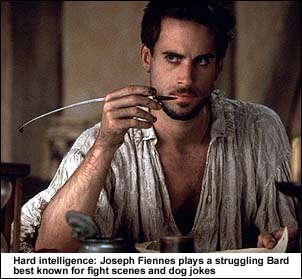
in Love is a biographical fantasy about the writing of Romeo and
Juliet. Young Will Shakespeare
(Joseph Fiennes) is a freelance playwright struggling with writer’s block
until he meets his muse, Viola, a beautiful upper-class English woman
(Gwyneth Paltrow) with a taste for the stage.
Viola not only recognizes the power of Shakespeare’s poetry, but also
wishes to perform it. The only problem
is that women were not allowed to act in Renaissance theater—all female roles
were played by boys. To realize her
dream of acting on the stage, Viola disguises herself as a boy and auditions
for “Romeo and Ethel, the Pirate’s Daughter,” the play Shakespeare is then
struggling to write. The aspiring
actress and playwright meet and fall in love in a romantic comedy that
inverts gender roles and turns reality on its head. |
|
| Like The Real
Inspector Hound, Shakespeare in Love critiques and celebrates the
theater and its patrons and uses the stage metaphor to show us the
transformative, protean nature of reality, even within the confines of the
Elizabethan world’s rigid social constructs. |
|
| The scenes
listed on the slide above illustrate the film’s postmodern qualities,
particularly Stoppard’s use of the theater to represent the blurred
boundaries between art and life. The
film opens with a sequence that introduces the thematic use of the stage to
explore the intersection of reality and artifice. A long shot of Elizabethan London pans into
the interior of the Rose Theater, where theater owner Philip Henslowe is being
tortured by his moneylender for failure to repay a loan, while a script of
the play, “The Lamentable Tragedie of the Money Lender Reveng’d” flutters in
the breeze on the theater floor.
Henslowe escapes further torture by promising his creditor the
proceeds (and an acting part) from his next play, and desperate to make the
needed profits from his theater, contacts young Shakespeare to demand the
script he has promised for his new play, “Romeo and Ethel, the Pirate’s
Daughter.” But the Bard is suffering
writer’s block; and in Scene 1 listed above, he visits an Elizabethan
“therapist” to seek a cure. The scene
with its hilarious Freudian references is a fine example of postmodernism’s
irreverent and anachronistic treatment of history and personalities
associated with “high art.” The
therapist suggests that the Bard’s “impotence” in art results from an
impotence in life, a need for “real” love. |
|
| Scene 2
takes place just after a court performance of Shakespeare’s play Two
Gentlemen of Verona. Lady Viola
(Gwyneth Paltrow), who has not yet met the play’s author, is discussing the
performance with her nurse. Entranced
by the poetry and by Shakespeare’s depiction of love, Lady Viola dreams of
having love in life and on the stage.
Consider the boundaries Lady Viola discusses between “real” love and
stage love, art and life, dreams and reality.
How does the stage magically cross and blur these boundaries? |
|
| Lady Viola’s
determination to “have poetry in my life” (note the convergence of art and
life in that goal!) leads her to audition for a stage role herself in
Shakespeare’s upcoming play “Romeo and Ethel, the Pirate’s Daughter” (of
which the Bard has still written only a few scenes, while his rival
playwright, Christopher Marlowe, has produced another stage hit). |