
Shakespeare in Love
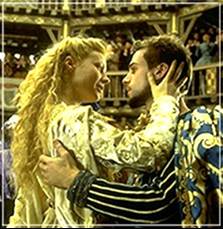
Viola and Shakespeare on stage as Juliet and Romeo
| Still trying to
discover Thomas’ identity, Shakespeare crashes a party at Viola’s manor
(where he thinks Thomas works as a servant) and there meets Lady Viola, with
whom he falls desperately in love. In
conversing with her on her balcony after the party, he recovers his poetic
powers and expresses his admiration in a sequence that will become the
balcony scene in Romeo and Juliet (the name “Ethel” was quickly
discarded when the Bard’s poetry returned!).
After their meeting, Shakespeare races to his garret, blissfully free
of his writer’s block, to work on composing his play. |
|
| Having fallen in
love with Shakespeare, Viola is more determined than ever to continue her
dual life as a stage actor and returns to the theater disguised as Thomas
Kent to join the cast of Romeo and Juliet. Shakespeare, believing Thomas to be Lady
Viola’s servant, gives Thomas a love letter (a new sonnet) to convey to Lady
Viola. In Scene 4, Shakespeare
inquires about the reception of his letter and discusses his lady love with
Thomas in a conversation that reveals the “play-acting” involved in gender
roles and considers the relationship between reality and fantasy in the realm
of love. Lady Viola reveals her dual
identity as Thomas the actor and Viola the lover, and the scene ends with
Shakespeare and Viola consummating their love. After the “real” love-making, Viola
attests, “I would not have thought it, but there is something better than a
play. Even your play!” |
|
| As the Bard and
the lady continue their affair in private, Shakespeare continues to write his
play, and Viola continues to rehearse it with the theater company in public,
disguised as Thomas. The lovers’
on-stage and off-stage relationships intertwine, feeding and enriching both
the reality of their love and the art of the play they’re composing and
performing. Scene 5 illustrates
this vibrant intermingling of life and art in a sequence that cuts back and
forth between the lovers’ private meetings and their stage rehearsals. As they make love in private, they
“rehearse” the play, quoting lines of poetry from it to express their
love. Rehearsal of the same scene also
occurs on stage where Viola’s private emotions inspire her public
performance. Note, too, how this
sequence plays with reality by continually switching the gender roles. In their private “rehearsals,” Shakespeare
performs the part of Romeo and Viola recites Juliet’s lines, while in the
public stage performance, Viola plays Romeo disguised as Thomas. How do we distinguish between the “real”
love and the stage love in this sequence?
Is any distinction possible?
What is the scene saying about the relationship between life and art,
reality and illusion? |
|
| Despite her love
for Shakespeare and the stage, the reality of Viola’s situation as a
Renaissance lady asserts itself, and she finds she must marry the man her
parents have chosen. She leaves the
acting company, and Shakespeare himself must assume her part as Romeo. But the day of Viola’s wedding is also the
opening day of the play (surprise!), and Viola escapes immediately after the
ceremony to rush to the theater and see the opening performance. The boy playing Juliet is unable to
perform, and Viola volunteers to replace him, so that the film ends with
Shakespeare and Viola again performing their private roles as the lovers, but
this time on a public stage. |
|
| The film shows
the play’s climax, the suicides of Romeo and Juliet, in a magnificent scene
that illustrates the powerful effects on the theater audience of the very
real emotions they see performed on the stage. Reality and stage illusion become one to
allow the audience to experience a moment of true tragedy. The scene dramatizes the power of art (in
the form of the stage play) not only to envision a myriad of other realities
for us, but also to let us truly experience those realities. |
|
| After the play,
Lady Viola must return to her husband and leaves with him on a journey to the
New World where he owns a plantation.
She leaves Shakespeare behind, but her inspiration remains, and in the
final scenes, Shakespeare begins writing his next play, Twelfth Night. As he writes, the film shows Viola caught
in a shipwreck off the shore of the New World. But instead of tragedy, the shipwreck is
depicted as a moment of rebirth for Viola.
She rises from the ocean alone and approaches the verdant shore of the
New World a survivor, an independent woman.
The scenes don’t specify if this situation is happening to Viola in
reality, or if it is just the story Shakespeare is imagining as he writes his
play (Twelfth Night is about a heroine named Viola who survives a
shipwreck and assumes a man’s identity to begin a new life). But these final moments imply that in the
end there is no distinction—the illusion of art can envision the very real
and empowering potentialities of human life.
So perhaps art can allow us to realize our true potential. Consider comparing the stage metaphor in
this film and in The Real Inspector Hound—how does
the stage represent the many realities possible in the postmodern experience? |
|