
Dr. Oliver Dinius is a Croft Associate Professor of History in the Department of History and Croft Institute for International Studies at the University of Mississippi.
Research Interests
Dr. Dinius' research focuses on the history of social and economic development, above all in 20th-century Brazil. His first book, "Brazil's Steel City: Developmentalism, Strategic Power, and Industrial Relations in Volta Redonda, 1941-1964" (Stanford UP, 2011), is a history of the country's foremost state-owned enterprise, the Companhia Siderurgica Nacional. He is also the co-editor of Company Towns in the Americas: Landscape, Power, and Working-Class Communities (University of Georgia Press, 2011).
Currently, Dinius is working on a monograph on the history of regional development initiatives in Brazil’s Amazon region over the last eighty years. The project is interdisciplinary and brings together ecological questions with the history of economic, political, and social dimensions of development, enabling a critical reflection of the development paradigm -- a term so central to Brazil’s national narrative. His goal is to structure the book as truly interdisciplinary, with sections using conventional historical sources and others (especially covering the 21st century) drawing on other disciplines and current journalistic material. The inspiration for this modified structure for the book came during two stays as Fulbright Scholar in Belem in 2023-24.
Biography
Oliver Dinius is a Croft Associate Professor of History & International Studies. His research focuses on modern Latin America. A native of Germany, he received the equivalent of a B.A. from the Ruprecht-Karls Universitaet Heidelberg before moving to the United States to pursue doctoral work in Latin American history. He earned his Ph.D. from Harvard University in 2004 and joined the faculty at the University of Mississippi the same year. From 2016-25, he served as the Executive Director of the Croft Institute for International Studies.
Publications
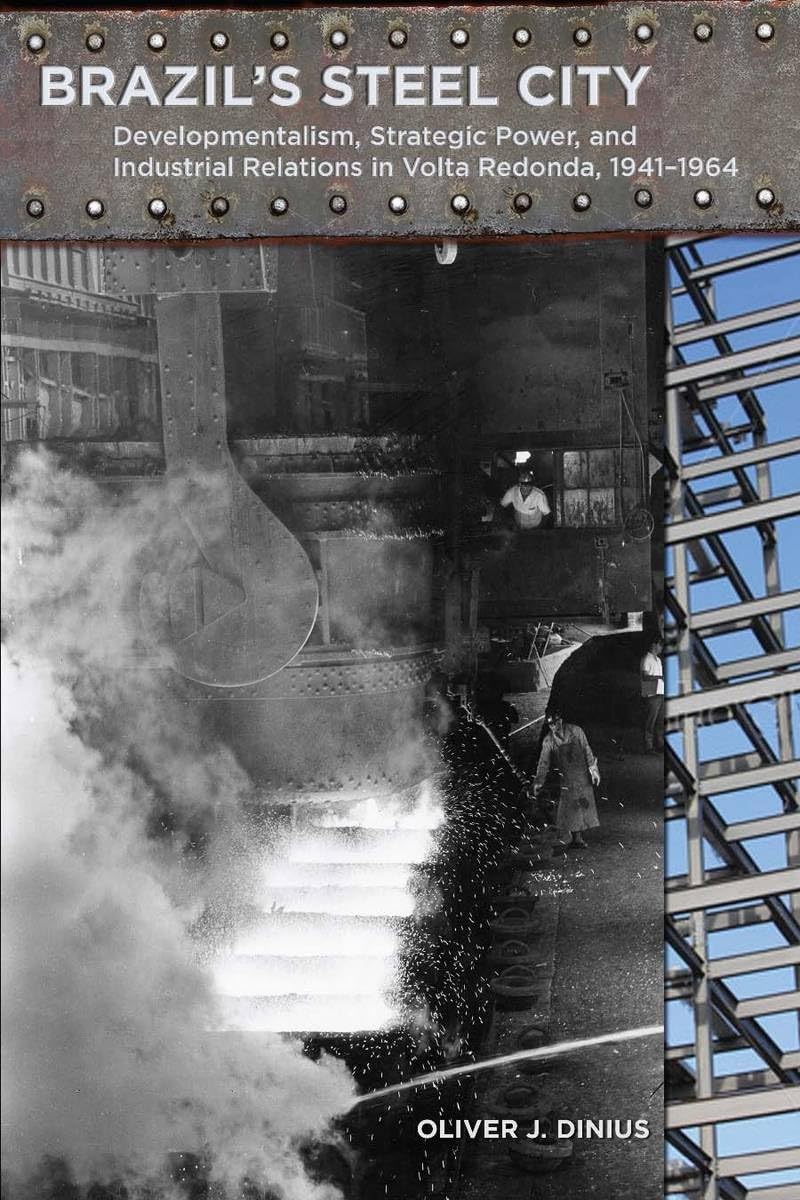
Developmentalism, Strategic Power, and Industrial Relations in Volta Redonda, 1941-1964
From the publisher:
Brazil's Steel City presents a social history of the National Steel Company (CSN), Brazil's foremost state-owned company and largest industrial enterprise in the mid-twentieth century. It focuses on the role the steelworkers played in Brazil's social and economic development under the country's import substitution policies from the early 1940s to the 1964 military coup.
Counter to prevalent interpretations of industrial labor in Latin America, where workers figure above all as victims of capitalist exploitation, Dinius shows that CSN workers held strategic power and used it to reshape the company's labor regime, extracting impressive wage gains and benefits. Dinius argues that these workers, and their peers in similarly strategic industries, had the power to undermine the state capitalist development model prevalent in the large economies of postwar Latin America.
Selected Book(s):
Courses Taught
- INST 1010 Introduction to International Studies
- INST 2070 Latin American Studies
- INST 3140 Special Topics: Soccer Madness: From Brazil to the World
- INST 3140 Special Topics: The Problem of Inequality in Latin America
- INST 3610 The War on Drugs in Latin America
- HIST 1600 Intro to Latin American History
- HIST 3680 Latin America and the Cold War
- HIST 6910 Readings - Modern Latin American History
Education
M.A. History, Harvard University (1996)
Ph.D. History, Harvard University (2004)
B.A. History, Ruprecht Karls Universität Heidelberg (1992)
Recognitions
- Fulbright U.S. Scholar - Brazil, US Department of State, 2023-24
- Fulbright U.S. Scholar - Taiwan, US Department of State, 2023