
What is an Accelerated Master's Program?
An Accelerated Master's program allows you to begin graduate-level coursework while still completing your bachelor’s degree.

Improve Career Opportunities
In many fields, a master’s degree can help strengthen your resume, expand your qualifications, and prepare you for positions that value specialized skills and advanced education. Workers with master’s degrees also earn higher salaries and experience lower unemployment rates than those with only a bachelor’s degree, based on data from the U.S. Bureau of Labor Statistics.
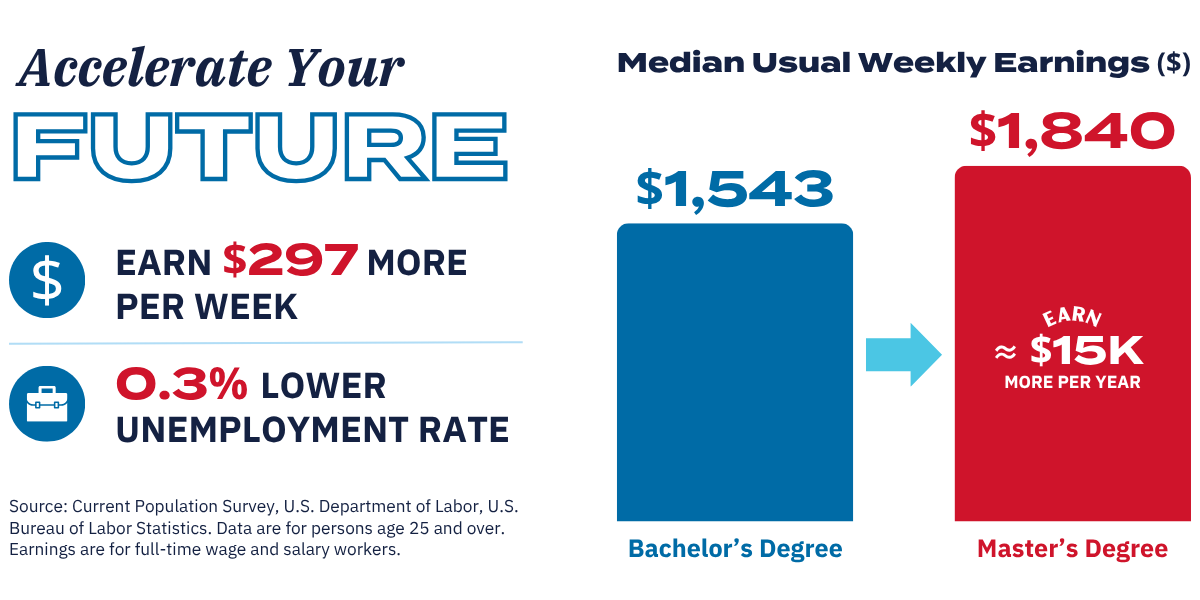
Beyond the classroom, accelerated master’s programs can provide valuable hands-on experience and professional development opportunities while helping you build connections with professors, classmates, researchers, and industry professionals.
Keep the Momentum
Continuing directly into graduate coursework means you never have to rebuild the habits and routines that make academic work sustainable and effective. You already know the campus, the expectations, and the professors. Because many faculty teach both undergraduate and graduate courses, the relationships you built as an undergraduate can translate directly into research opportunities, lab positions, mentorships, and graduate assistantships.
How Does the Accelerated Master's Degree Work?
An Accelerated Master's Degree program allows you to earn both a bachelor's degree and a master's degree in approximately five years instead of the traditional six. You'll spend your first three to four years completing undergraduate requirements before applying to the accelerated master's program, often during your sophomore or junior year. Because most programs require you to maintain strong academic standing and meet specific GPA or admission requirements, doing well in undergraduate courses is important early on.
Once admitted, you'll begin taking graduate-level courses while still enrolled as an undergraduate student. Depending on the program, some of these courses may count toward both the bachelor's and master's degrees, reducing the total number of credits needed to earn a graduate degree.
For many students, senior year includes a mix of undergraduate and graduate coursework. During this time, you'll work closely with professors, advisors, and mentors who can provide academic guidance, research opportunities, and professional connections as you transition into graduate-level study.
After earning your bachelor's degree, you'll typically spend one additional year immersed in graduate-level study, research, and professional opportunities such as graduate assistantships.
Is an Accelerated Master's Degree Program Right for You?
Accelerated master's programs can be a great option if you already know your future career requires an advanced degree or if you're interested in the opportunities graduate school can offer. However, these programs are not one-size-fits-all, and it's important to consider how the timeline, workload, and commitment align with your goals.
Before applying, ask yourself:
Will a master’s degree help support my future career goals?
Am I financially prepared for graduate school?
Can I balance graduate coursework with internships, work, campus involvement, or other responsibilities?
Do I want to continue directly into graduate school after undergrad?
Do I want to stay at the same university for graduate school, or would I rather explore other schools or opportunities?
Academic advisors, professors, or graduate program coordinators can help you better understand program expectations, financial aid considerations, and whether an accelerated program aligns with your future goals.
Frequently Asked Questions
What kind of programs offer accelerated options?
Many fields offer accelerated master's options, from business and education to public health and social work. If you have a program in mind, it is worth checking to see if an accelerated path exists.
When should I start planning for an accelerated program?
Planning early gives you the most options. Many accelerated programs require you to apply during your junior year, making your sophomore year a smart time to start exploring.
Do I need to get good grades in undergrad?
Yes, most accelerated programs have a minimum GPA requirement and may be competitive. Strong grades not only keep your options open but can also strengthen your application when the time comes.
Will my financial aid or scholarships change?
It depends on your university and the type of aid you receive. Some financial aid carries over into graduate coursework, and some does not, so it is worth checking with your financial aid office before committing to a program.
At the University of Mississippi, scholarships for undergraduate students will typically be disbursed as long as the student is classified as an undergraduate student and enrolled in a full-time schedule.
Explore Accelerated Master's Programs at the University of Mississippi
Interested in learning more? Explore available accelerated master’s programs at the University of Mississippi and talk with your academic advisor to see if an accelerated pathway could be the right fit for you.
Next Steps
Explore Affordability
We have a variety of scholarships and financial aid options to help make college more affordable for you and your family.
Apply to the University of Mississippi
Are you ready to take the next step toward building your legacy?