
Landscape Services Team Plays Key Role in Ice Storm Recovery
Crews have cleared more than 22,500 cubic yards of tree debris; work continues across campus
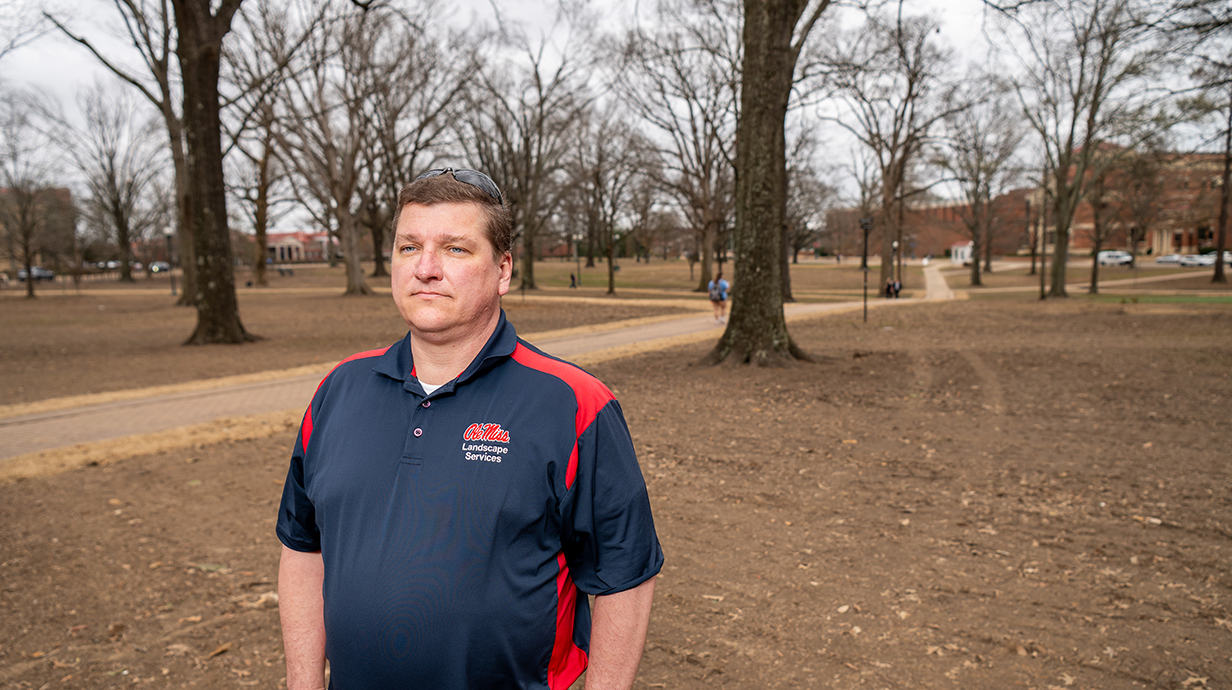
OXFORD, Miss. – Like thousands of people across north Mississippi, Nathan Lazinsky lay awake the night of Jan. 24, listening to trees snap and limbs crash to the ground in the woods surrounding his Lafayette County home.
"Snap, crackle, pop," said Lazinsky, director of the Department of Landscape Services at the University of Mississippi. "That's all you heard; there were limbs falling every three seconds."
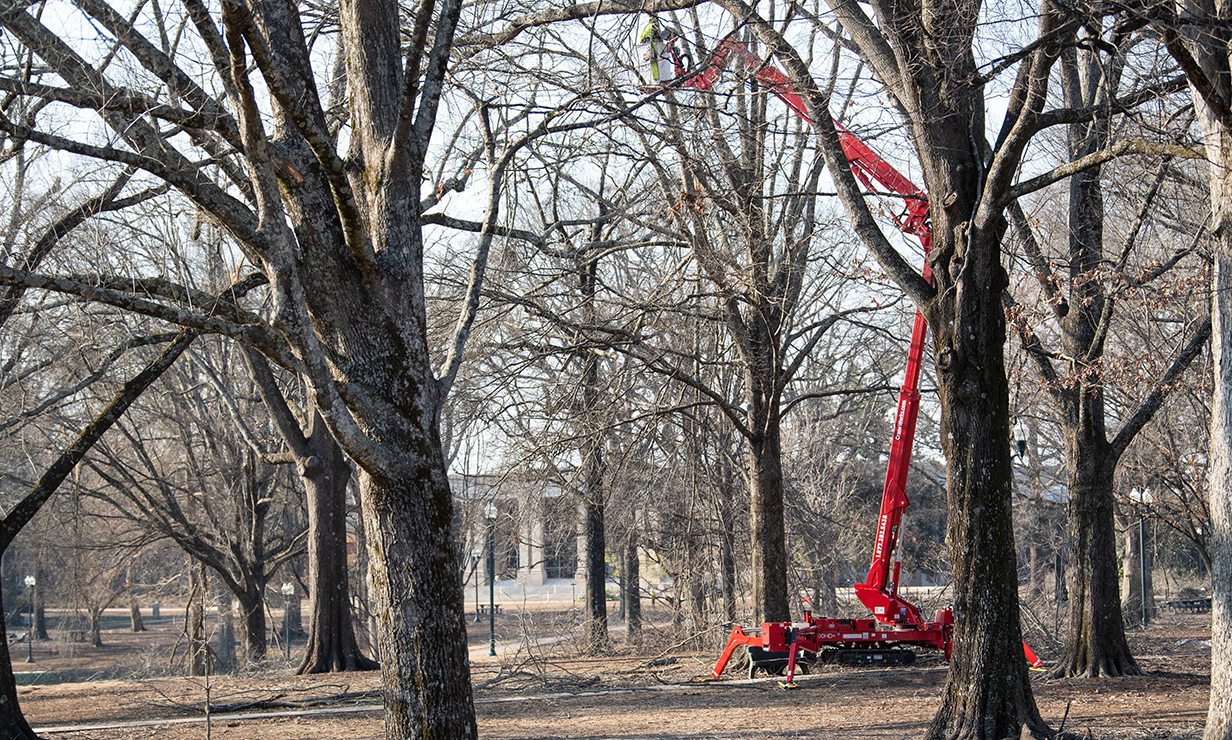
Workers from Looks Great Services, a contractor from Columbia, work to remove damaged branches from trees in Grove in the days following winter storm 'Fern.' Photo by Kevin Bain/Ole Miss Digital Imaging Services
Come morning, he stepped out into what he described as the remnants of a "frozen tornado" that tore through the area, blocking his driveway and isolating him, his wife and their 2-year-old son without power. Not waiting for the weather to settle, he took to his driveway with a chainsaw, working to clear it of debris so he could get to work.
"There were limbs falling all around me," Lazinsky said, "I was like, 'This is not safe at all,' but I knew I had to get here because we still had students on campus."
He directed his team from home for a couple days until the roads thawed enough for him to drive to campus on Jan. 27. Even then, the icy roads proved a challenge. Along the way, Lazinsky had to drive over and under downed power lines, counting more than 20 on his street alone, he said.
"When I first pulled onto campus, I was kind of upset," he said, "I've been here 15 years and seen a lot of trees I planted had damage to them."
In the days following the storm, the buzz of chainsaws was inescapable all across campus and throughout Oxford. Workers dragged thousands of downed limbs off parking lots, sidewalks and lawns on campus and dangled like trapeze artists to examine and prune damaged branches.
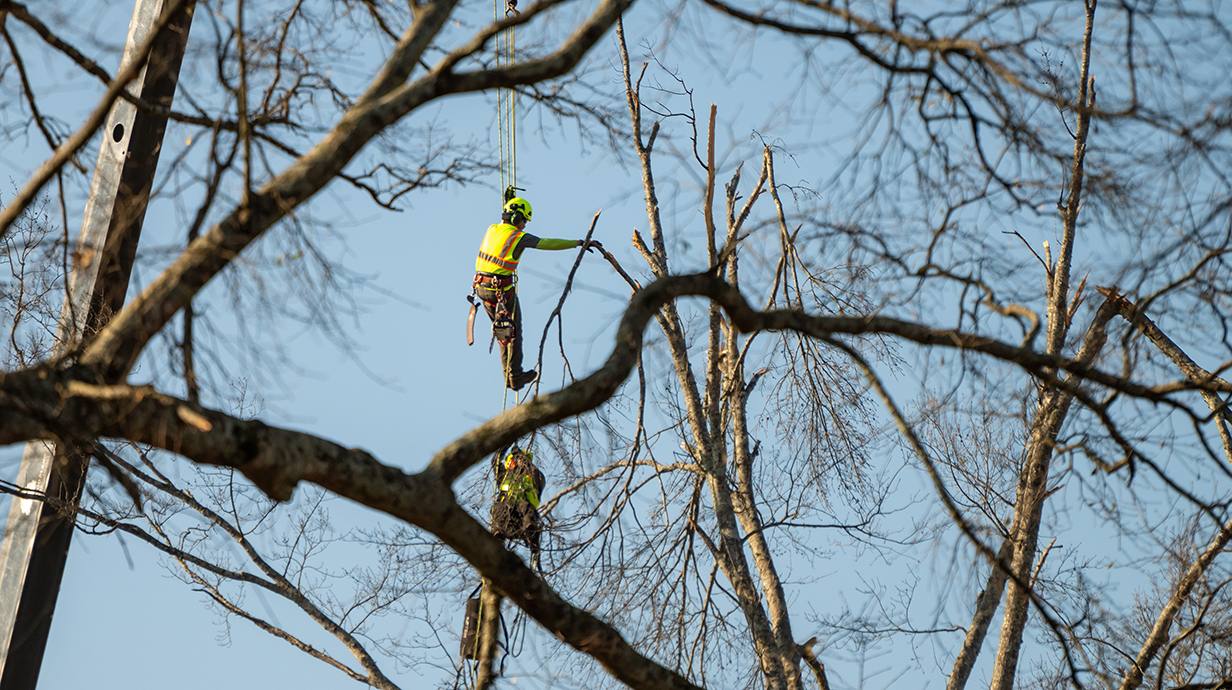
Workers from contractor Looks Great Services, of Columbia, dangle from a bucket as they inspect and prune damaged branches on campus. Photo by Srijita Chattopadhyay/Ole Miss Digital Imaging Services
Amid this work, most of the department's workers returned to homes without power each night. Lazinsky was without electricity for almost two weeks, lost water for a week and had to find somewhere with power and heat for his wife and son to stay.
Still, Lazinsky does not regret the work he and others have done to keep students on campus safe.
"We take pride in what we do," he said. "I was tired, but I feel like we were doing the right thing."
Over the last two weeks, Lazinsky worked with Landscape Services superintendent Sophie Kline and two other experts to visit every damaged tree on campus, logging them and examining whether they can recover.
"If you tell me a tag number, I'll tell you exactly where that tree is," Lazinsky said.
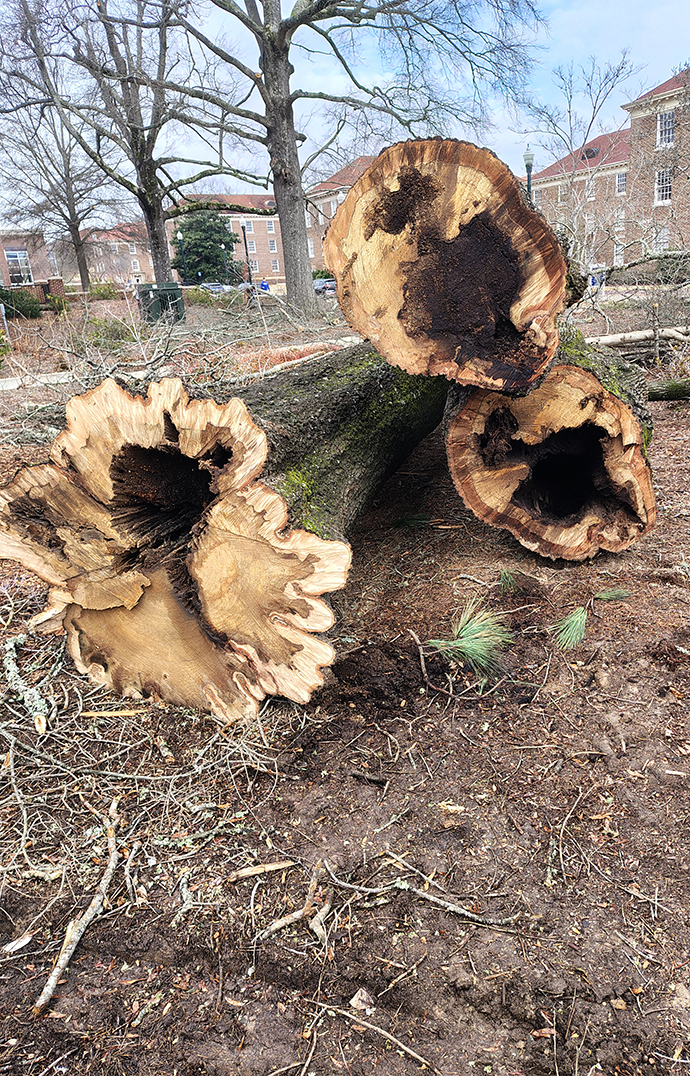
Several older trees, including two willow oaks planted in 1932 near the Paul B. Johnson Commons in honor of George and Martha Washington, were weakened by age and disease and had to be cut after the ice storm. The university plans to replace the trees lost with hardier species that will endure for generations. Photo by Brian Smith
The team developed a metric to decide which trees stay and which must be removed, taking into account the danger of limbs falling in the future, whether people are likely to gather nearby and how much damage the tree endured.
The group helped him keep a balanced perspective, Lazinsky said.
As director, he built a reputation among peers for advocating for the trees, even patrolling campus to ensure work crews practice proper safety. But as much as he wanted some trees to stay due to their age or prominent locations, many trees were just too badly damaged to survive.
"A lot of these trees have seen crazy things like the invention of ice cream or however many students walking across the Grove stage," he said.
Thanks to careful pruning and ongoing maintenance care, 95% of the university's trees survived the crippling ice that caked campus for more than a week. That includes the university's two state champion trees, the northern catalpa near the Gertrude C. Ford Ole Miss Student Union and Osage orange near the University Museum.
It wasn't just trees that Landscape Services had to focus on to get the campus back to normal. In the days after the storm, crews worked to clear vital walkways to ensure the students who remained on campus during the closure could access critical services.
Fletcher Atkinson, a freshman public policy major from Oxford, was among the students stuck on campus. When he turned in that Saturday night, he thought the storm would not be any worse than previous snows in Oxford.
"I thought, 'Oh well, we'll be back in school Tuesday,'" Atkinson said. "Come Sunday, I come down and see all these trees outside covered in ice. And I thought, 'Oh, this does not look good.'"

He and his neighbors in the Residential College South generally eat in the residence hall's cafeteria, but had to find another place within walking distance to get food when much of campus lost power. Noting that Rebel Market was open, Atkinson and his friends braved the icy conditions through paths cleared by Landscape Services crews.
"We knew Rebel Market was going to stay open for the entirety," Lazinsky said. "We tried to clear all the arterial roads and the pathways to the Rebel Market from the residence halls."
Lazinsky sees his department as a critical piece of outreach and recruiting new students. It is all part of the Hotty Toddy spirit, he said.
He reasons that when prospective students come to visit, they already know the curriculum. The appearance of the university and how it makes them feel can close the deal in recruiting them.
"They might be the next president," Lazinsky said. "They might get the Nobel Peace Prize. I try to tell our staff that in a little way, we had a part in that because we helped them come here with that first impression."
The department's staff will continue clearing away the damage for some time. Dean Hansen, assistant vice chancellor and chief facilities officer, foresees a long road ahead for recovery efforts.
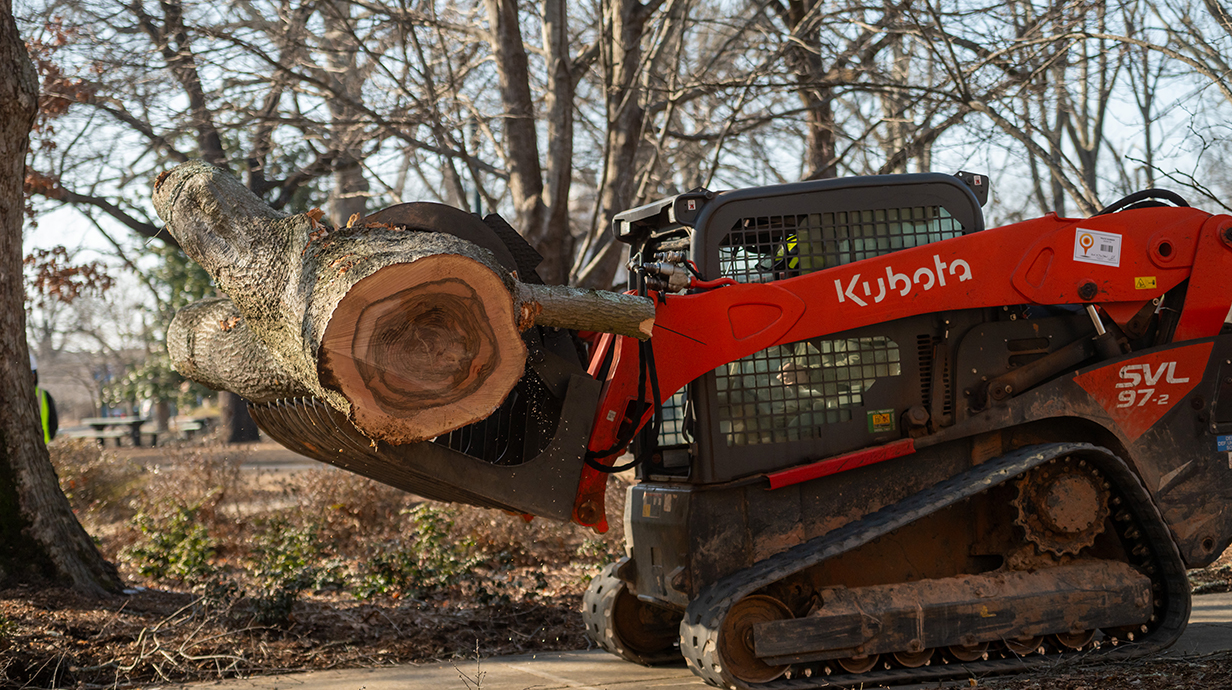
Workers have removed more than 22,000 cubic yards of tree debris from campus since the ice storm cause extensive damage to the area's tree cover. But thanks to careful pruning and ongoing care, 95% of the university's trees survived the storm. Photo by Srijita Chattopadhyay/Ole Miss Digital Imaging Services
"It will likely be weeks, if not months, before the campus aesthetic gets back to what most people would consider somewhat normal for Ole Miss," Hansen said.
The storm left an estimated 100,000 cubic yards of debris strewn across campus. The department and outside contractors transport it all to the university's wood processing facility, where it will be shredded into wood chips.
Due to the sheer volume, most of the processed debris will be sent to a landfill to avoid potential fire hazards. A portion, however, will eventually rejoin the campus ecosystem.
Lazinsky is optimistic about the future of the trees that weathered the storm, as well as the new trees that will be planted as replacements. Hardier oaks and other species that are better able to withstand harsh weather will fill the spots left vacant in the storm's aftermath.
"I always tell our staff, 'You're putting your signature on everything you do out here,'" Lazinsky said. "'That's your legacy.'"
Top: Nathan Lazinsky, director of the Department of Landscaping Services, surveys cleanup work in the Grove on Tuesday (Feb. 10). Most of the Grove and Circle have been cleared of debris as work continues across campus, where workers from the department and outside contractors have removed more than 22,000 cubic yards of branches and fallen trees left by winter story 'Fern.' Photo by Srijita Chattopadhyay/Ole Miss Digital Imaging Services