
Researchers Study Underwater Lakes to Understand Oceans, Outer Space
Brine pools are rich in critical minerals, hint at how life might survive in space
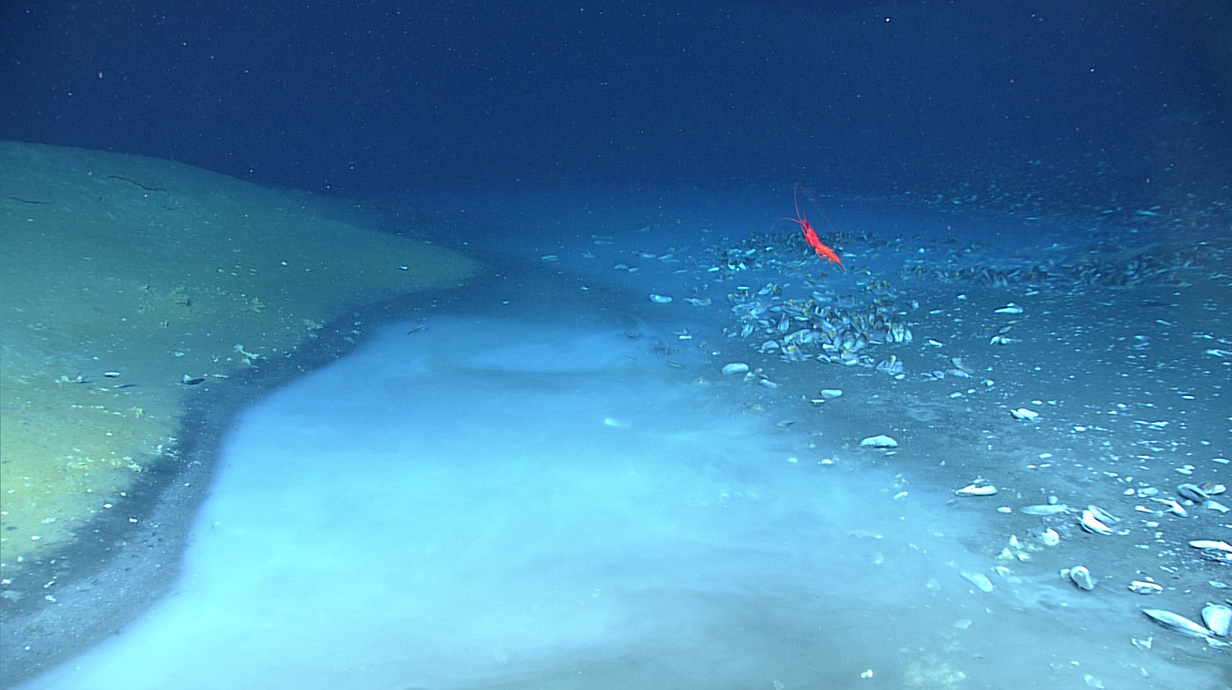
OXFORD, Miss. – Underwater lakes may sound like fiction, but they dot the ocean floor and, according to a new University of Mississippi study, the structures could also help researchers understand life in space.
Leonardo Macelloni, director of the Mississippi Mineral Resources Institute and Center for Marine Resources and Environmental Technology and associate geology professor, and Erica Luzzi, a volunteer Ole Miss researcher, published a compilation of scientific knowledge on brine pools in Marine and Petroleum Geology.
The review examines both what brine pools could offer on Earth – rare earths, lithium and other critical minerals – and how these extreme environments could support life in space.
"Brine pools are extremely unique geological environments, and they are really rare across the world, but they are common in the Gulf of America," Macelloni said. "These pools form very deep, often more than 500 meters, and that means they are hard to study, but they are very interesting, very extreme environments."

Often called "death pools" or "Jacuzzis of despair," brine pools are areas where the water's salt content is more than five times that of the surrounding ocean, causing the water to be denser and unable to mix with ocean water. This thick, highly toxic brew forms an underwater lake that kills everything that enters it.
"It's such an extreme environment that life does not thrive there, but bacteria do," said Luzzi, a former research associate in the Department of Geology and Geological Engineering. "And so, we can use brine pools as a terrestrial analog for ocean worlds."
Bacteria in the gills of mussels living on the rims of brine pools feed off the methane and other gases that seep from the ocean floor. This symbiotic relationship between bacteria and mussels means deadly brine pools are surrounded by life.
A more comprehensive understanding of how this life survives could help researchers understand how life might form in ocean worlds such as Enceladus, a moon of Saturn, and Europa, a moon of Jupiter, Luzzi said.
"We know more about space than we do about our oceans," she said. "But this is an instance where, if we try to understand everything we can from brine pools, we could learn about how life might form in space."
The review also suggests that brine pools could hold reserves of critical minerals such as lithium, which is necessary for rechargeable electric batteries and has many other applications in modern technology. If brine pools are rich in lithium, this could provide a new source of the material for energy operations, Macelloni said.
But extracting those minerals will be a challenge.

The pools form on the ocean floor and are difficult – and expensive – to access. While remote sensing allows scientists to determine the rough location of potential brine pools; the technology cannot reveal the composition of those pools and whether critical minerals can be found there, Macelloni said.
"So, the only way to be sure is to go down either with a ROV – a remotely operated vehicle – that has a camera, or with an autonomous submarine that has a camera, or with a submarine," he said. "But as you imagine, those are really expensive."
Brine pools are also delicate environments, where even the slightest disturbance of the water's surface could slosh a deadly brine of salt water over the mussels and bacteria that live nearby, the researchers said.
"So, we see that these brine pools are a very important resource, also an economically valuable one," Macelloni said. "But at the same time, we see that there is a very rich and unique benthic fauna that lives there, and we don't want to impact them. So, we have to find a solution that will preserve life there while also allowing us to access the minerals.
"So, we are doing the study for two parallel reasons, ecological and also economical."
Before Luzzi and Macelloni's publication, no definitive guide to brine pools existed. Researchers had named the same brine pools many times, and information about "death Jacuzzis" was spread far and wide.
"Everyone was using different metrics and different names for the same pools, so it was not a very good understanding," Luzzi said. "Our publication is a review where all of that information is in one place; it is like a bible of brine pools."
Top: Brine pools, such as this one discovered during a 2017 expedition in the Gulf of Mexico, are structures that form because of differences in density between the salty ocean water and the highly salinated water near salt deposits. These underwater lakes are highly toxic, but a new publication from UM researchers indicates they could also hold a wealth of critical minerals and hint at how life might survive near similar water bodies in space. Photo courtesy of the NOAA Office of Ocean Exploration and Research
By
Clara Turnage
Campus
Office, Department or Center
Published
February 24, 2026