
Ole Miss Goldwater Scholar Searches Molecules for Life's Origins
Nathaniel Carlson honored for work that could help trace the molecular origins of life
OXFORD, Miss. – Sealed in the frozen dust of a distant comet, there may be a molecule that helps explain how life began.
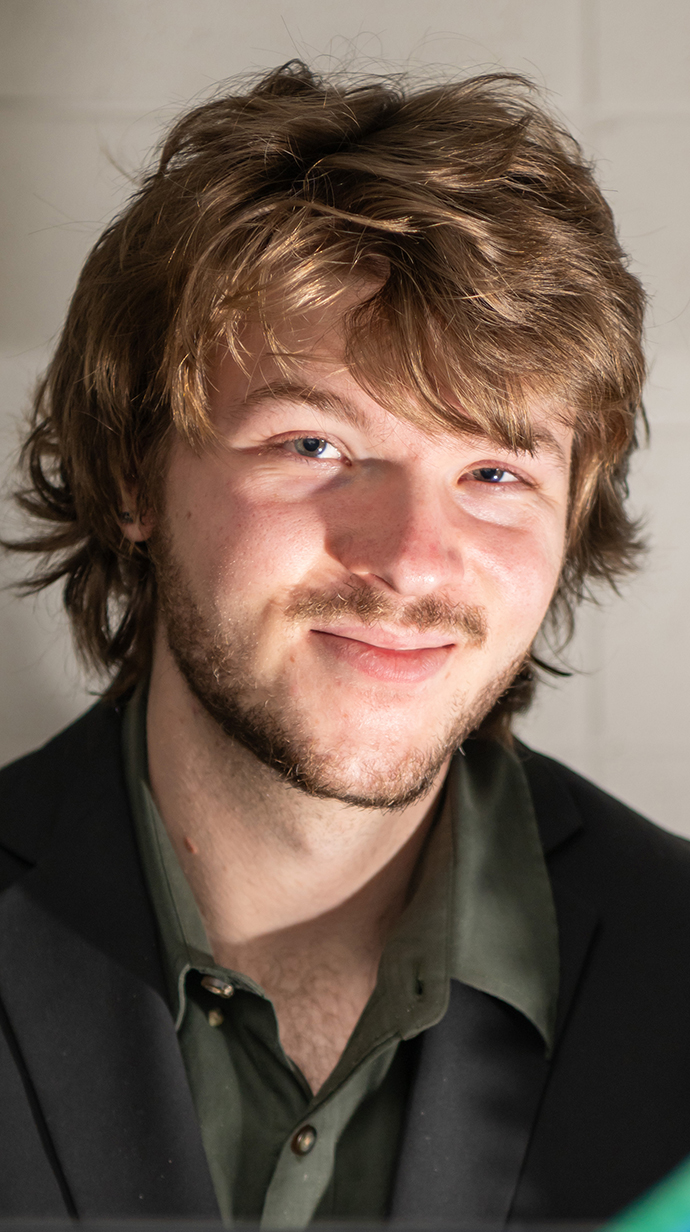
University of Mississippi junior Nathaniel Carlson is trying to find it from an Ole Miss computer lab. The chemistry major from Apex, North Carolina, recently joined a select group of students named as a Goldwater Scholar.
"We are especially proud to celebrate Nathaniel as the University of Mississippi's 27th Goldwater Scholar, and our ninth in the past five years," said Vivian Ibrahim, director of the Office of National Scholarship Advisement. "Being named a Goldwater Scholar really signals that a student is on a path toward significant impact in their field.
"His recognition reflects not only his individual talent and determination, but also the strength of the mentoring and research environment here at UM."
The Barry Goldwater Scholarship and Excellence in Education Foundation awards scholarships to college sophomores and juniors planning to pursue research careers in the natural sciences, mathematics and engineering. This year, the foundation selected 454 students from a pool of more than 5,000 applicants nominated by universities across the country.
"The Goldwater Scholarship in many ways is an affirmation of the time and sacrifice he has made to have an impact on human knowledge," said Ryan Fortenberry, associate professor of chemistry and head of the Computational Astrochemistry Group where Carlson does his research.
"Learning how to do research is a non-trivial task, and this shows that he is not only capable of performing such, but he is capable of doing so at the highest level."
The group of researchers use precise computer methods to study molecules found in space. The work is as practical as it is otherworldly, Carlson said.
Many molecules believed to exist in the interstellar medium are nearly impossible to synthesize under Earth conditions. That means scientists must calculate their spectral properties mathematically before they can search for them using telescopes, such as the James Webb Space Telescope or the Green Bank Telescope in West Virginia.
"The big draw behind computational astrochemistry is the fact that a lot of the molecules we expect to be out in space can't really be made efficiently here on Earth," Carlson said.
"The computational data we generate is essentially the roadmap for finding them out there."
Carlson is creating a roadmap to success of his own. The Journal of Chemical Physics published his methanetriol research, and he was listed as the first author – a rare and difficult achievement for an undergraduate – along with Fortenberry and Zachary Palmer, a Fortenberry Lab alumnus.
The compound at the center of his research exists naturally only at temperatures below minus 441 degrees Fahrenheit and under intense radiation, he said. Scientists believe it may be present in cometary ice grains in significant quantities.
Astrobiologists are specifically interested in what the molecule produces when it breaks down because it may shine new light onto the origins of life.
"Nathaniel is perpetually curious," Fortenberry said. "He always wants to know how to arrive at the answer from as many perspectives as possible. He wants to know the easy way, the hard way, the long way and the roundabout way to get there."
Carlson has taken his research beyond the borders of campus. He completed a Research Experiences for Undergraduates program in 2024. He also presented research at a recent American Chemical Society event.
But his road to chemistry may seem unconventional.
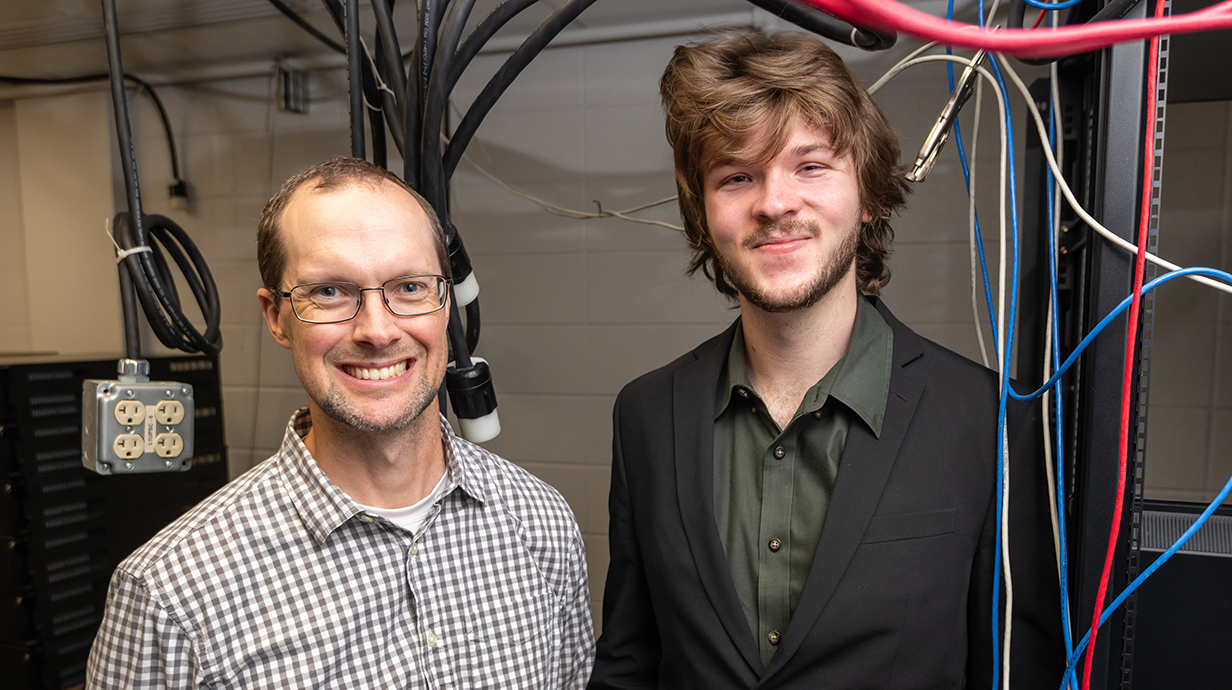
Nathaniel Carlson (right), a junior chemistry major, conducts research in the Ole Miss Computational Astrochemistry Group, run by chemistry professor Ryan Fortenberry. Photo by Srijita Chattopadhyay/Ole Miss Digital Imaging Services
He initially enrolled as a music major at another university and found that the enjoyment of performing didn't necessarily translate into a career calling. After a difficult academic stretch, he took time away from school then transferred to Ole Miss, pivoting to study the same field in which his mother earned her master's degree.
Carlson still nurtures his love for music. He plays tuba in the Pride of the South marching band and saxophone in a UM jazz ensemble. He is set to perform Wednesday (April 15) with the jazz ensembles in the Gertrude C. Ford Center for the Performing Arts.
The transition to chemistry, and what he has built since, still catches him off guard.
"Before coming here, I'd never really been the best student," he said. "Now I'm doing all of this academically significant stuff and it's like, wow, I'm actually doing this."
Carlson is extending his research to include methanetetrol, a related molecule, and the computational modeling is already turning up unexpected behavior, he said.
He plans to pursue a doctoral degree in theoretical chemistry, contributing to a lab where the whiteboard is always full of scribbles and the questions never cease.
"I want to be the kind of person where there's just always something wild up on the whiteboard," he said. "Being able to work through things and get to the root of them; that's what I love."
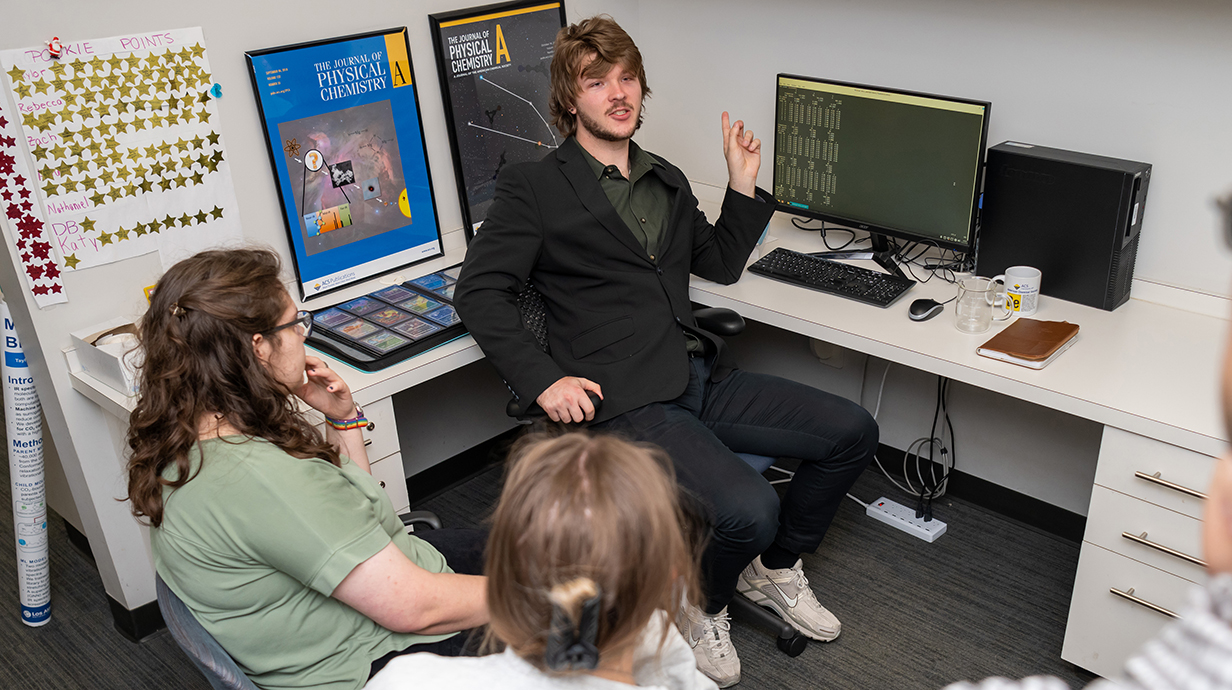
Top: Nathaniel Carlson (top) discusses his research with Ole Miss graduate students Rebecca Firth (left) and Taylor Cole in professor Ryan Fortenberry's Computational Astrochemistry Group lab. Carlson, a junior chemistry major, has been named a Barry Goldwater Scholar for work that uses quantum chemistry to study molecules that may hold clues to the origins of life. Photo by Srijita Chattopadhyay/Ole Miss Digital Imaging Services
By
Marvis Herring
Campus
Office, Department or Center
Published
April 09, 2026