First-Gen Student, Cancer Survivor Earns National Research Fellowship
Doctoral student overcomes challenges to receive prestigious award for research
OXFORD, Miss. – Six years after joining the University of Mississippi as the first in her family to attend college, Victoria Amari has earned one of the nation's most competitive graduate research awards.
Amari, a first-year doctoral student in biomedical engineering from Hayden, Alabama, has been awarded the National Science Foundation Graduate Research Fellowship.
The fellowship will support her research into how parts of a cell called the cytoskeleton sense and respond to their environment, work that has implications for understanding several diseases.
"For something like cancer, heart disease, Alzheimer's – all of these diseases happen because something has gone wrong," Amari said. "So, in order for us to know how it's going wrong, we have to know how it functions when it's right. That's what we're studying.
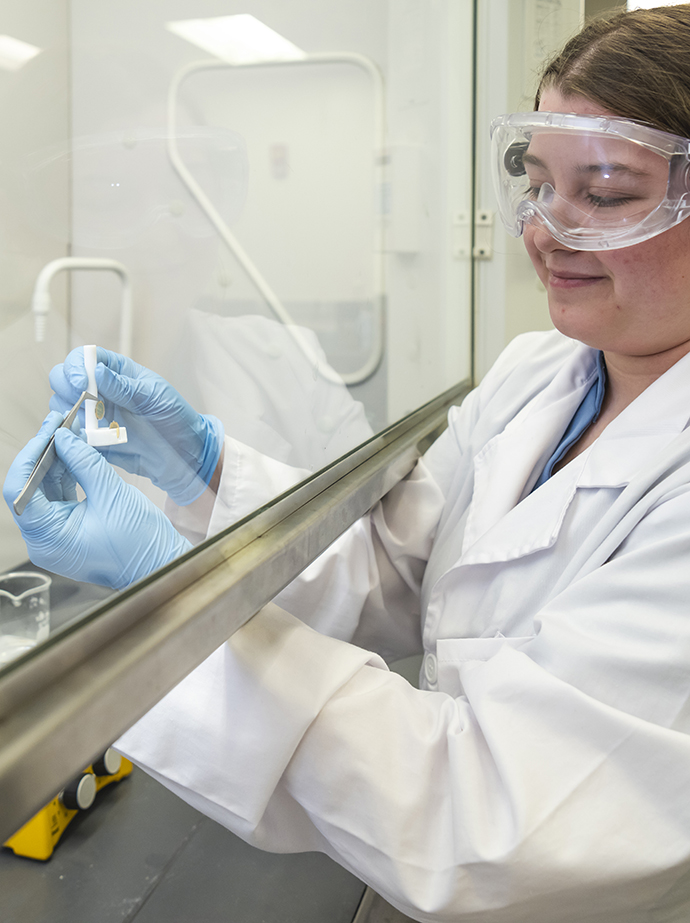
Victoria Amari works with a quartz crystal microbalance in Nikki Reniemann's biomedical engineering lab. Photo by Srijita Chattopadhyay/Ole Miss Digital Imaging Services
"We understand these conditions on a bigger scale, but what is happening in the individual cytoskeleton pieces? We don't know what's happening there nearly as well."
The fellowship will fund three years of Amari's study and provide a living stipend, allowing her to pursue her research in Nikki Reinemann's lab.
"The NSF Graduate Research Fellowship is one of the most prestigious awards a graduate student can receive in the United States," said Reinemann, associate professor of biomedical engineering. "This recognition affirms what those of us who have worked with her already know: she has the drive, perspective and ability to make a lasting impact as a scientist."
Amari has not always been so confident in her potential. Growing up as one of five children and working to help support her family since she was 15, Amari has overcome challenge after challenge to pursue her research.
It began when a high school visit to the Oxford campus sparked her interest in the biomedical engineering program.
"I met our department chair, Dr. Dwight Waddell, when I was a junior in high school," she recalled. "He talked to me and two other students about the program, and it sounded so interesting. He was really the reason I came to Ole Miss."
When Amari enrolled at the University of Mississippi in 2020, she took on a full-time job as a retail store manager to make ends meet, but her grades began to suffer.
"I went to Dr. Waddell, and I said, 'I need to change my major,'" she said. "I couldn't keep almost failing classes, and I couldn't keep up when I was working full-time. I just didn't think I was smart enough to do it."
Instead of agreeing that Amari should change her major, however, Waddell gave her a job.
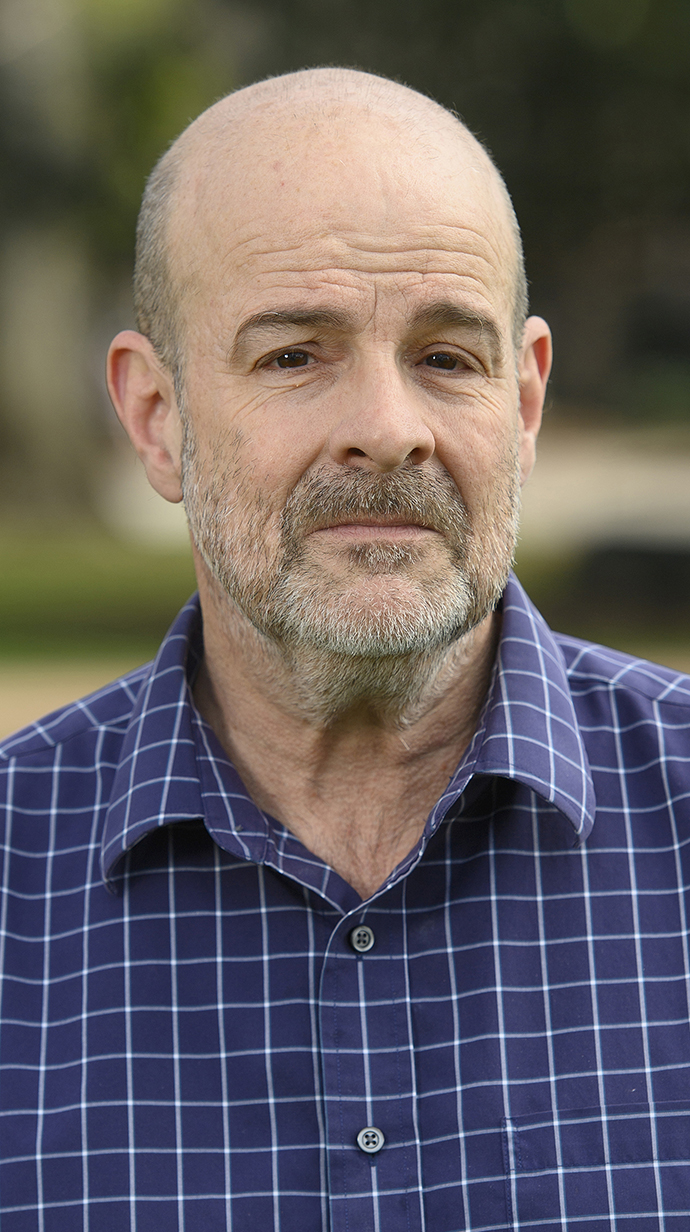
"There's a few different kinds of problems presented to me when a student isn't doing well," said Waddell, chair and associate professor of biomedical engineering. "The hardest ones are the students who are doing everything that we ask them to and more, the ones where they want to do all the right things, but they're being pulled somewhere else."
Amari was one of those students, he said.
"We were a young department that was growing fast, and I needed help," Waddell said. "And I thought, if she can run a store and be a student, she can handle being our student worker."
Amari began working in the Department of Biomedical Engineering, where she was able to focus on her classes, and her grades began to improve.
"It was through that I met Dr. Reinemann, and at first I thought she was really intimidating," Amari said. "I had met other female faculty, but she was the first woman in science that I had really gotten to interact with.
"I knew I wanted to work with her, but it was scary because I felt like maybe she wouldn't want me in her lab."
Despite her initial trepidation, Amari asked Reinemann in 2023 if she had room in her lab for another student researcher, and Reinemann said yes.
"She didn't know me," Amari said. "I hadn't taken her classes. She really took a chance on me. But then I got in her lab, and I just fell in love with it."
Reinemann said she first noticed not only Amari's drive and passion for the work, but her dedication to helping others along the way. Amari led lab sessions as a teaching assistant, co-founded the Biomedical Engineering Undergraduate Mentorship Program and was the founding president of the UM chapter of the Biophysical Society.
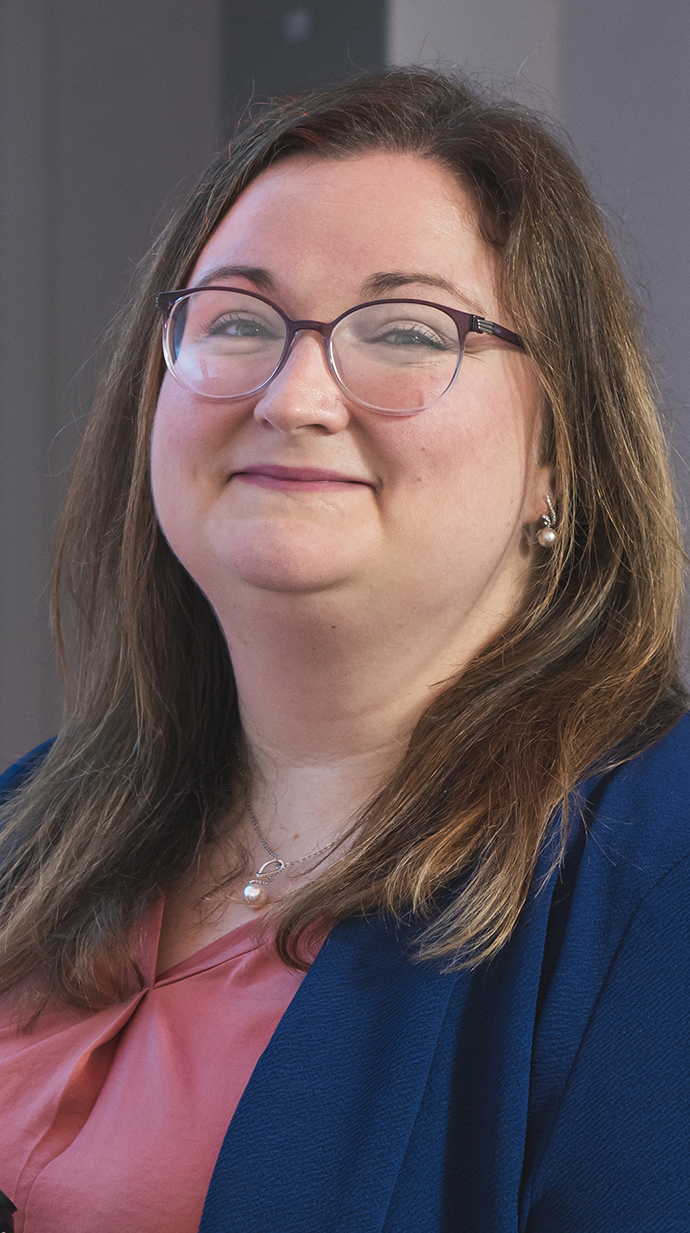
"Victoria has stood out from the beginning because of her work ethic, intellectual curiosity and determination," Reinemann said. "As an undergraduate, she balanced a demanding schedule that included working as a departmental student worker, serving as a teaching assistant and conducting research in the lab.
"Despite all of that, she still made outstanding contributions and co-authored two publications as an undergraduate, which is a remarkable accomplishment."
At Amari's first-generation student graduation ceremony in 2025, Waddell and Reinemann were in the crowd cheering for her.
"Students like Victoria are a gift," Waddell said. "Sometimes you make an effort for a student, and for whatever reason, it just doesn't work out. But this one has. It's worked out splendidly.
"These are the little gifts toward the end of your career, when you see a student grow and you get to watch what they do."
After graduation, Amari faced one more challenge: She was diagnosed with a rare form of breast cancer. After noticing the symptoms in her final semester of undergraduate study, she was diagnosed and underwent multiple surgeries in the summer before her first year of the doctoral program.
She was still healing when she returned to classes that fall and applied for the NSF fellowship.
"This fellowship really means a lot to me because it feels validating," Amari said. "I didn't have parents who'd graduated college, and I didn't have the leg-up that some people do. I supported myself.
"There have been a lot of times when I felt like I wasn't smart enough, or I wasn't good enough, and I think I'll always have a little of that imposter syndrome. But if the National Science Foundation believes that I can do independent research, so should I."
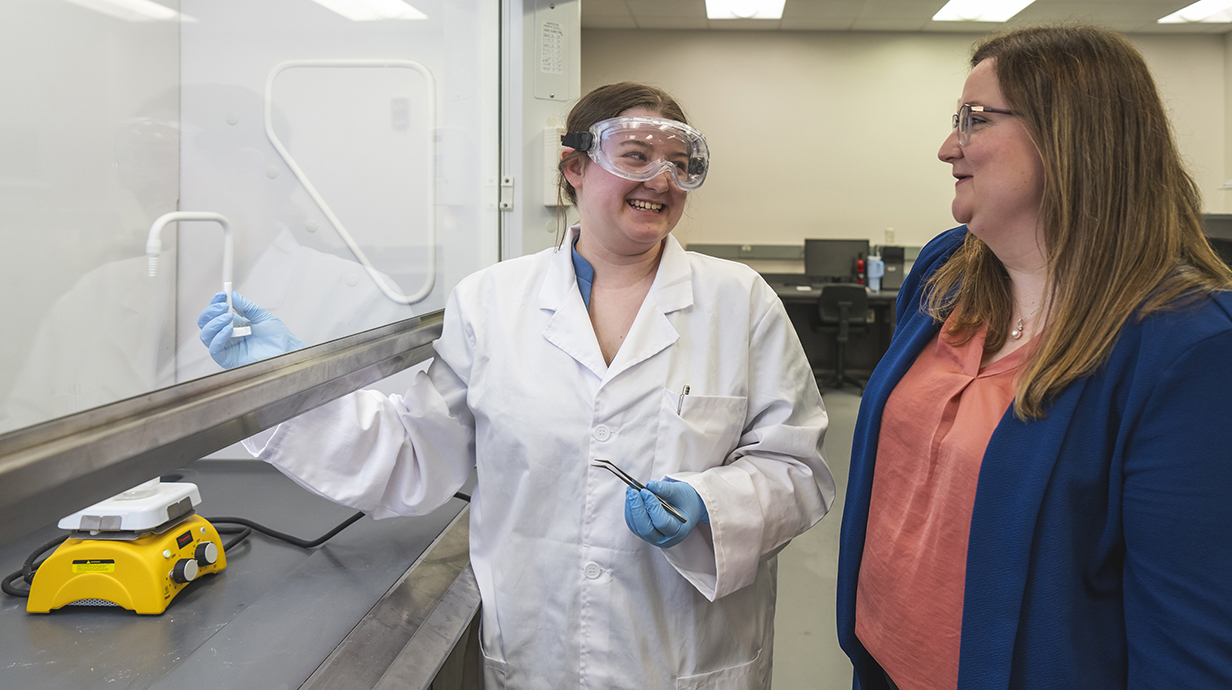
Top: Doctoral student Victoria Amari (left) and Nikki Reinemann, associate professor of biomedical engineering, work in Reinemann's lab. Amari, who has worked in Reinemann's lab since 2023, has been awarded a National Science Foundation Graduate Research Fellowship to continue her work on how cells sense and respond to their environment. Photo by Srijita Chattopadhyay/Ole Miss Digital Imaging Services
By
Clara Turnage
Campus
Office, Department or Center
Published
June 08, 2026