Researcher Uses Award to Study Nanoscale Reactions for Cleaner Fuels
NSF CAREER award funds Vignesh Sundaresan's study of how tiny pores shape energy conversion
OXFORD, Miss. – A University of Mississippi researcher has earned a National Science Foundation CAREER Award to study how tiny structures can make clean energy production more efficient.
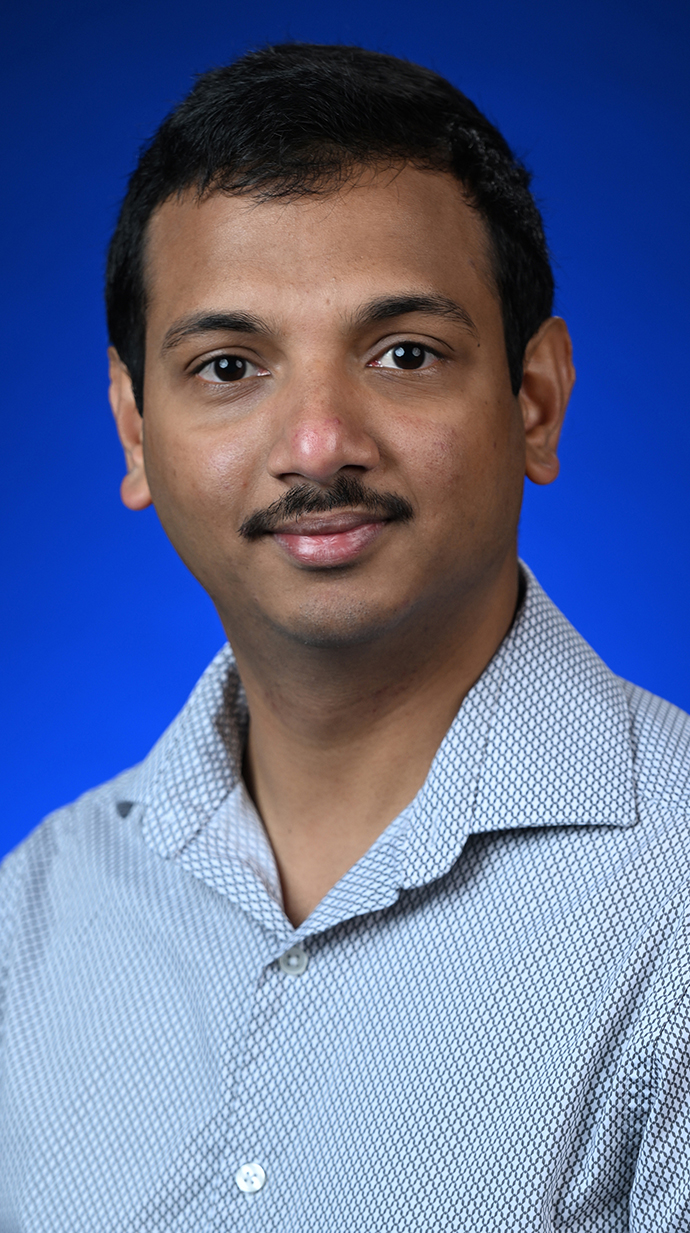
Chemistry professor Vignesh Sundaresan is the recipient of an NSF Faculty Early Career Development Program award. The program is the NSF's most prestigious award to early-career faculty and is designed to identify and support young researchers.
Sundaresan's lab will focus on streamlining renewable energy by understanding electrochemical reactions at the smallest levels and developing more efficient ways to use the materials needed for those reactions.
"We talk about how carbon dioxide emission is high, but what if we could use a process to convert the carbon dioxide into a fuel, for example?" Sundaresan said. "That would be much more valuable. Platinum is best for driving hydrogen production, but of course platinum is also expensive. So how do we use it more efficiently?"
Sundaresan's project will create "nanopores," or tiny holes, in those expensive materials, creating more spaces where electrochemical reactions can occur.
Each nanopore is like the cup of a muffin tin – an enclosed space where chemicals can react when an electrical signal is applied. Instead of using a flat sheet of costly, reactive material – such as platinum – the nanopores create many tiny reaction sites.
These confined spaces can help control how molecules interact, allowing reactions to happen more efficiently while using less material.
"Inside these nanopores, we study individual nanoparticles in a confined and controlled environment during electrocatalytic reactions," said Shubhendra Shukla, a doctoral student in chemistry from Gonda, India, and a member of Sundaresan's lab. "Unlike traditional methods that measure an average response from an electrode containing thousands of particles, these arrays provide thousands of individual electrode sites, allowing us to study each nanoparticle independently."
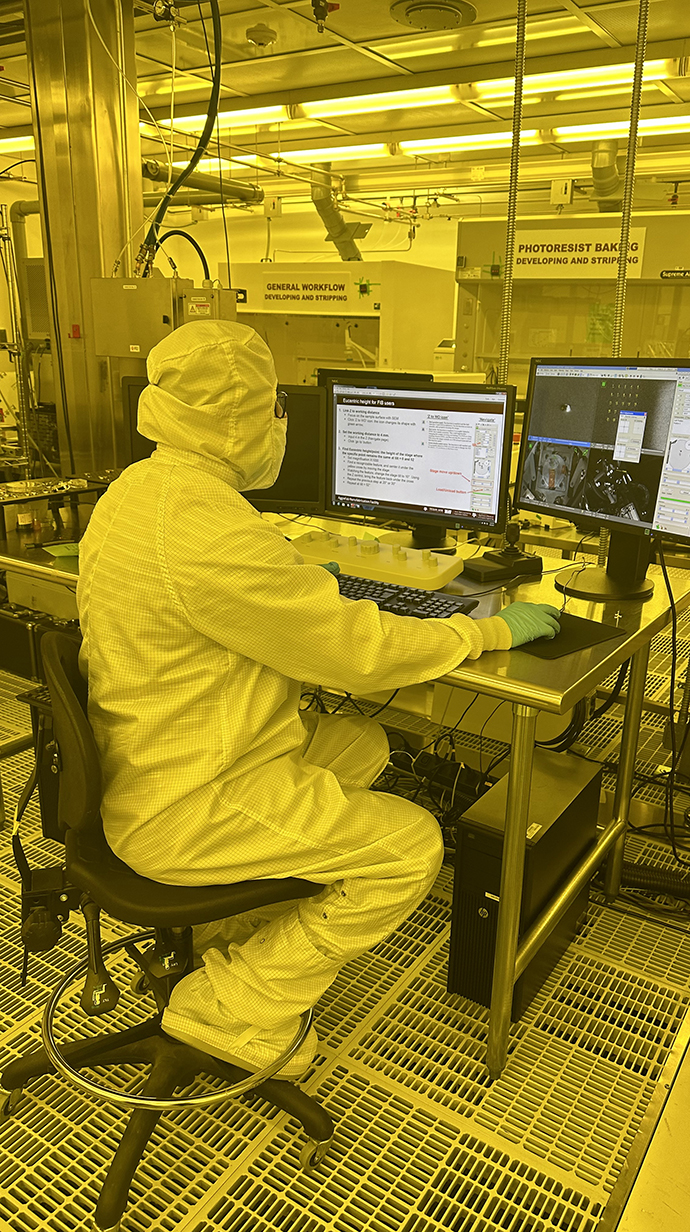
Doctoral student Shubhendra Shukla produces a nanopore electrode array using a FIB-SEM instrument at the AggieFab Nanofabrication Facility at Texas A&M University. Submitted photo
Using the NanoFrazor Explore, a tool that can "write" nanoscale and microscale patterns, Sundaresan and his team can design a sheet of nanopores to host multiple chemical reactions at once. They will also test how the reactions change when the pores are connected via a submerged tunnel.
"The nanopores are not only advantageous in that they provide more surface area where more reactions can occur, but when you decrease the dimension of the pore to, for example, less than 100 nanometers, the chemicals start to behave differently," Sundaresan said. One hundred nanometers is approximately one-tenth the width of a human hair.
"It's like if you're claustrophobic and I start closing in the walls," he said. "You'll start to act differently, and so do the chemicals."
Understanding how chemicals act in such tight confines is a major component of the study, said Gray Andres, a second-year doctoral student from Clancy, Montana, in Sundaresan's lab.
"We'll be using microscopes to identify regions of interest for the molecules themselves, but we'll also be using luminophores, which emit light whenever they go through a chemical reaction," Andres said. "And since we're using nanopores, we can do it in bulk.
"With my luminophore, I should see the image in the microscope of the reaction, but I should also see a light happening as well. It's like a twofold visualization."
Using high-powered microscopes and light-emitting probes, Sundaresan and his team will study how chemicals behave inside the pores and which pore sizes, shapes and configurations produce the most efficient reactions.
The NSF CAREER emphasizes an educational component to each research project. Sundaresan plans to make a video-game style virtual interface to teach students how to operate complex scientific instruments.
"I've selected the top five instruments that are heavily used in industries and that industry personnel are expecting that students know how to use," Sundaresan said. "Most labs can't afford breaking an instrument in order to teach someone how to use it, right?
"What I'm proposing is more of a gaming-style virtual interface that gives you all the parts of the instrument, and then you need to put together the instrument in the right location."
Creating a reusable tool will allow students beyond Ole Miss to use the program, he said.
"'How do you run it? How do you assemble the instrument? If you run it properly, how do you get results?' Students are expected to know these things," Sundaresan said. "And since we're focusing on the top five instruments that the industry is expecting, we're going to be able to show them, even for schools that lack the instrumentation."
This material is based on work supported by the National Science Foundation grant no. 2541356.
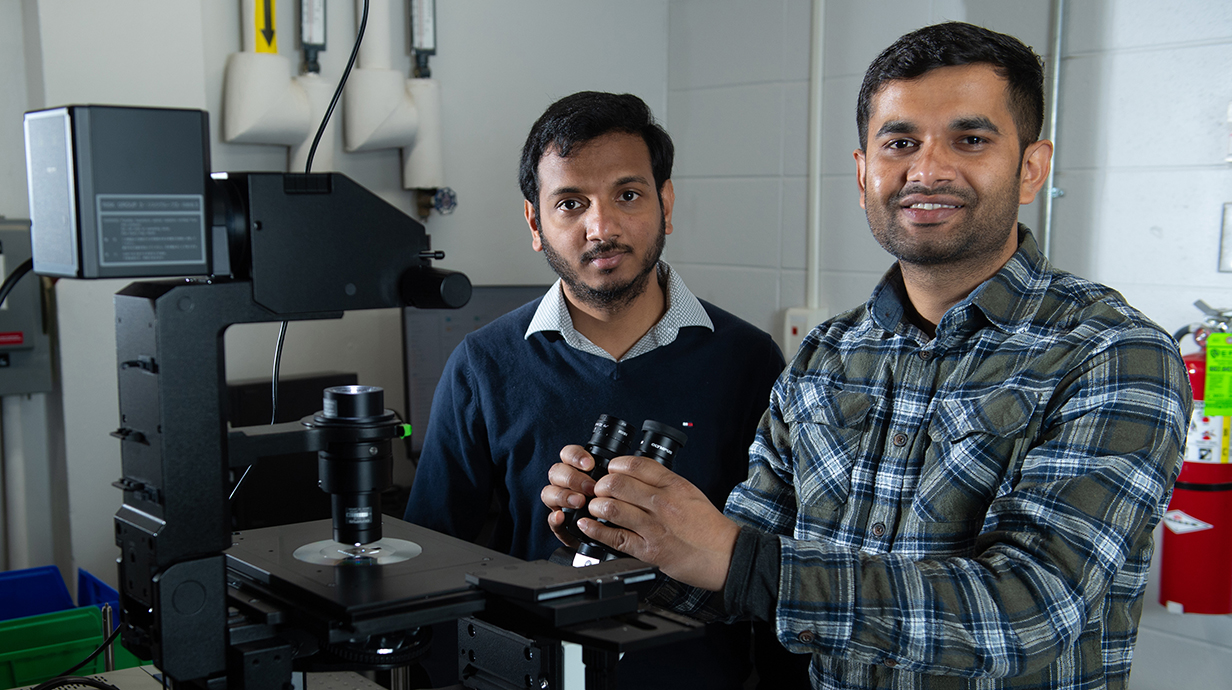
Top: Vignesh Sundaresan (left), assistant professor of chemistry and biochemistry, and doctoral student Shubhendra Shukla study nanoparticles in Sundaresan's lab in hopes of developing technologies to produce clean energy. Photo by Kevin Bain/Ole Miss Digital Imaging Services
By
Clara Turnage
Campus
Office, Department or Center
Published
June 04, 2026