
Ancient Tools Reveal How Ice Age Humans Learned the Land
Study of projectile points offers clues about how knowledge shaped early human behavior
OXFORD, Miss. – At the end of the last Ice Age, early humans crisscrossed the Americas following seasons, rivers and game, often with a trusty spear in hand. Nearly 13,000 years later, archeologists are using those spearheads to study how America's first inhabitants understood risk.

Stone projectile points are among the few surviving traces from the Tennessee River Valley's earliest settlers, but the chipped stone weapons can be an indicator of how humans adapted to unfamiliar environments, according to a new study published in the Journal of Archaeological Method and Theory.
"We're talking about Ice Age hunter-gatherers, people that looked and acted just like us and had the same needs that we do," said Jesse Tune, associate professor of anthropology at the University of Mississippi and director of its Center for Archaeological Research. "But they're living in a world that is dominated by mastodons, mammoths, giant sloths – all these animals that are totally unfamiliar to us today.
"What we're looking at – the points – is a tiny part of their life, but we're trying to see the rest of their behaviors through the lens of these spear points because that's what we have."
Tune and Shane Miller, assistant professor of anthropology at the University of Alabama, studied some 500 spear points recovered from the Tennessee River Valley region to glean insights into the lives of the Clovis and Cumberland people.
The Clovis people are thought to be among the earliest inhabitants of the Tennessee River Valley region, with the earliest evidence of the group being dated to around 13,200 years ago. Being in a new landscape meant not knowing where to find resources such as chert, a type of sedimentary rock ideal for making weapons.
"How did they adapt to a place no one has ever been before?" Miller said. "We can't interview these people, so we have to look at the things they left behind.
"There aren't that many archeological sites for these people that we can dig, but what we have instead are lots and lots of points that people have found in this region."
Tune and Miller found that the Clovis groups were more likely to resharpen spearheads, possibly signaling that they were concerned about managing their resources.

"We hang on to stuff today, but when we're talking about mobile hunter-gatherers, they had a different understanding and worldview when it came to personal possessions," Tune said. "Spear points were designed to be disposable objects, and that makes what the Clovis were doing interesting."
By the time the Cumberland people came along several hundred years later, they inherited the knowledge of where chert deposits and other resources were located from their predecessors.
"When we look at the Cumberland points, we can see where they got the raw material, roughly the time period that they lived and that they've used the point multiple times," the Ole Miss researcher said. "But (the point) was rarely completely broken to the point that it couldn't be used anymore.
"So how did it end up in what was essentially the trash, and then in the archeological record?"
Being more knowledgeable of the landscape allowed the Cumberland people to discard points that were still useable, evidence that they had learned where to gather new resources and were more comfortable in their surroundings, the researchers said.
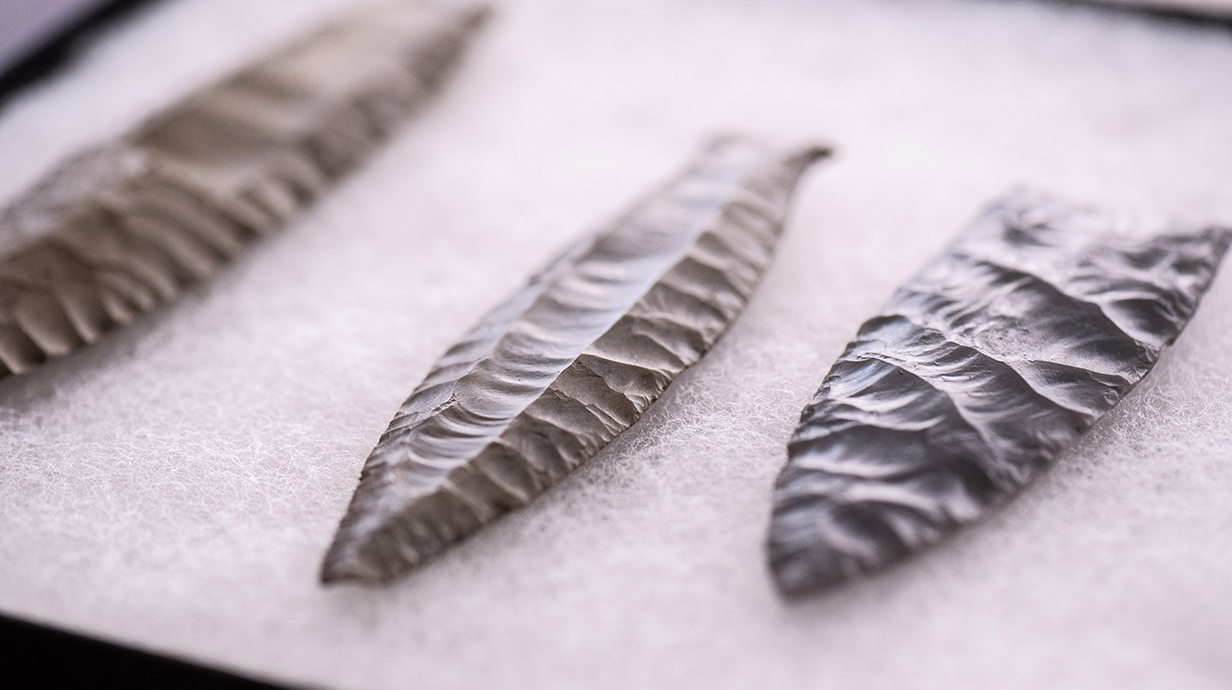
The amount of resharpening and wear on 13,000-year-old spearheads, similar to these replicas, is helping archeologists understand how North America's first inhabitants understood risk during the last Ice Age. On the right is a replica of a projectile point from the Clovis people, who were among the first people to live in the Tennessee River Valley region. On the left are two spear points from the Cumberland people, who inhabited the region after the Clovis. Photo by Kevin Bain/Ole Miss Digital Imaging Services
"When you think about a people who are moving around a lot, understand that they didn't have any pack animals," Miller said. "That puts limitations on what tools you discard and what you carry around.
"You really don't want to be carrying around a bag of rocks, and so you're going to be judicious about balancing what you need versus what you can carry."
While the question of what to discard and what to keep from local resources may seem like a problem of the past, humans are making the same decisions today, Tune said.
"Think about space exploration," Tune said. "There really is no difference between Ice Age hunter-gatherers and the people sending missions and rovers to Mars. We're moving into an area, deciding what to take with us, learning the resources and slowly expanding. It's the exact same process.
"What we learn and how we pass on that knowledge are the same things that we're still dealing with today. The only thing that's changed is the technology."
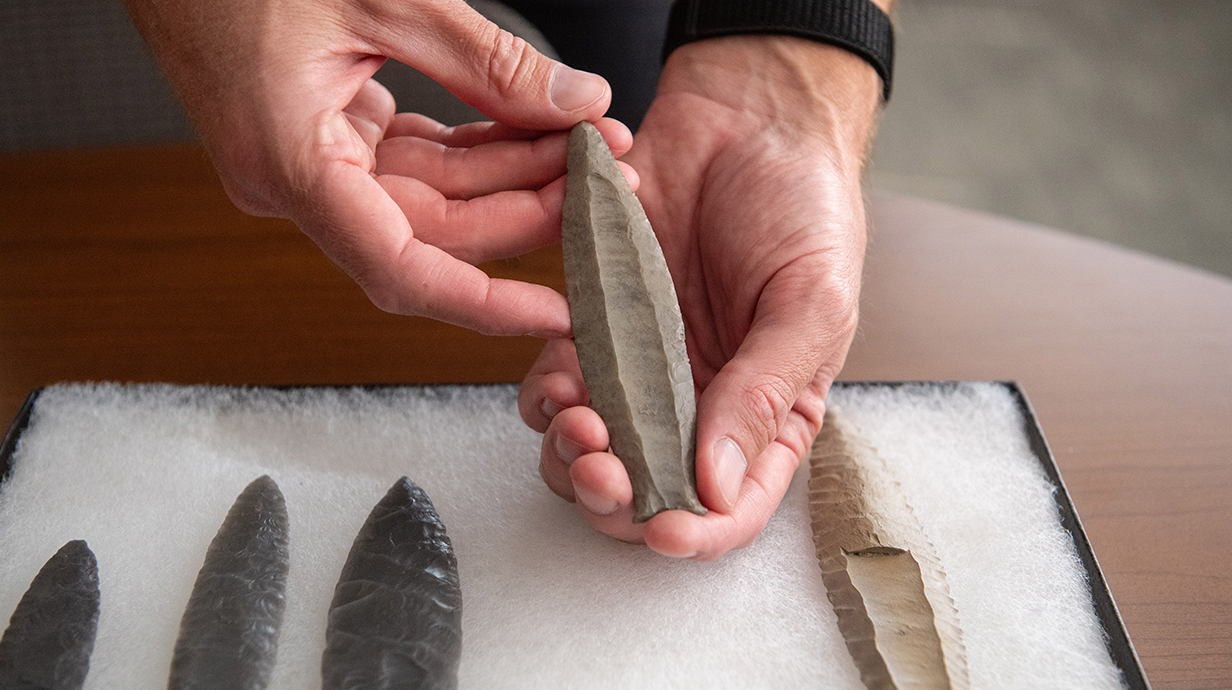
Top: Jesse Tune, director of the Center for Archaeological Research, examines a replica of a Cumberland spear point, one of two types of stone projectiles he and Shane Miller, assistant professor of anthropology at the University of Alabama, studied to gain insights into the lives of ancient inhabitants of the Tennessee River Valley. The Cumberland people were the second known group of humans living in the region some 12,000 years ago, at the end of the last Ice Age. Photo by Kevin Bain/Ole Miss Digital Imaging Services
By
Clara Turnage
Campus
Office, Department or Center
Published
September 28, 2026