
UM Study Peers Into Molecular Roots of Eye Health, Disease
EPSCoR-funded project will study molecules that make up eyes' outer walls
OXFORD, Miss. – Researchers at the University of Mississippi are working to map the molecular makeup of the eye's outer wall to better understand why some people may be more vulnerable to conditions such as nearsightedness and glaucoma.
The National Science Foundation recently awarded an Established Program to Stimulate Competitive Research fellowship to Yi Hua, assistant professor of biomedical engineering. The fellowship will allow Hua and Baudrul Mohammad Shahjalal, an Ole Miss doctoral student in biomedical engineering, to study the inner workings of the outer eye.
"Many people think of the sclera as simply the white covering of the eye, but it's actually a very important structural tissue," Shahjalal said. "In our research, we are combining biology, chemistry, biochemistry, imaging techniques and biomedical engineering to understand what the sclera is actually made of and how those molecular components affect its mechanical behavior.
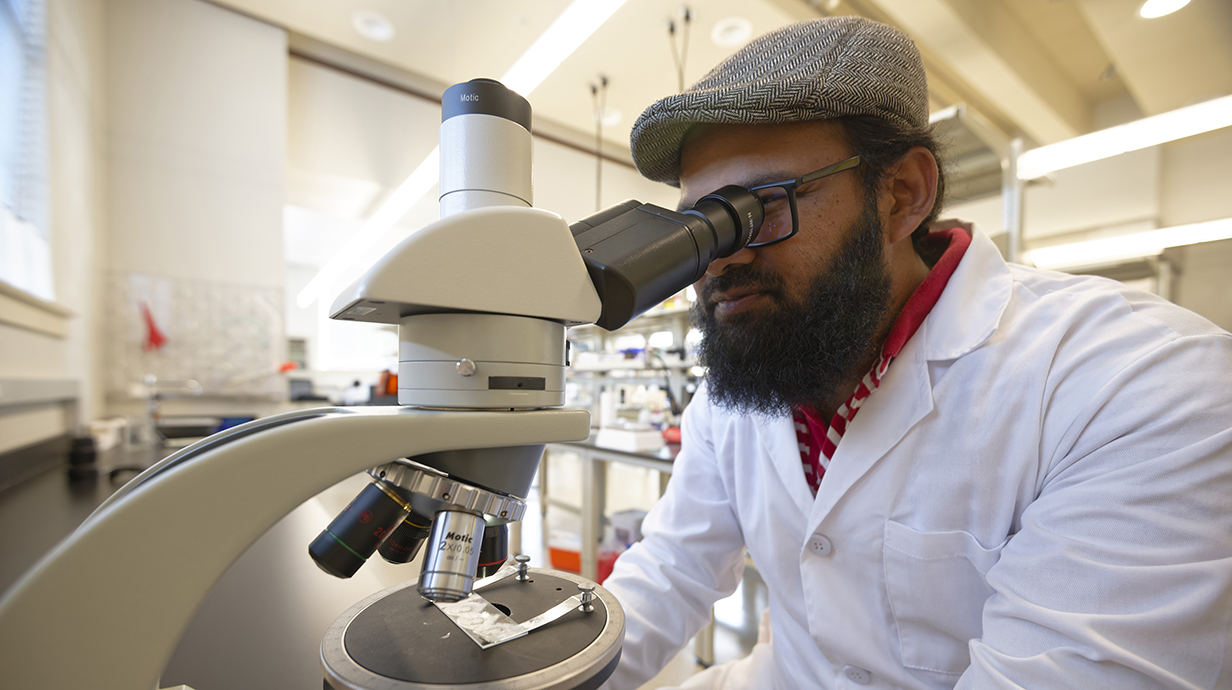
Doctoral student Baudrul Mohammad Shahjalal examines eye tissues in biomedical engineering professor Yi Hua's lab. Shahjalal and Hua are working to understand the molecular makeup of the eye's outer wall. The project could lead to better understanding and treatment of vision disorders. Photo by Hunt Mercier/Ole Miss Digital Imaging Services
"This mechanical behavior is very important because it's related to diseases like myopia and glaucoma."
Each EPSCoR fellowship offers researchers and their students a chance to collaborate with some of the nation's premier research facilities. Hua and Shahjalal will partner with Umesh Desai, chair of medicinal chemistry at Virginia Commonwealth University.
"My lab is a biomechanics lab, but this is a complex problem that involves biochemistry," Hua said. "For us to study this question, we need training and to work with another lab that specializes in biochemistry.
"That's why we want to visit the lab in Virginia, so we can learn these techniques and bring them back to Mississippi."
Glaucoma is the world's second-leading cause of blindness. Nearsightedness affects more than 30% of the global population, but research shows that number is growing.
The causes behind these conditions remain unclear, but Hua and Shahjalal believe the sclera could play a role.
The sclera is a tough but flexible layer of tissues that help maintain the eye's shape and withstand internal pressure.
"In the sclera, collagen helps maintain the shape of the eye, but one of the important extracellular molecules is glycosaminoglycans, which we call GAGs," Shahjalal said.
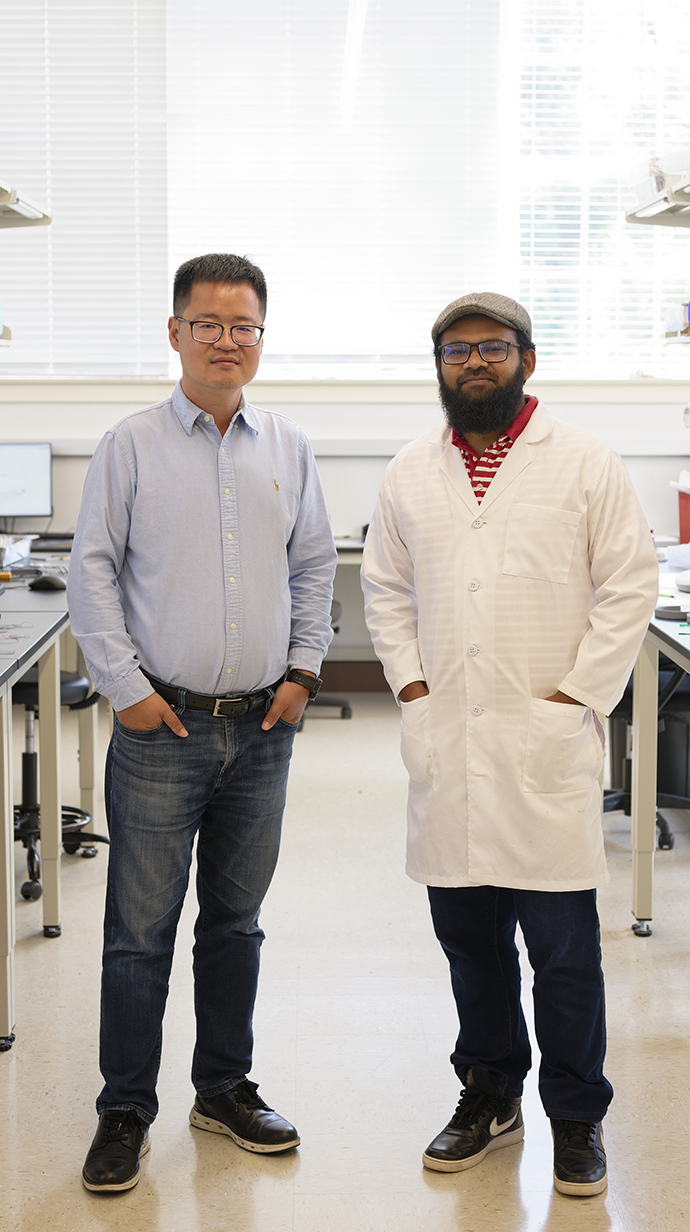
Biomedical engineering professor Yi Hua (left) and doctoral student Baudrul Mohammad Shahjalal are using a National Science Foundation EPSCoR award to study glycosaminoglycans, a molecule found in the outer wall of the eye. Photo by Hunt Mercier/Ole Miss Digital Imaging Services
The GAGs – small, sugar-like molecules – help organize the collagen fibers and influence how the sclera responds to pressure. GAGs are not evenly distributed throughout the sclera; instead, they are concentrated in some places and scarce in others.
Hua and Shahjalal plan to map the distribution of GAGs throughout the sclera, identifying which types are present in different regions. Understanding the placement and function of the sugar-like molecules in a healthy eye will give them a baseline for future research.
"This is very important for the future endeavors of our lab because we have to make sure we understand GAGs very accurately before we study them further," Hua said. "In the next stage of this research, we plan to remove GAGs and do testing to see how that changes the eye's mechanical properties.
"But to remove the GAGs, we have to know what they are and where they are."
In myopia, or nearsightedness, the eye has elongated, and the sclera has stretched. Hua's previous research has connected glaucoma to elevated eye pressure, which also affects the sclera.
Creating a map of the eye will allow the researchers to test whether the distribution of GAGs plays a role in those conditions.
"Our hypothesis is that maybe for glaucoma patients and for myopia patients, the GAG distribution is different in different regions of the eye, but that is currently a question we can't answer," Hua said. "First, we have to have a characterization of these molecules. That's what this study will provide.
"I think of this research like a foundation. So many of our later studies will be based on this foundation."
This material is based on work supported by the National Science Foundation grant no. 2624453.
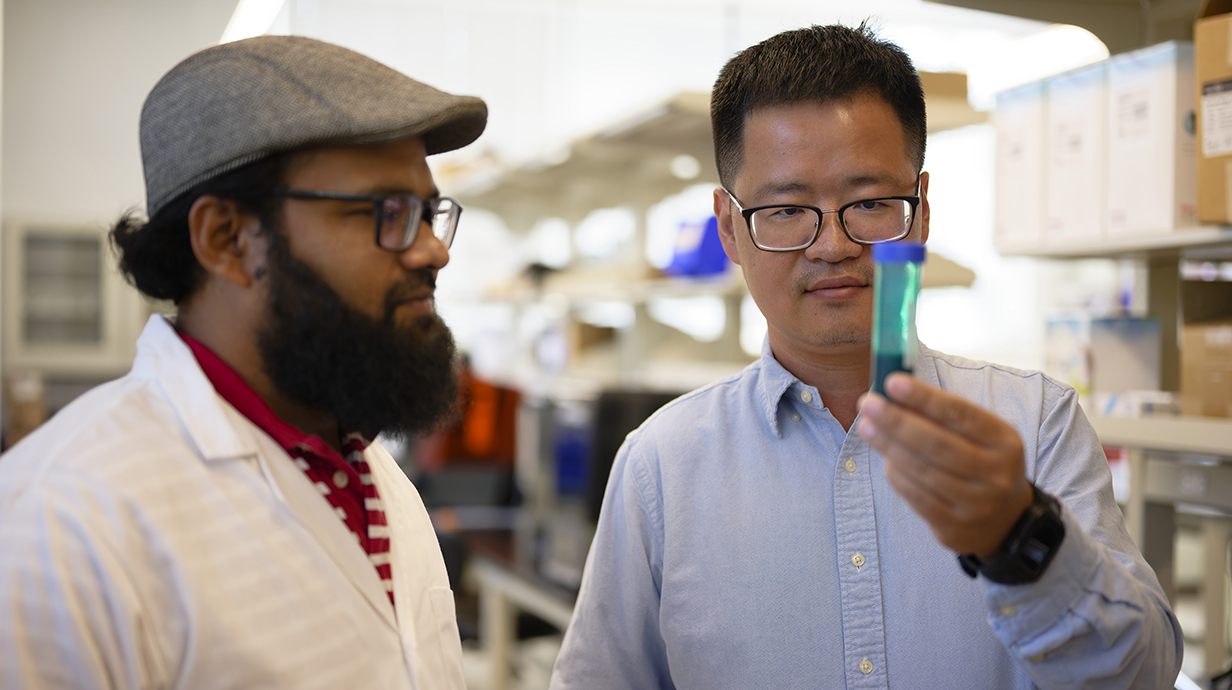
Top: Yi Hua (right), assistant professor of biomedical engineering, and Baudrul Mohammad Shahjalal, a doctoral student in biomedical engineering, examine a vial of fluorescents in the Vision Lab, Hua's research laboratory. The National Science Foundation has awarded Hua and his team an EPSCoR fellowship that will allow them to work on a project studying the molecular makeup of the sclera. Photo by Hunt Mercier/Ole Miss Digital Imaging Services
By
Clara Turnage
Campus
Office, Department or Center
Published
September 09, 2026