
Researchers Study How AI Could Improve Weed Management
Study examines promise, potential pitfalls of technology-guided weed control
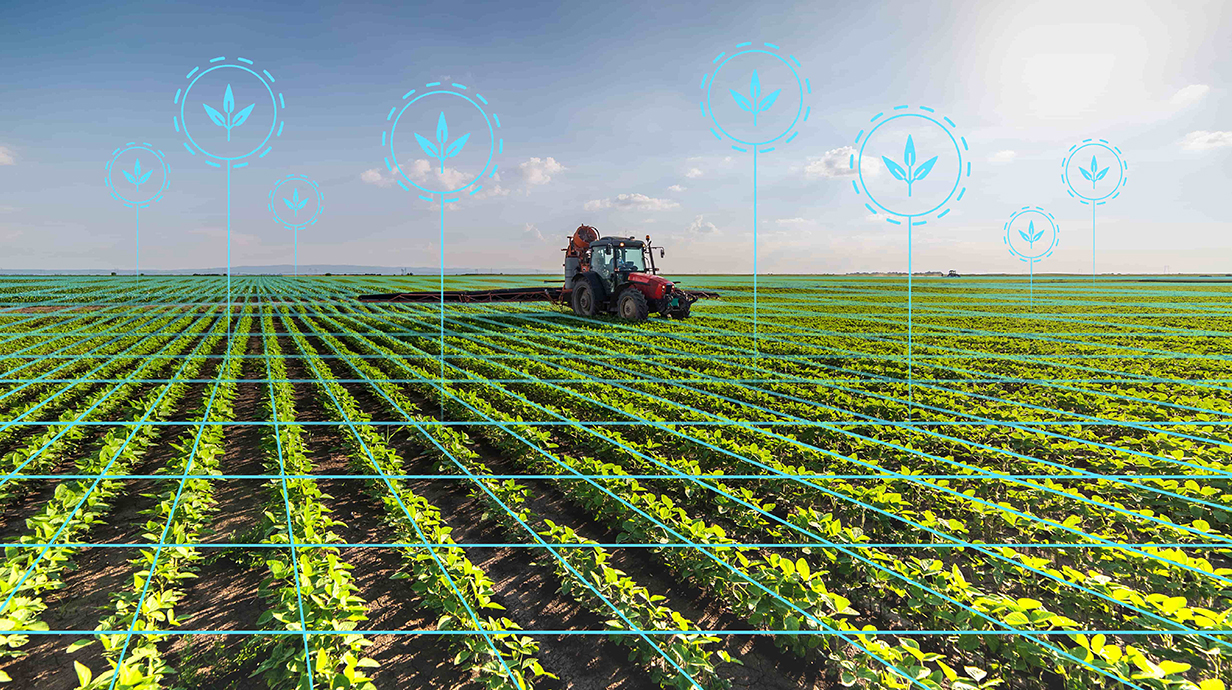
OXFORD, Miss. – Advances in weed management technology could reduce reliance on herbicides and manual labor, but a new review from the University of Mississippi and Cornell University indicates those tools also bring steep costs and potential challenges.
Lasers, robots and precision sprayers could present a "third revolution" of weed management, said Stephen Duke, research professor at the Ole Miss National Center for Natural Products Research.
"In the last 100 years, there have been two revolutions in weed management: synthetic herbicides and herbicide-resistant crops," he said. "It looks to me like AI-driven precision weed management will be the next revolution.
"This has the potential to drastically change how we manage our crops."
Duke and Lynn Sosnoskie, associate professor in the School of Integrative Plant Science at Cornell University, described the potential benefits and challenges facing robotic weed management in an review published in the journal Engineering. The researchers focused on three emerging technologies: AI-guided lasers, robotic cultivators and precision sprayers.

Each of the three technologies the researchers reviewed relies on real-time image analysis to detect weeds in crop rows. When a weed is detected, the machinery can either shoot it with a high-powered light beam, spray it with a herbicide or mechanically remove it from the soil.
"There are many reasons for wanting to look at alternative technology for weed management," Sosnoskie said. "One is crop safety. I work in specialty crops, and fruits and vegetables can be very sensitive to herbicide tools, which can delay crop emergence or cause damage or stunting in crops.
"We accept this amount of injury to the plant because the need for weed suppression is so much more important. But what we're finding is that with precision technology, we can keep some, and sometimes even all, of the herbicide off the crop."
For organic farmers, who do not use synthetic herbicides, lasers and robotic tilling could help weed large crop fields without intense manual labor, Duke said.
"Organic farmers don't have good weed management tools," he said. "They rely largely on hand labor, which is getting more and more expensive and difficult to find."
Reducing herbicide use could also reduce chemical exposure on farms. Studies show that spraying large amounts of herbicides onto crops each year may damage the local ecosystem.
"This is something that could also benefit the people who work on these farms," Sosnoskie said. "Less exposure, protecting workers, potentially less residue on crops and less going into the environment – there are many values and benefits associated with the adoption of this technology."
But these benefits come with potential downsides, including cost. Some commercial mechanical and robotic weed-management systems can run around $75,000 or more, while laser-based systems can cost over $1 million.
"I have an acquaintance in Germany who is a consultant for European farmers," Duke said. "He knows an organic farmer in the Netherlands who bought one of the robotic laser weeders for more than a million dollars. He said it saved him so much hassle that he bought a second one, but that's not going to be the case for everyone.

"Some of these farmers who are working with high-value crops can spend that much, but many can't."
While prices for machines that apply herbicides more precisely will likely fall as more people adopt the technology, they may still carry the risk of promoting evolution and spread of herbicide-resistant weeds, the researchers said. Many farmers are facing herbicide-resistant weeds, and using less herbicide and more precise spraying is not likely to remove that problem, they said.
"That doesn't mean every weed is resistant to every herbicide, but there are a lot of herbicide-resistant weeds out there," Duke said. "It's become a really big problem."
Similarly, too much tilling – like with a robotic tiller – can affect soil quality, and many of the AI models backing live-detection systems are trained only on specific crops or in specific environments.
"Many of these companies have very much targeted the western United States, because there's a huge amount of vegetable production in Arizona, California, Oregon and Washington, but that's a very different climate compared to, say, the Southeast," Sosnoskie said. "I worked with a company whose original algorithm kept missing one specific weed species: common ragweed. Well, it turns out they don't have the same ragweed species in California.
"That means if a vegetable grower in Mississippi, Alabama or the region wants to adopt this technology, we need to make sure it's trained on this environment and these weeds."
The weeds themselves could also evolve in response to the technology, Sosnoskie said. If weeds that look like crops – a phenomenon called crop mimicry – survive, they could reproduce and make more croplike weeds.
Over time, that could favor weeds capable of evading the machines designed to destroy them, Sosnoskie said.
"What I've been arguing is just because we have this technology, that doesn't free us from weeds," she said. "With weed control, we always have to think about how the weed is going to respond or try to 'win.' We have to be proactive with how we think about these problems."
Top: Artificial intelligence-powered lasers, robotic tillers and precision sprayers could revolutionize how farmers manage weeds, but a recent review from the University of Mississippi and Cornell University found that these technologies could also present financial and ecological challenges. Graphic by Sarah Tewolde/University Marketing and Communications
By
Clara Turnage
Campus
Office, Department or Center
Published
October 20, 2026