
Is Graduate School Right for You? Five Questions to Consider.
Graduate school is right for you if your career goals or personal growth justify the time and financial investment.From career goals and costs to personal and professional growth, consider these five questions before applying to graduate school.

2. Will a Graduate Degree Increase My Salary?
According to 2024 data from the U.S. Bureau of Labor Statistics, graduate degrees can increase your salary:
- Workers with a master’s degree earned a median of $1,840 per week. That’s nearly 19% more than the $1,543 median for workers with only a bachelor’s degree.
- Doctoral degree holders earned a median of $2,278 per week. Nearly 48% more than bachelor’s degree holders.
- Professional degree holders earned even more, at $2,363 per week. 53% more than a bachelor’s.
That pattern holds across every level of graduate education: the further you go, the more it pays off. Here’s how those annual earnings stack up by degree. 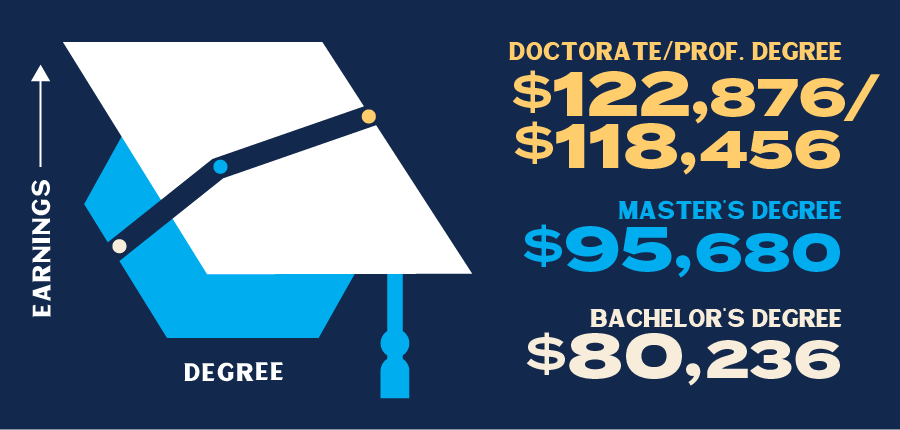
3. Does Grad School Cost Too Much?
Graduate school can certainly be expensive, but many universities have taken steps to make things more affordable for students.
Graduate Assistantships are a great option for financial assistance. Select programs also offer stipends to financially support their students who are funded through a graduate assistantship. These are just a couple ways to help pay for your graduate education.
4. How Do I Know if the Timing is Right for Graduate School?
There's no universal right time to apply to graduate school, but there are a few signals worth weighing before you decide.
You're still in undergrad and don't want a gap. If you're on track to graduate and want to keep momentum, an accelerated path lets you start graduate coursework before you finish your bachelor's.
You've been in the workforce and hit a ceiling. If a promotion or role change requires credentials you don't have, that's a different kind of readiness than the recent-grad case above.
- Browse our career training and online programs
You're weighing cost against career payoff. If funding and ROI are stopping you, that's worth resolving before timing.
- If you're worried about cost, How Much Does Graduate School Cost? breaks down what grad school usually runs.
How Do I PIck the Right Graduate School?
Once timing feels right, the choice comes down to a short list of concrete factors:
- Program specialization. Does the department have faculty and coursework in your specific area of interest, not just the general field?
- Funding and assistantships. What's actually available, and what does it cover?
- Format. Accelerated, full-time, part-time, online, or hybrid?
- Outcomes. Where do graduates from this program actually end up?
If you're trying to narrow down your graduate school list, check out our article on choosing the best grad school for your future.
Next Steps
Explore Affordability
We have a variety of scholarships and financial aid options to help make college more affordable for you and your family.
Apply to the University of Mississippi
Are you ready to take the next step toward building your legacy?