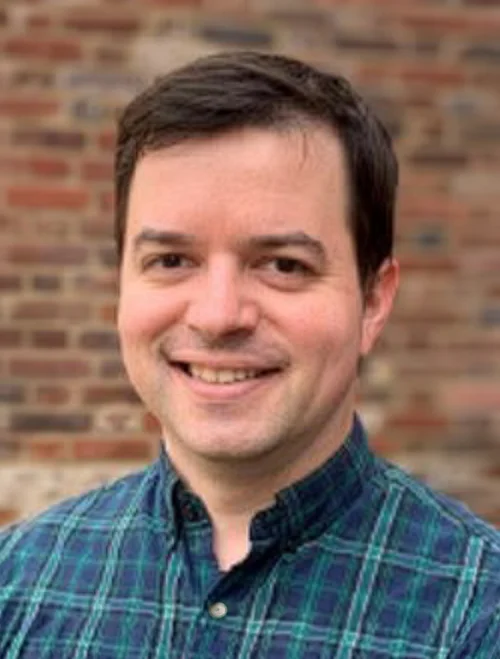
Learn More About Jacob Graham
While at UM, Jacob excelled at physical chemistry classes and was asked to join Dr. Nathan Hammer’s lab. He was immediately given the challenge of designing and building a time-of-flight mass spectrometer with the eventual goal of using it to perform infrared spectroscopy on mass selected molecules and clusters.
After graduation, Jacob earned his Ph.D. in chemistry at Johns Hopkins University. As a postdoc at the University of Chicago, Jacob expanded his expertise to include interfacial physics by studying molecular beam-surface interactions. He is currently a Research Space Scientist in the Planetary Environments Lab at NASA Goddard Space Flight Center.
How did you first get interested in chemistry?
Growing up I remember watching Bill Nye the Science Guy and various PBS shows like NOVA and this is where my initial interest in science began. I always felt more interested in and comfortable with chemistry and physics than in biology (dissecting animals) so I steered towards the physical sciences. I had an especially enthusiastic and talented high school chemistry teacher and once I started learning about atomic and molecular orbitals I was hooked.
Growing up I remember watching Bill Nye the Science Guy and various PBS shows like NOVA and this is where my initial interest in science began. I always felt more interested in and comfortable with chemistry and physics than in biology (dissecting animals) so I steered towards the physical sciences. I had an especially enthusiastic and talented high school chemistry teacher and once I started learning about atomic and molecular orbitals I was hooked.
Tell us about an influential professor or class that made an impact on you.
Alongside all of the practical knowledge involving vacuum systems, lasers, and electronics that I picked up during the [time-of-flight mass spectrometer] project, Dr. Hammer helped me improve my scientific communication ability, project management skills, and even my resilience through failures.
Alongside all of the practical knowledge involving vacuum systems, lasers, and electronics that I picked up during the [time-of-flight mass spectrometer] project, Dr. Hammer helped me improve my scientific communication ability, project management skills, and even my resilience through failures.
Why study chemistry at UM?
The department was a very positive environment for me. I was prepared well academically and I was able to do rewarding experimental work as an undergraduate. I genuinely felt that all the faculty I interacted with cared about my future and they would always make time to talk to me about both academic and non-academic issues.
The department was a very positive environment for me. I was prepared well academically and I was able to do rewarding experimental work as an undergraduate. I genuinely felt that all the faculty I interacted with cared about my future and they would always make time to talk to me about both academic and non-academic issues.