
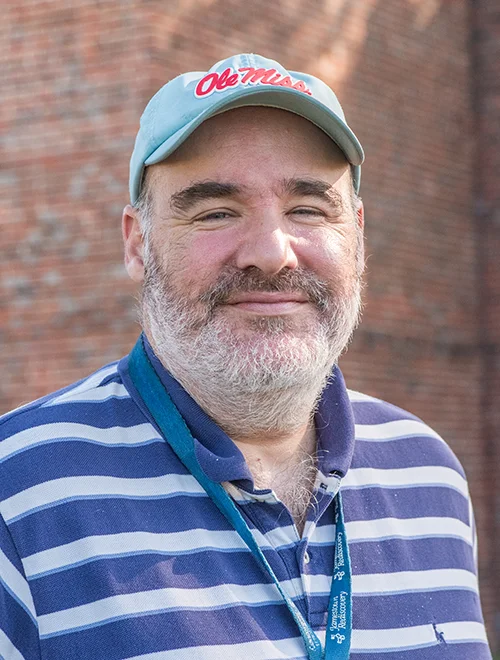
Meet Mark
Alumni Spotlight
Can you tell us why you selected UM for your undergraduate degree?
My high school in Virginia allowed three in-state college visits, and time for one out-of-state visit. I had grown up liking the University of Mississippi, and my grandfather once lived in Mississippi (Yazoo City). I honestly wrote to UM on a whim and set up a campus visit in 1995. I loved the beauty of the UM campus, that it was a medium-sized school with big school atmosphere, and how nice the campus guide and professors were that I met. I was also offered a much better deal on tuition that I would have received in-state in Virginia. I fell in love with the place within minutes. It was an easy decision for me.
My high school in Virginia allowed three in-state college visits, and time for one out-of-state visit. I had grown up liking the University of Mississippi, and my grandfather once lived in Mississippi (Yazoo City). I honestly wrote to UM on a whim and set up a campus visit in 1995. I loved the beauty of the UM campus, that it was a medium-sized school with big school atmosphere, and how nice the campus guide and professors were that I met. I was also offered a much better deal on tuition that I would have received in-state in Virginia. I fell in love with the place within minutes. It was an easy decision for me.
What are some of your proudest accomplishments and/or favorite memories from your time at UM?
Socially, I had a lot of fun there, and it was the place where I learned to grow up.
Academically, I think UM has a very underrated history department. I focused on Latin American history with Dr. Sullivan-Gonzalez, and New South and Civil Rights Era history with Dr. Ownby and Dr. Eagles. For my senior seminar on Civil Rights, I did some oral history interviews with both Civil Rights activists, and those that participated in “massive resistance”. Some of these interviews were difficult, and much of the history I learned first-hand was very harsh, but it prepared me for my future career. I learned a lot of first-hand information about 1962, and it opened my eyes to the long-term history of racial and social class injustice.
I also minored in English and have developed a love for Southern Lit since that time.
I would argue that UM is a place where you can receive a good education but is also a place where you need to develop social skills to navigate. I think both aspects of the school shaped me for my career as a public historian. Faulkner said “in order to understand the world, you must understand a place like Mississippi”. I think that has been true in my journey.
Any words of advice for young people considering studying history?
It is fine if you wish to pursue a PhD in history to become a professor. But that is not all you can do with a history degree. Many history majors become attorneys, and the research and presentation skills from history do apply. I have also known history majors that have become classroom teachers, or worked in the foreign service. In my case, I have worked in the public history field (museums).
A knowledge of history is important to be an informed citizen. I tell people that when you know history, you are never surprised when you watch the news. You will learn research skills, critical thinking, how to write well, and how to make a reasoned argument. My history degree has helped me write resumes and cover letters, and when I served as a fore person on a jury.
What has been your journey since graduation at UM?
I worked in museums for 9 years after graduation, then earned my master’s in history at Virginia Tech in 2011 as it’s necessary for promotion in the museum world. My focus during the master’s program was 17th century Virginia and the Trans-Atlantic World. I researched the Black Virginians that went to Liberia and became a “Virginia dynasty.” Then they essentially replicated the plantation social order to the indigenous Liberians. My time at Virginia Tech opened the doors to Jamestown directly as I studied under the professor that created the Virtual Jamestown archive.
I not only work at the original site of the first permanent English settlement in North America – Jamestowne, I engage in how the 17th century shaped the present. I have done some original work on the 1619 arrival of the First Africans, and the development of the first slavery laws and racial separation that directly ties into my studies at UM.
Please tell us about your current position.
On a day-to-day basis I write and deliver tours for children’s groups, tourists, and civic organizations. I have worked with an archaeology team that has made three top-ten discoveries in the world. I have had the opportunity to publish historical pieces, been interviewed on national and international media outlets, and am now working on my own podcast. My public history work is like being a 4th grade teacher, college professor, travel concierge, and office worker all in the same job. My job also involves working with a variety of people and views, so my time navigating the social world of UM has been just as impactful as the academic for what I do.
Occasionally, you meet celebrities as well. One day John Grisham, former Chancellor Bob Khayat, and Dan Jordan (former head of Monticello) had a self-described “visit from a bunch of old Mississippians” and I got to lead the tour for some famous UM alums.