Mississippi UAS Symposium 2026 - Unleashing UAS for Crisis Response and Disaster Relief

Organized by the Center for Air and Space Law, and funded by a grant from the FAA's ASSURE: Center of Excellence for UAS Research, this one-day event will explore how drone technology can be effectively deployed during emergencies and natural disasters to save lives and provide critical assistance.

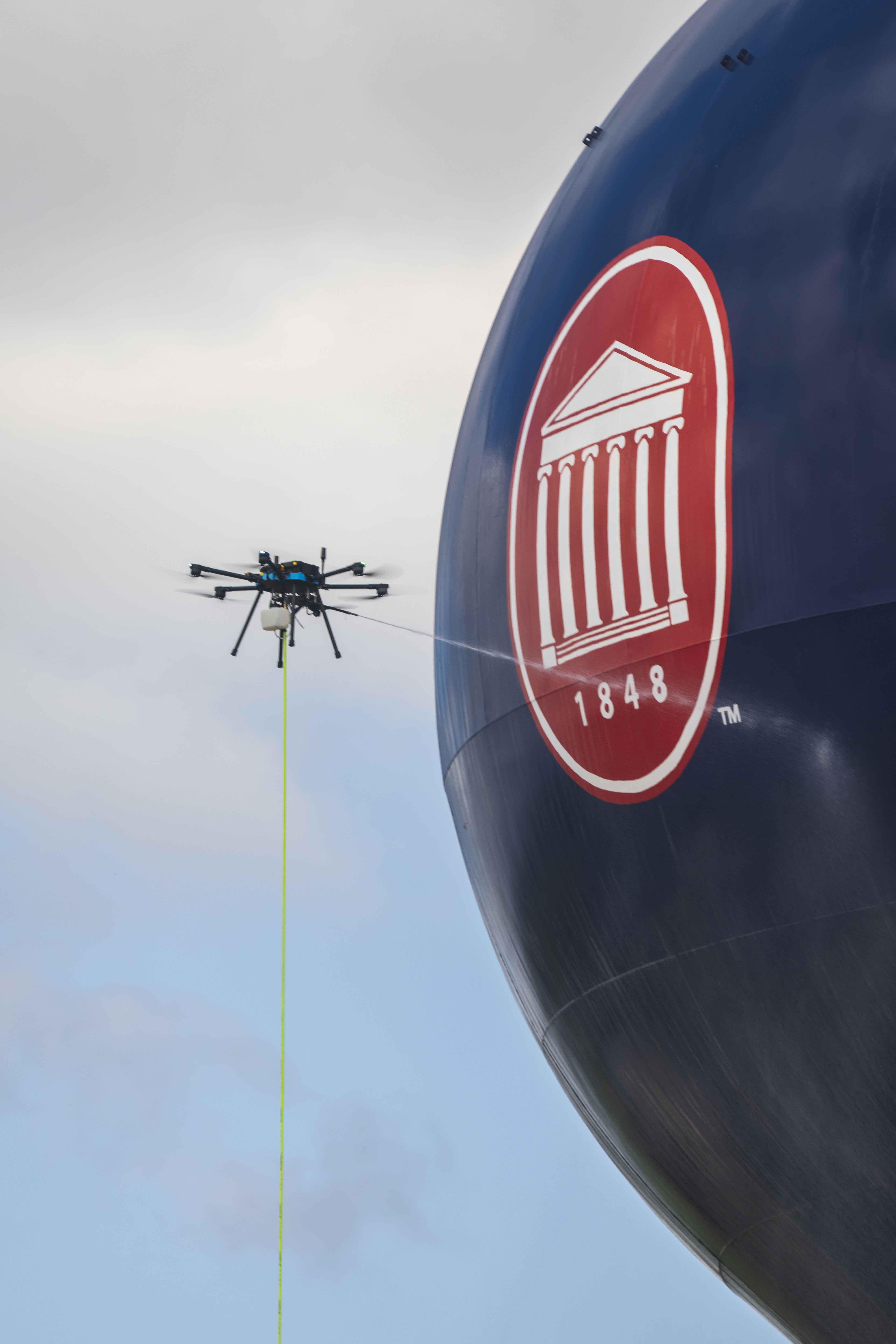
drone by ole miss water tower

Guest Speakers

Hear from nationally recognized leaders, innovators, and first responders who are shaping the future.

Michelle Hanlon photograph  

Michelle L.D. Hanlon has been dubbed the Godmother of Space Law. She is Executive Director of the Center for Air and Space Law at the University of Mississippi and co-founder of For All Moonkind, the only organization in the world devoted to protecting human heritage in outer space. Under her leadership, For All Moonkind became a Permanent Observer to the United Nations Committee on the Peaceful Uses of Outer Space. Michelle is also the Editor-in-Chief of both the Journal of Space Law and the Journal of Drone Law and Policy.  Her work bridges governance, commerce, heritage and ethics, examining how law can shape humanity’s expansion into space and prevent conflict in an already contested domain. She has testified before the United Nations and the U.S. Congress and advised governments and international organizations on the drafting of space legislation and regulations. Her voice is regularly sought by international media. Michelle received her B.A. in Political Science from Yale College and her J.D. magna cum laude from the Georgetown University Law Center. She earned her LLM in Air and Space Law from McGill University where the focus of her research was commercial space and the intersection of commerce and public law.

Dr. Narcisa Pricope photograph  

Dr. Narcisa G. Pricope is Associate Vice President for Research at Mississippi State University, where she contributes to campus-wide research strategy and has secured more than $4 million in new direct funding for MSU over the past two years. 

Dr. Pricope is the national lead on the expert areas functional team in the National Science Foundation’s SECURE Center (Safeguarding the Entire Community in the U.S. Research Ecosystem), developing tools and guidance that fortify research security nationwide. She spearheaded Mississippi’s entry into the Department of Defense Microelectronics Commons network, is actively working on creating the Mississippi Energy Research Innovation & Technologies (MERIT) Center to advance grid modernization and water-energy-nexus solutions, and negotiated a four-year Cooperative Research and Development Agreement with the U.S. Naval Meteorology and Oceanography Command to drive public-private innovation. Her coalition-building with state leaders also earned an invitation to develop the East Mississippi Sentinel Landscape, aligning military readiness with conservation and rural-economy goals. Most recently, the project she architected, called “PFAS Solutions: GeoHealth Intelligence and Human-Centered Design for Gulf Sustainability” was named one of ten national finalists in the National Academies–MacArthur Foundation Grand Challenge, positioning MSU to compete for a $20 million implementation award. 

A land-systems scientist with more than seventy peer-reviewed publications and active awards from NSF, NASA, and the National Geospatial-Intelligence Agency, Dr. Pricope translates interdisciplinary discovery into solutions that strengthen national security, critical infrastructure, and regional economic growth while cultivating a diverse next-generation STEM workforce. 

Linda Ziemba photograph 

Linda Ziemba’s experience spans internet security, telecommunications, and entrepreneurship at companies including Websense, Secure Computing, AT&T, and Lucent Technologies. Before founding AeroDefense in 2015, she was a key executive at LiveLOOK, a collaboration software company acquired by Oracle in 2014. 

At AeroDefense, Linda applied her deep background in security and technology to pioneer fixed and portable drone detection solutions that detect and locate both drones and their pilots. Her leadership has earned the company six patents, three Small Business Innovation Research (SBIR), two Department of Homeland Security Support Anti-terrorism by Fostering Effective Technologies (SAFETY) Act designations, and a reputation for delivering effective airspace awareness systems to critical infrastructure, correctional facilities, military/defense, public safety organizations, stadiums and event venues across the country.

Frank Noppel photograph
Frank Noppel is a co-founder and the CEO of blueflite, a drone manufacturer focused on cargo, medical logistics, and emergency-response operations. He has close to 20 years of experience across aerospace engineering, operations, and strategy, spanning both commercial aviation and government-supported programs.
His background is aerospace engineering with a PhD from Cranfield University in the UK, holds a private pilot and remote pilot certificate, and he is the inventor of multiple aerospace patents. Prior to blueflite, Frank worked as a strategy consultant at McKinsey & Company, advising multinational organizations on aerospace, operations, and transformation initiatives.

Katherine Ayres photograph  

Katherine (“Kate”) is a municipal & aviation regulatory Attorney who loves to fly. After 34 years of aviation, and 17 years in both her municipal and aviation law practice within a big law firm setting, she saw a global need in Advanced Air Mobility (AAM), and became the first lawyer to merge municipal law and aviation law into a single practice. In 2022 she founded CAYRES Inc. CAYRES specializes in AAM community integration, conflict resolution and risk management for the integration for drone and future VTOL delivery via urban & regional air transport.

Kate is also a proud member of Team Pivot, acting as Chief of Staff, Legal & Compliance. Pivot Airlines is a growing Canadian 705/121 air carrier focused on sustainable regional air mobility. Kate speaks and is an author on aviation law & AAM, air corridor protections, RPAS regulations, litigating an aviation case before Canadian juries & corporate governance for modern air carriers. As a glider pilot, and a commercial pilot for fixed-wing aircraft (with some rotary time), Kate loves all things that defy gravity. She’s also a loving mom of two boys with big hearts, and their rescue dog named Tilly.

Denise Navicky photograph  

Denise Navicky is a Senior Program Manager at Mississippi State University’s Office of Research and Economic Development.  She supports major MSU research programs, including a DARPA award in agricultural biosecurity and data commons, and advances initiatives focused on energy resilience, grid modernization, and the water–energy nexus. She also supports efforts to strengthen MSU’s partnership with the U.S. Naval Meteorology and Oceanography Command. Most recently, she managed the proposal submission for “PFAS Solutions: GeoHealth Intelligence and Human-Centered Design for Gulf Sustainability,” a top-ten national finalist in the National Academies–MacArthur Foundation Grand Challenge, positioning MSU to compete for a $20M implementation award.

Prior to this role, Denise served as MSU’s Business Development Manager for Alliance for System Safety of UAS through Research Excellence (ASSURE), the FAA Center of Excellence for UAS Research and Aviation Program Manager at Raspet Flight Research Laboratory (RFRL). Denise is integral to advancing technologies and practices by identifying growth opportunities to propel innovative research initiatives and forging strategic partnerships.  Her contributions support MSU’s mission to advance technologies through cutting-edge research.

With over 30 years of experience in government contracting, Denise Navicky has a diverse skill set encompassing federal acquisition, regulatory compliance, capture and proposal management, and developing strategic partnerships. She specializes in serving the aerospace and defense sectors, while also supporting contracting efforts across a broad range of federal agencies.  Denise has expertise in platforms widely used across the government such as SAM.gov, Grants.gov, Procurement Integrated Enterprise Environment (PIEE), and government contract writing software such as Contracting Information Technology (CON-IT), as well as government industry platforms such as GovWin IQ and Deltek Costpoint, reflecting experience on both the government and industry sides of federal acquisition and a strong understanding of the full contract lifecycle.

Scott Bowins photograph  

Scott is a Navy veteran, entrepreneur, and unmanned systems leader with a deep background in UAS operations, training, organizational development, and business management. He currently serves as Deputy Director for Strategic Partnerships with the ASSURE and ASSUREd SAFE programs, where he helps advance Unmanned Aircraft Systems (UAS) safety, integration, and real-world impact across public and private sectors.

Since 2011, Scott has been at the forefront of robotics and aviation technologies, leading efforts in UAS operations, training, and research and development that bridge cutting-edge capability with practical mission needs. His work regularly connects federal agencies, academia, and industry to accelerate innovation while maintaining a relentless focus on safety and operational excellence.

Scott’s career began with 26 years of distinguished service in the United States Navy, where he built front-line leadership skills and technical expertise in complex, high-stakes environments. After retiring from active duty, he founded and led a consulting firm for five years, helping organizations align strategy, technology, and talent to deliver measurable results.

In his current role, Scott leverages this combined military, entrepreneurial, and technical experience to architect strategic partnerships that enhance UAS safety, resilience, and mission effectiveness. His efforts directly support ASSURE’s mission to inform policy through high-quality research and to enable the safe integration of autonomous systems into national and international infrastructures, shaping how unmanned systems are trusted and employed in the years ahead.

Grant Guillot photograph  

Grant Guillot is the Vice President for Regulatory Affairs at DroneUp, where he oversees federal, state, and local regulatory matters impacting the company’s UAS operations. In that capacity, he regularly meets with officials and staff from various legislative and executive branches of the United States government to discuss matters impacting the integration of unmanned aircraft systems into the National Airspace System. He also regularly engages the Department of Transportation and the Federal Aviation Administration to discuss legislative and regulatory matters pertinent to drone integration, such as the FAA Reauthorization Act and regulatory impediments to drone integration. Grant has given many seminar presentations and written extensively for several publications regarding the regulatory issues and societal impacts of drone integration on the National Airspace System. 

Prior to his position with DroneUp, Grant spent 12 years in private legal practice, during which he most recently advised drone manufacturers and companies that provide UAS services, as well as companies operating in industries using drones. He has been featured on Fox Business and Fox News to discuss the opportunities and challenges arising from drone use. Grant previously hosted three seasons of  “Drones in America”, a video podcast produced by MarketScale, which explored how drones are improving lives and impacting various end-user industries. After graduating first in his class in mass communications from Louisiana State University, Grant attended the Paul M. Hebert Law Center at LSU, where he graduated in the top six percent of his class, was selected to the Louisiana Law Review, and inducted into the Order of the Coif.

Symposium Information Guide

This Symposium Information Guide provides a clear, comprehensive overview of the Mississippi UAS Symposium.

The event will be held on Monday, March 2, 2026, on the Ole Miss campus in the Johnson Commons Ballroom.

Find Johnson Commons through our map.

Agenda:

8:00-8:30 am – Registration & Breakfast

8:30-9:00 am – Opening Keynote

9:00-9:45 am – Law. A foundational overview of legal and regulatory framework to safely and effectively integrate UAS into disaster response operations.​

10:00-10:45 am – Emergency Ops and Data. How emergency responders can use UAS-collected data for disaster response while addressing privacy concerns.

11:00-11:45 am – Things to Come/Air Traffic Control. How UAS operations are integrated into disaster-response airspace through ground-and-air coordination.​

12:00-12:45 pm – Lunch​

12:15:00-12:45 pm – Lunch Keynote

1:00 – 2:30 pm – Scenarios. Real-world operational examples to showcase the challenges first responder face with using UAS. ​

2:45 – 3:45 pm – Air Space Coordination, Counter UAS, & No Drone Zones. How disaster-response organizations are currently integrating UAS into their missions and the growing role of counter-UAS strategies. ​

3:45-4:15 pm – Survey of first responder UAS-users for FAA research.

4:15-4:45 pm – Closing Keynote

5:30-6:30 pm – Reception in Ole Miss Law School atrium

Attendance is $75 per attendee and $25 per student, with complimentary registration for sponsors and panelists.

Sponsorship Packages

We would love your support! Checks can be made out to UMFoundation. Write "Air and Space Law" in the memo line. Contact aclewis5@olemiss.edu for more information.
Allison Lewis

Have questions?

We’re here to help.

Allison Lewis

Program Director