
British Scholar Ponders Why the Blues Still Matters
Tom Attah blends performance and sociology

OXFORD, Miss. – Tom Attah has played as a featured artist at the Glastonbury Festival of Contemporary Performing Arts and at the Great British Rhythm and Blues Festival. He also composed and recorded acoustic guitar tunes for a permanent exhibition at the former home of Georg Frideric Handel and Jimi Hendrix in Mayfair, London.
He recently moved across the pond and into a classroom teaching sociology and Southern studies at the University of Mississippi. But Attah hasn't put down his guitar completely; it's just off to the side a bit as he teaches.
Attah is a researcher and internationally known musician and author, and his passion for the blues shines through in conversations.
"I didn't realize that I was a sociologist initially, because I'd always been doing performance, but what I found was that the questions I was asking about blues music didn't actually have their answers in musicology," he said.
"The questions that were more interesting were: What's this music for? How does it work? How does it affect? Why is it still here? The key one was why does it persist?"

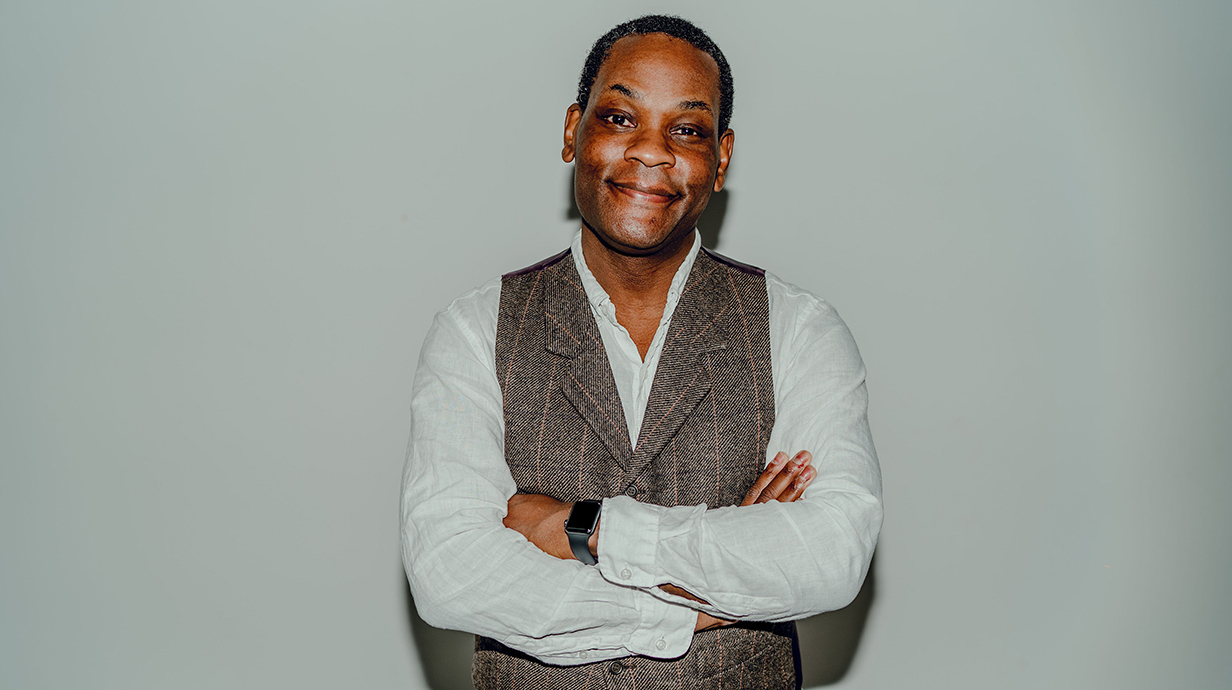
Tom Attah is known internationally as a guitarist and blues scholar. Photo by Chris M. Saunders
His research interests include the effects of technology on popular music, particularly blues music and blues culture. He is interested in how the music that sprang from the Mississippi Delta soil remains relevant for modern listeners and how people around the world, including those who have never been to America, understand it.
"As I built my research and writing and teaching, the answers were in sociology and Southern studies," Attah said.
He earned a bachelor's degree in popular music studies from the University of Sheffield and a master's in music performance and a doctorate in popular music from the University of Salford. Attah's dissertation "Halls Without Walls: Perpetuation, Development & Dissemination of the Discourse on Blues Music and Blues Culture in the Digital Age (1996-2016)" will be published by Bloomsbury as a monograph in 2027.
He also has a book on the blues in northern England due from Manchester University Press in 2028.
"People sometimes assume that blues music is somehow primitive, and it's not," Attah said. "It's a really forward-looking living tradition, because you've got steel guitar strings, which in 1910 and 1920 is the cutting edge of technology. All guitars up until that point have been made out of wood.
"As soon as technology was able to fashion metal at scale and make these into instruments and sell them at a reasonable cost, resonator guitars appeared. And this is before the gift of electric guitars to the world transformed the world."
Attah joined the Ole Miss faculty in fall 2025. In his short time in Oxford, he has already discovered concerts at the Foxfire Ranch and other music in and around the area.
"If we want to understand what the blues was 100 years ago, or 200 years ago, all we have to do is listen to it today," he said. "It's not a question of having to get in a time machine."
The guitarist, who has jammed alongside Robin Trower, Toots Hibbert and Honeyboy Edwards, brings an exciting perspective to the classroom as someone who is both a musical performer and a scholar of music, said Jeffrey Jackson, professor and chair in the Department of Sociology and Anthropology.
"Whether you're interested in B.B. King or Beyoncé, music videos or music in video games, students are in for a real treat," Jackson said. "Dr. Attah's classes will shed light on the role that music plays in society and how it shapes our experiences and our identities in profound ways."
He taught an introductory sociology course, SOC 440: Sociology of Music, and is teamed with Adam Gussow, professor of English and Southern studies and an accomplished blues musician, to teach SST 118: Introductory Topics in Southern Music.
Sela Ricketts, a student in the M.F.A. in Documentary Expression program, is Attah's graduate assistant this spring. She looks forward to learning alongside the undergraduate students in his course.
"It's exciting to work with someone who doesn't just know the blues; he's lived it," said Ricketts, a Greenwood native who earned a bachelor's degree in integrated marketing communications and art, and a master's degree in Southern studies, both from Ole Miss.
With multiple heavyweight credentials as a scholar and researcher, Attah is honored to share his experience and insights with students, he said.
"The key thing is, as long as you're genuinely interested in the music and the people, respectful of the power of both, then everything's fine," he said. "And if you're interested in your students and respectful of the subject before anything else, everything flows from that.
"I'm very lucky. I can write, I can read, people ask me to go and play shows, people are supportive and generous, and it all kind of works out."
Top: Guitarist Tom Attah (center) performs at the Great British Rhythm and Blues Festival. Attah, a scholar, author and performer of the blues, is sharing his expertise with students at the university, where he teaches sociology and Southern studies courses. Photo by Adam Kennedy
By
Rebecca Lauck Cleary
Campus
Office, Department or Center
Published
January 23, 2026