
Sound Science: Ole Miss, USM Use Acoustics to Monitor Coastal Threats
Students, researchers, industry unite to create acoustics surveillance systems
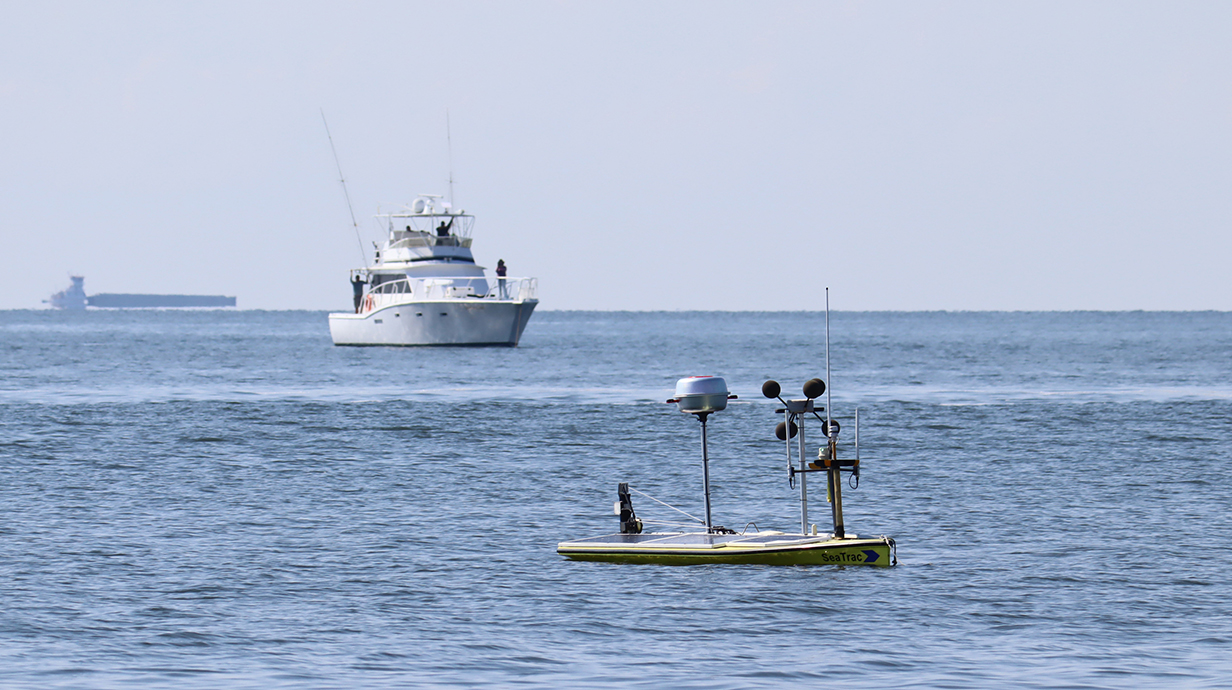
OXFORD, Miss. – When a motorboat cuts across the ocean or a helicopter buzzes overhead, it leaves a sonic signature. Mississippi researchers recently teamed up to test sensors designed to detect and analyze those signals in real time, potentially offering a new way to monitor coastal threats.
Students and researchers from the University of Mississippi and the University of Southern Mississippi recently joined Mississippi companies Hyperion Technology Group and BLUEiQ on the Gulf Coast to try out new acoustic sensors.
The sensors, loaded onto autonomous watercraft, use sound to detect boats, aircraft and underwater activity. This technology could inform national defense, commercial shipping and coastal resilience efforts.
"This collaboration demonstrates the strength of Mississippi's innovation ecosystem," said Nathan Murray, director of the National Center for Physical Acoustics. "Working together across institutions and with private industry, we are able to move research from concept to application more quickly."
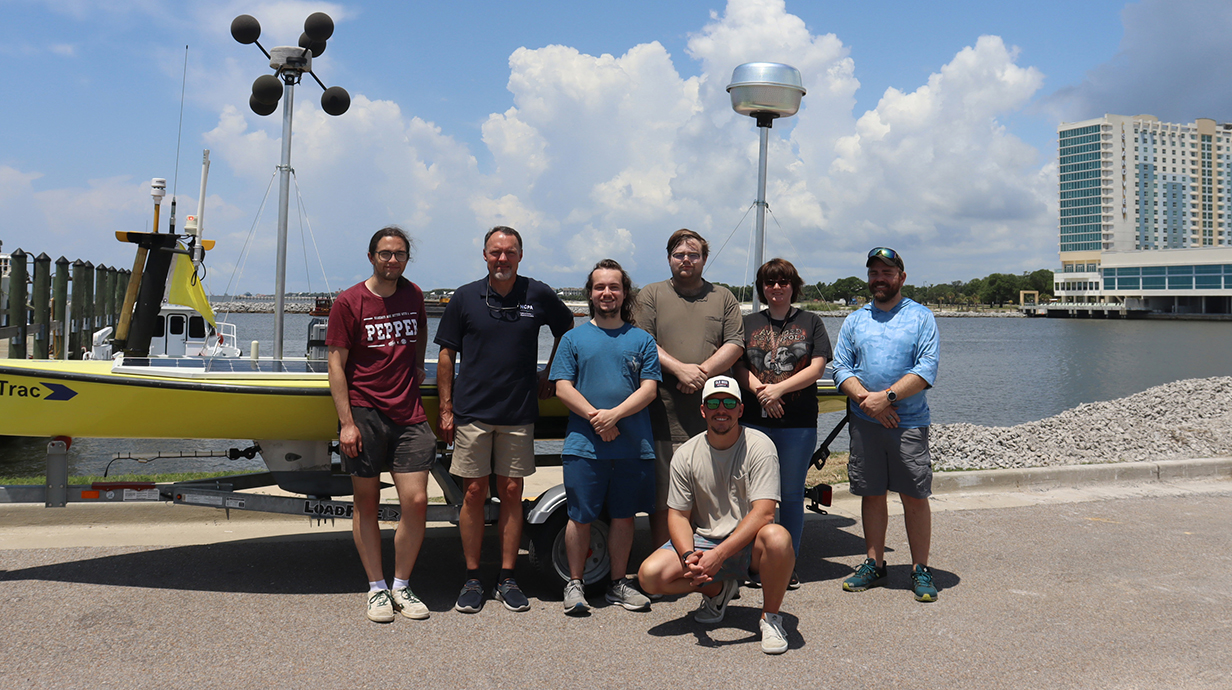
Wayne Prather (second from left), principal scientist at the university's National Center for Physical Acoustics, gathers with Harley Garrett (third from left), a master's student in computer science, and other Ole Miss students during an acoustics demonstration on the Mississippi Gulf Coast. Submitted photo
The test, coordinated by the USM Marine Research Center, used SeaTrac's unmanned watercraft, Hyperion's acoustic sensors and BLUEiQ's underwater hydrophones to detect sound both in the air and underwater in different coastal environments.
"Water covers nearly 75% of the earth, but we can perceive far less about our environment there," said Wayne Prather, principal scientist at the National Center for Physical Acoustics. "If I look outside my window right now, I can see cars going by.
"I can tell the make of the car and what color it is. I can't do that in the water. In the ocean, there could be a submarine beneath me and I'd never know it.
"That's what all this is about: improving our ability to be aware of what's going on in the environment. We would like to have techniques to have a better understanding of what's going on and where."
Harley Garrett, a third-year master's student in computer science from Memphis, was among the Ole Miss students who joined Prather during the test.
"The largest difference between a field test and the classroom is, to me, robustness," he said. "In class, I might have full control of the environment of my project, and I only have to get my project to work in a specific way. In field tests, especially this one, it's the other way around.
"Our work has to adapt to the environment; we have to prepare for every eventuality. One of my tasks for this specific collaboration was to monitor our various contributions and ensure they were continuously recording. I've never had to design a system so robust before."
The acoustics center led the acoustic modeling and signal analysis for the project, helping the team distinguish meaningful targets from background ocean noise such as waves, weather conditions and other ambient sounds, Prather said.
"Anytime you put sensors into the environment, you have to understand the noise of the environment," he said. "If you want to, say, record birds chirping, are you going to do that in a quiet forest glade or do you want to do it in the center of Manhattan?
"That's why we need to understand background noise."
By combining information from sensors above and below the waterline, researchers can pinpoint not only what a sound may be, but where it is, he said.
"For ocean-based detection, acoustics has always been stuck in either underwater detection alone or air detection alone, and that has limitations," he said. "You could say, 'There's a submarine over there' or 'There's a boat over there,' but you would have no idea how far away it is.
"But if you have sensors both in the air and underwater and you detect it in both, you now know how far away it is."
The tools could provide a way to track suspicious vessels, monitor commercial traffic and route ships safely through shipping lanes.
"This project highlights the importance of collaboration between universities, industry and federal partners to accelerate innovation through technology demonstrations," said Brian Cuevas, USM associate vice president for research and innovation. "These demonstrations are essential for rapidly identifying solutions to meet the mission-critical needs of our war fighters and federal agencies."
Top: Students and researchers from Ole Miss and University of Southern Mississippi use an unmanned boat (foreground) to gather acoustic data from both above and below the waterline during a test on the Mississippi Gulf Coast. The group collaborated two Mississippi companies to test acoustics monitoring equipment in the area. Submitted photo
By
Clara Turnage
Campus
Office, Department or Center
Published
January 14, 2026