
Facilities Management Crews Fight Ice Storm on All Fronts
Solid planning, nonstop teamwork help workers restore power and limit damage
OXFORD, Miss. – As winter storm "Fern" slowly knocked out power and took down trees across Lafayette County, two dozen University of Mississippi employees waited in The Inn at Ole Miss, knowing that the hard work was about to begin.
Those employees were pre-positioned at the hotel to better respond to calls. The Department of Facilities Management oversees several specialized teams that tackled separate fronts in helping the university recover from the storm. The department had sought out volunteer employees to spend however long it took on campus.
"We knew it was coming," said Mike Dunnavant, director of facilities services. "We tried to be as preventative as possible in ensuring the facilities, buildings and systems were all protected."

Mike Dunnavant, the university's director of facilities services, helped prepare campus for the ice storm in the days before it hit Oxford. He also worked with department leaders to coordinate recovery efforts and ensure that students on campus remained safe. Photo by Carter Diggs
By 11 p.m. Jan. 24, limbs snapping from pine trees on Poole Drive took a power line to the ground. Charles "Toby" Bowen and his crew donned their rain suits and safety gear, beginning what would turn into an entire night of downed power lines.
The calls of downed trees came faster than his team could resolve them, often from locations they had just been.
As the night wore on, the wind and rain intensified, Bowen said. Explosions from fuses around campus were joined by crackles of thunder and lightning that lit up the sky.
At several points, the arm of the team's bucket truck froze, leaving a worker stuck 15 feet in the air. Each time, the team had to disconnect components to lower the worker and reset the bucket arm.
Despite their nonstop efforts, the university began to go dark.
"There's a big glow around Oxford as you come into it," Bowen said. "As we were out there, you could see lights going out from different locations on campus and in the city."

Many employees on campus reported working 16-hour days and had time for only about six hours of sleep each night, Dunnavant said. Due to the frequency of calls, Matt Klow, the university's transportation supervisor, managed just two hours of rest some nights.
"They are an example of putting the needs of campus first," said Dean Hansen, assistant vice chancellor and chief facilities officer.
In the first few days after the storm, those teams prioritized restoring power to essential areas to make sure those still on campus could manage on their own. The university used the Gertrude C. Ford Ole Miss Student Union as a warming center and kept Rebel Market open so that all students had access to food.
"As a result of the nature of the outage from (North East Mississippi Electric Power Association), some of the equipment inside our generation plant was damaged," Hansen said. "We ended up having about 25% capacity in the generation plant to power the needs of campus for the first two days."
Power was restored to most of campus within 36 hours, with almost every building back up by the following Wednesday (Jan. 28).
"It's been nonstop," Bowen said. "I stayed on the phone for the first few days, just constantly answering phone calls from dispatch, UPD and different people on campus that were running into issues."

Other groups, including the department's trucking crews and carpenter shop, provided support to teams needing assistance with tasks such as clearing debris and getting equipment hauled around campus. The storm left chaos in its wake, but Klow said he just took it all one step at a time.
"You just do it," he said. "You just kick in and you don't freak out. You just go at it and when you're done, you're done."
Many of the department's employees lost power at their homes for days or even weeks. Jeff Hood, coordinator of university fire services, was without power for 11 days.
Hood said the only source of heat in his home came from his dogs Ralph and Breezy, which he called "mini nuclear reactors."
"We just stuffed them under the down comforters," he said. "I'll be honest with you, I was trying to come out of it because, those little dogs, they put out some heat.
Hood lived in New Orleans during the winter storm of 1994 that affected much of the Southeast. He described that storm as the "hand of God" coming down with gardening shears to cut everything in half.
This time, the sound of limbs crashing to the ground was nonstop, and one of his neighbors had a tree pierce their roof, he recounted.

A contract worker helps with repairs in the university's Sally McDonnell Barksdale Honors College. The building was among the hardest hit on campus, but it is open for classes this week. Photo by Kevin Bain/Ole Miss Digital Imaging Services
"I'm looking at my neighbor's house," he said. "They've got a lot of pine trees where I couldn't see the sky because of all the branches. Now, these pine trees are just bare."
Hood initially managed his team from home through a group chat with other Facilities Management leaders, and was able to travel to campus once a neighbor cleared his yard with a chainsaw.
His team oversaw much of the prep work to drain water lines and fire suppression systems from historically vulnerable buildings to ensure pipes and HVAC systems did not burst. Lines broke on two other systems, and 12 buildings across campus suffered significant damage, he said.
Among those hit hardest were Connor Hall, the Sally McDonald Barksdale Honors College and the V.B Harrison Building, home of the Student Health Center, where repairs are continuing. Outdoors, all above-ground power lines have been restored and the trees around them trimmed.
"We're still doing some repairs, but it's mostly cosmetic," Bowen said.
Many of the workers agreed the storm was the worst they've dealt with in their careers, whether they'd worked for the university five years or three decades. Hansen, who previously lived in Minnesota, was surprised at the extent of damage from Fern.
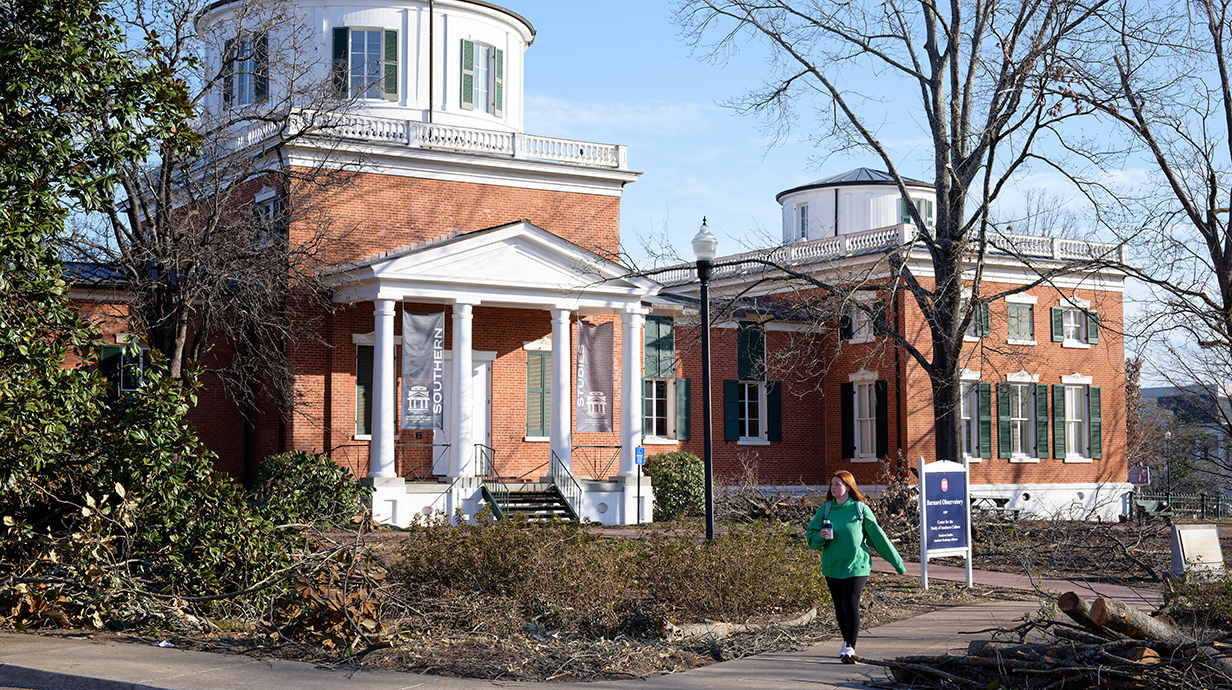
Cleanup continues across the Ole Miss campus as the university resumes normal operations this week. Photo by Hunt Mercier/Ole Miss Digital Imaging Services
"Places up north are a little more accustomed to winter weather," he said. "Our buildings just aren't really designed to handle that."
Each of the Facilities Management leaders cited the Hotty Toddy spirit, saying they work for the students and wanted to make sure they had a safe campus when classes resumed.
"It's all about the students for us," Bowen said. "That was the focus. Just try to keep the students warm and comfortable during an event like this."
That effort and care was noticed and rewarded by at least one student, who gave the team cookies as thanks for their work.
"We were very thankful," Bowen said. "It was very appreciative."
While the Student Health Center remains out of commission, students can access health services at the South Oxford Center, 2301 South Lamar Blvd.
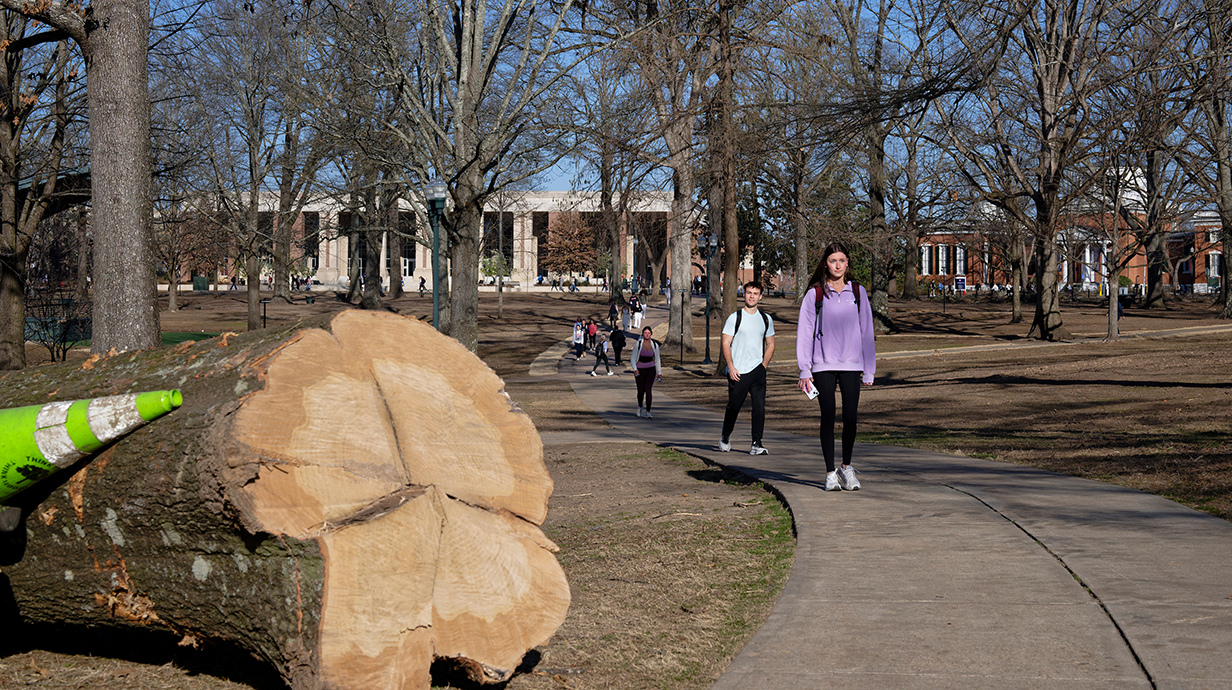
Top: Students walk past piles of storm debris in the Grove on their way to class this week. Workers from the Department of Facilities Management have cleared most walkways and made repairs to buildings that were damaged by the January ice storm. Photo by Hunt Mercier/Ole Miss Digital Imaging Services
By
Carter Diggs
Campus
Office, Department or Center
Published
February 12, 2026