
New Documentary Chronicles Life, Legacy of Ole Miss Icon Donald Cole
'Cole: Bridge to Justice' to screen at Oxford Film Festival, on campus
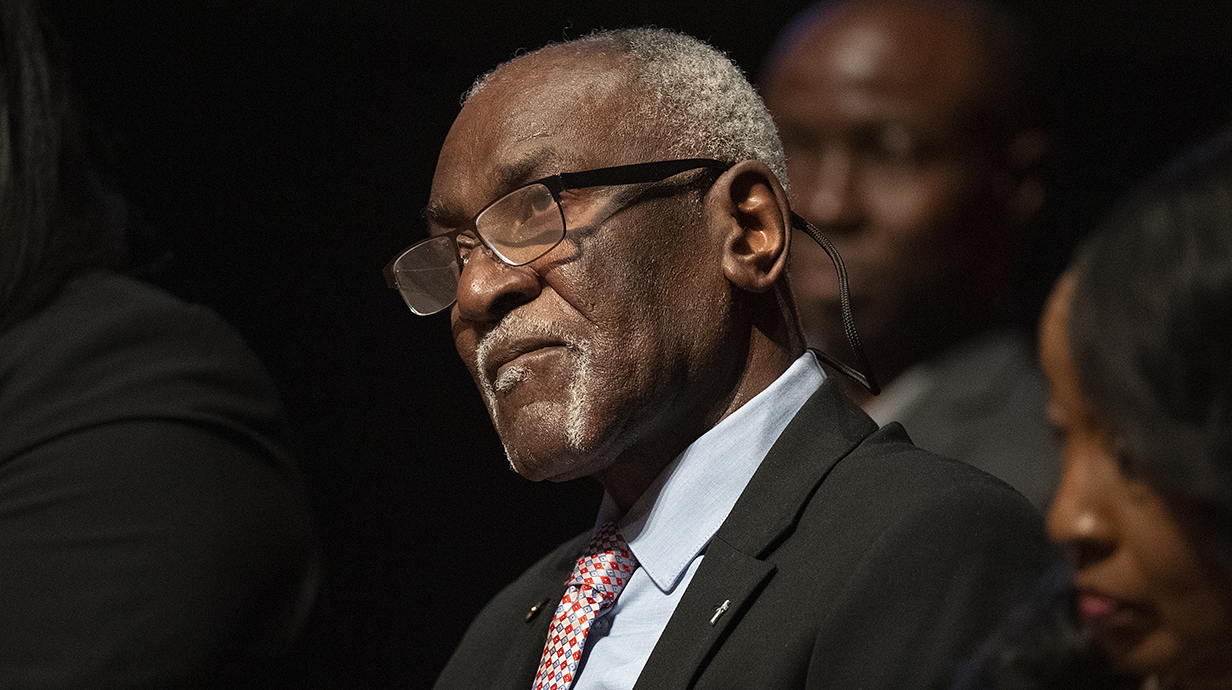
OXFORD, Miss. – A new documentary examining how Donald Ray Cole's 1970 expulsion from the University of Mississippi became the foundation for decades of leadership and service to the institution will debut at the Oxford Film Festival this week.
Cole, who retired in 2019, spent much of his adult life making the university a better and more welcoming place for all students. But in 1970, then an undergraduate, Cole was a member of the Ole Miss 8, a group of students expelled from the university following a peaceful protest that ended in 89 arrests in front of Fulton Chapel.
"Having this film screened in Oxford – where so many of these events unfolded – feels deeply significant," said Antonio Tarrell, the film's co-director. "This is not just another stop on the festival circuit. This is the ground where history happened.
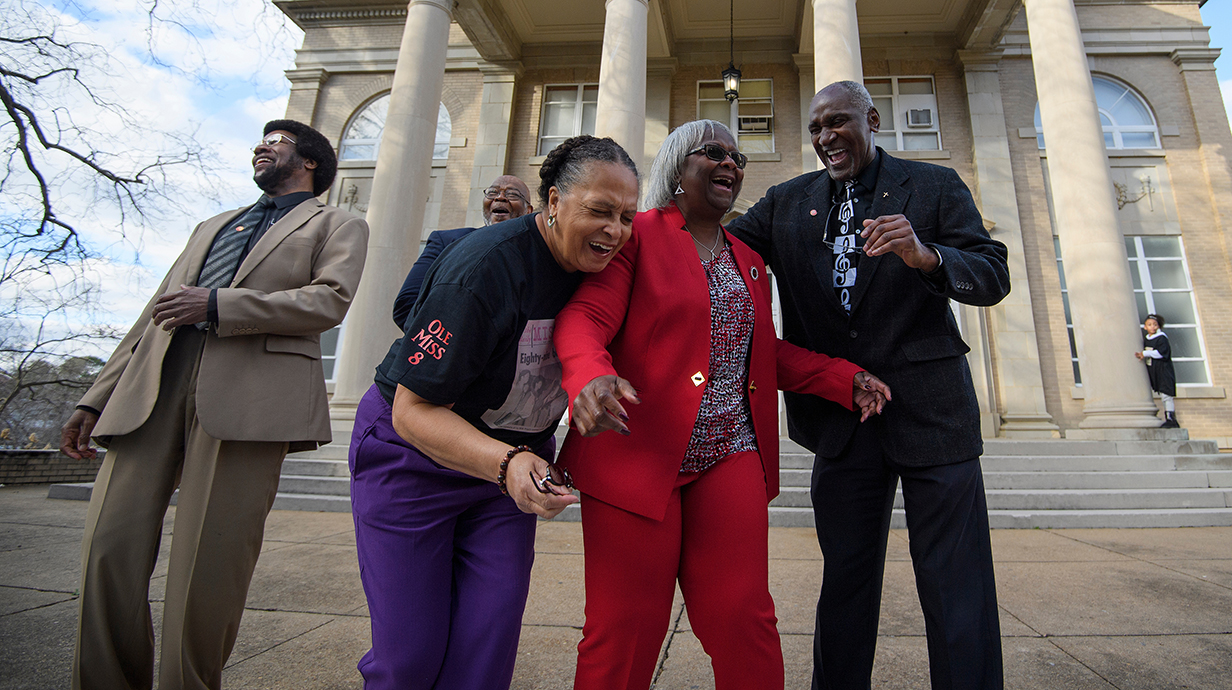
Kenneth Mayfield (left), Dr. Theron Evans Jr., Henrieese Roberts, Linnie Willis and Donald Cole gather in February 2020 to remember their time as UM students. Standing in the very spot where they were arrested for protesting 50 years ago, they share a laugh and reflect on the university's progress. Photo by Thomas Graning/Ole Miss Digital Imaging Services
"To bring the story back to the community that lived it, witnessed it and in many ways continues to wrestle with it carries real weight."
The 23rd annual festival will host a screening of the documentary at 6 p.m. Thursday (Feb. 26) in the Malco Oxford Commons. Tickets are available through the festival's website.
The Center for the Study of Southern Culture's SouthTalks series will host a second screening followed by a panel discussion featuring Cole, Tarrell and Castel Sweet, director of the Center for Community Engagement and co-director of the documentary. The screening, at 5:30 p.m. March 3, will be held in the same location as the protest more than 50 years prior: Fulton Chapel. The screening is open to the public.
Tarrell and his crew filmed segments for the documentary in Georgia, Florida, Virginia, North Carolina and several locations across Mississippi.
"The story stretches far beyond Oxford," he said. "But to have the film return here – and to be selected as the opening film – speaks volumes about Dr. Cole's impact on this community and the university. He is deeply respected and loved.
"The fact that the festival chose to center this story says something about where Oxford is today and its willingness to engage its own history."
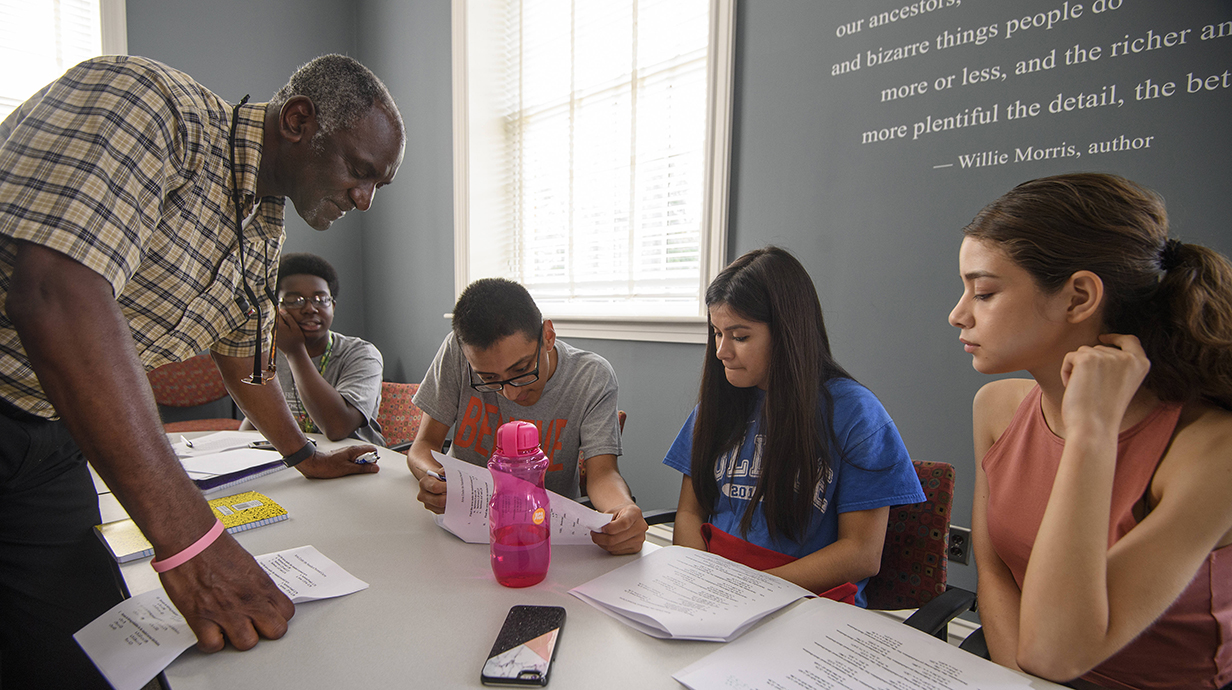
Donald Cole speaks to Grisham Fellows gathered to hear him lecture on mathematics. Cole, the subject of a new documentary, was a professor, mentor and leader at the University of Mississippi for more than 25 years. Photo by Thomas Graning/Ole Miss Digital Imaging Services
Although loved as a math professor and devoted mentor, Cole is most well-known for his advocacy for underrepresented students.
"Dr. Cole's impact on this university cannot be overstated," Sweet said. "He represents both the painful truths of our history and the possibility of transformation. His return to the very institution that expelled him, and his decades of leadership on behalf of students who followed, fundamentally reshaped what belonging and advocacy could look like at Ole Miss.
"This film invites us not only to honor his legacy, but to reflect on our collective responsibility to continue that work."
Cole, however, remains humble and even now avoids the spotlight. Instead, he says the other 88 people arrested that day and the seven others who were expelled should be the focus.
"I do think that there will be individuals inspired by it (the documentary), but I won't be the only inspiration there," he said. "I came back to the university – and was the only who came back – but I wasn't the only one who was torn apart by what happened.
"This is vindication for them, that is just as important to me as anything else. I was here, and I was a villain for a while, then I was a hero. Now, they get to be the hero, too.
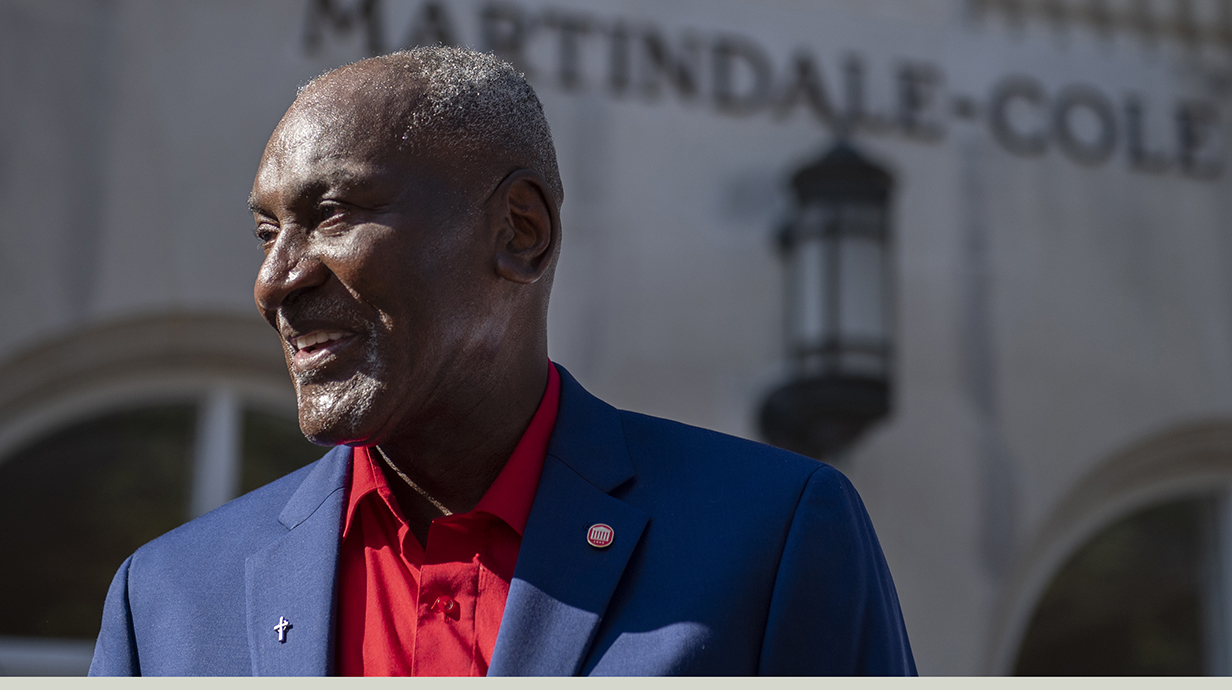
The university renamed Martindale Hall, which houses its student services center, in 2021, adding the name of longtime leader and student advocate Donald Cole. Photo by Logan Kirkland/Ole Miss Digital Imaging Services
"I never wanted to be a hero, but I think they are."
After his expulsion, Cole finished his bachelor's degree and earned a master's before returning to Ole Miss and completing his doctorate in 1985. In 1993, after working in the aerospace industry and as a mathematics professor at Florida A&M University, he once again returned to Oxford, this time as an assistant dean in the Graduate School and associate professor of mathematics.
Cole went on to spend the next 25 years as a champion of education for all, leading initiatives such as the Louis Stokes Mississippi Alliance for Minority Participation program, summer Bridge STEM programs and the McNair program. He also served as the assistant to the chancellor for multicultural affairs under Chancellor Robert Khayat and chaired the chancellor's standing committee on sensitivity and respect until 2017.
Cole retired leaving the university better than he found it nearly 50 years before, Tarrell said.
"My hope is that 'Cole: Bridge to Justice' teaches current University of Mississippi students that resilience is not abstract – it is lived," he said. "No matter the obstacles placed in front of you, you keep moving forward. You pursue your dreams. You stand firm in your convictions.
"And if that conviction requires protest, then you protest – with a clear understanding that there may be consequences. But history shows that the long-term rewards of principled action often outweigh the immediate cost.
"Dr. Donald Cole embodies that lesson."
Top: Donald Cole spent the majority of his adult life working to make the University of Mississippi a welcoming campus for all students. He is the subject of a new documentary, which debuts this week at the Oxford Film Festival. Photo by Thomas Graning/Ole Miss Digital Imaging Services
By
Clara Turnage
Campus
Published
February 23, 2026
Q&A With Filmmaker Antonio Tarrell on 'Cole: Bridge to Justice'
What drew you initially to this story? How did you first learn about Donald Cole's history and the Ole Miss 8?
I was first approached by Steven T. Case about directing a documentary on Dr. Don Cole's journey. Having lived in Oxford for more than 20 years, I was surprised that I had never heard the story of the Ole Miss 8. So, that history immediately struck me.
As I began to learn more, I was blown away by the depth of what had happened and how little it was publicly discussed. As a documentary filmmaker committed to Mississippi-based storytelling and institutional memory, I knew right away that this was not only a powerful story; it was a necessary one.
Once Steve and I agreed to move forward, I shifted into research and development. I began reviewing archival materials, mapping the historical timeline and building the creative team. I invited Castel V. Sweet to join as producer and co-director, given our long-standing creative partnership and shared commitment to culturally grounded storytelling.
I also brought on Jordan Wadley as sound operator to help ensure the film's tonal integrity. Castel and I have collaborated on multiple projects, and that established trust was essential in shaping the vision for this film from the outset.
I was first approached by Steven T. Case about directing a documentary on Dr. Don Cole's journey. Having lived in Oxford for more than 20 years, I was surprised that I had never heard the story of the Ole Miss 8. So, that history immediately struck me.
As I began to learn more, I was blown away by the depth of what had happened and how little it was publicly discussed. As a documentary filmmaker committed to Mississippi-based storytelling and institutional memory, I knew right away that this was not only a powerful story; it was a necessary one.
Once Steve and I agreed to move forward, I shifted into research and development. I began reviewing archival materials, mapping the historical timeline and building the creative team. I invited Castel V. Sweet to join as producer and co-director, given our long-standing creative partnership and shared commitment to culturally grounded storytelling.
I also brought on Jordan Wadley as sound operator to help ensure the film's tonal integrity. Castel and I have collaborated on multiple projects, and that established trust was essential in shaping the vision for this film from the outset.
Center for the Study of Southern Culture
The Center for the Study of Southern Culture seeks to investigate, document, interpret, and teach about the American South through academic inquiry and publications, documentary studies of film, photography, oral history, and public outreach programs.