
Ole Miss Researchers Recognized with Breakthrough Prize
International Muon g-2 experiment brings home the 'Oscars of Science' for fundamental physics
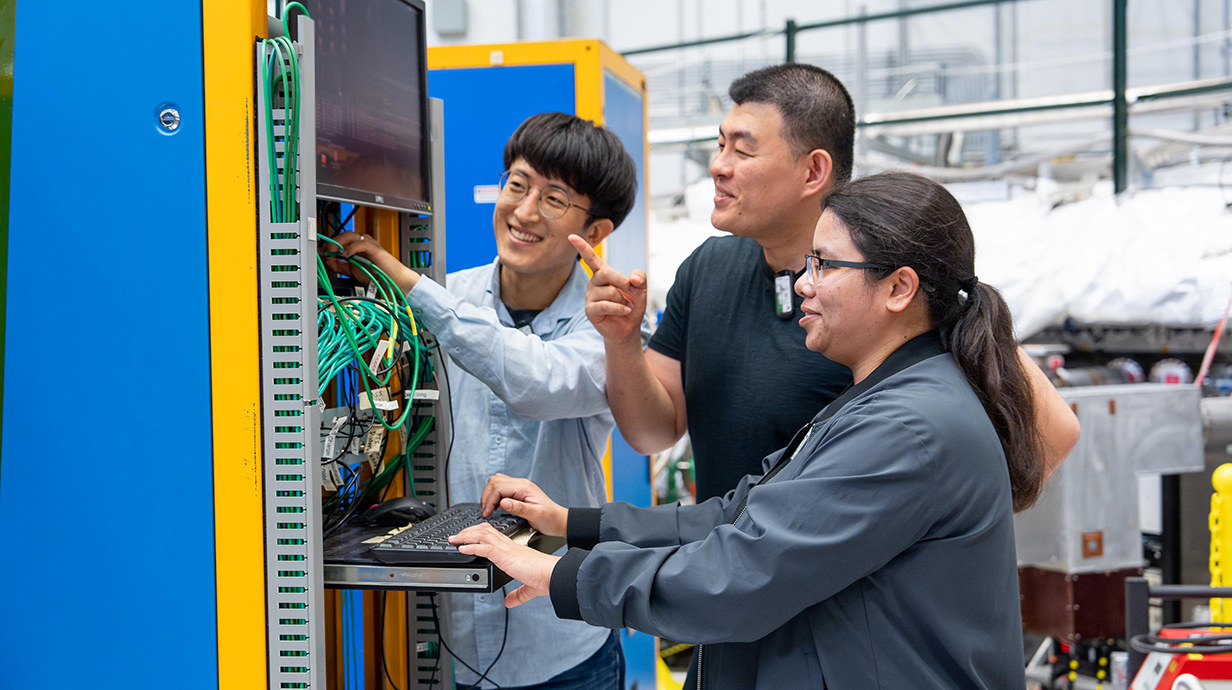
OXFORD, Miss. – An international team of researchers – including several from the University of Mississippi – recently celebrated after being named the 2026 winners of the Breakthrough Prize in Fundamental Physics, one of the field's most prestigious awards.
This year's winners in the field of fundamental physics are the Muon g-2 Collaborations at CERN, Brookhaven National Laboratory and Fermilab. The Fermilab Muon g-2 experiment includes more than 270 scientists, postdoctoral researchers and graduate students from 34 institutions. Among them are nine current and former Ole Miss researchers.
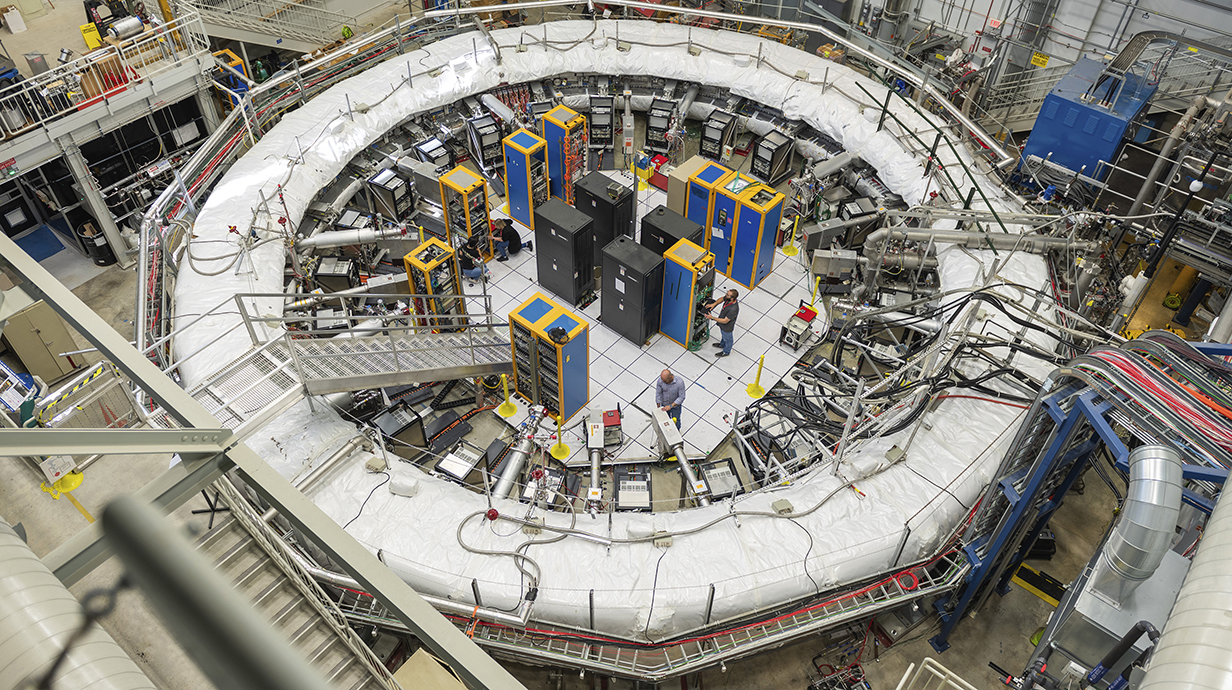
The core component of the Muon g-2 experiment at the Fermi National Accelerator Laboratory is a 50-foot superconducting electromagnet. Photo by Ryan Postel/Fermilab
"This recognition highlights the extraordinary work being done by our researchers and their collaborators around the world," said John C. Higginbotham, vice chancellor of research and economic development. "The Breakthrough Prize in Fundamental Physics is among the most prestigious awards in this field, celebrating discoveries that deepen our understanding of the universe.
"Receiving it reflects both the impact of the Muon g-2 experiment and the strength of research happening at the University of Mississippi."
The experiment, a culmination of more than 60 years of scientific advancement, sought to measure the movement of muons with more precision than ever before. The muon is a tiny subatomic particle similar to an electron, and studying its movement in a magnetic field could help researchers better understand the fundamental forces of the universe.
Breese Quinn, UM professor of physics and astronomy and director of the Center for Multimessenger Astrophysics, has worked with Fermilab for more than 35 years and on the Muon g-2 experiment for 13 years.
"This award was given for measuring the magnetic properties of the muon particle to a precision of 127 parts per billion," Quinn said. "That's the highest precision measurement of anything that has ever been achieved at a particle accelerator laboratory.
"That precision gives us the most stringent tests ever of the Standard Model of particle physics, which holds all we know about the fundamental building blocks of our universe and allows us to make the deepest searches yet for new physics."
The Breakthrough Prize is awarded to all current and former team members who worked on the experiment, meaning all the work performed by students and postdoctoral researchers is recognized, Quinn said.
"So much of the work that made this project successful was done by our early-career colleagues," he said. "Their names will not only be on the author list, but also forever attached to this amazing recognition of one of the greatest achievements in experimental science."
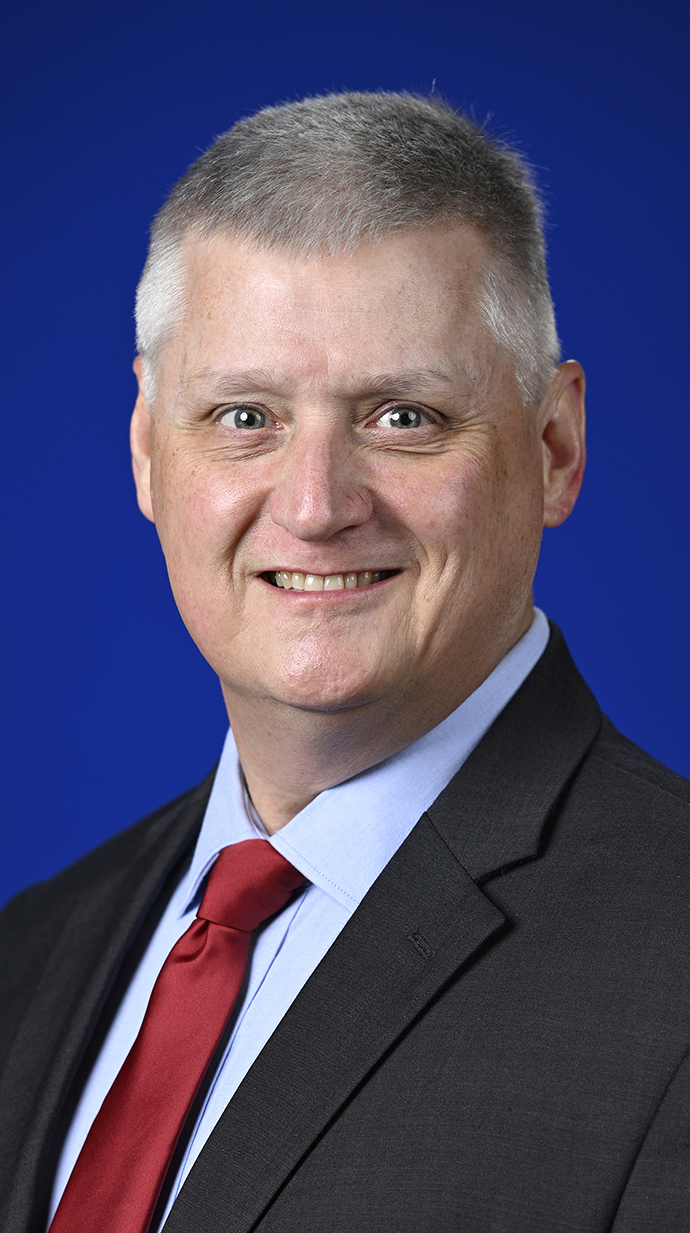
Besides Quinn, recipients from the university are:
- Meghna Bhattacharya (PhD 21)
- Jason Crnkovic, postdoctoral researcher
- Jenny Holzbauer, postdoctoral researcher
- Alex Keshavarzi, postdoctoral researcher
- On Kim, postdoctoral researcher
- Baisakhi Mitra (PhD 24)
- Wanwei Wu (PhD 18)
- Byungchul Yu, fifth-year doctoral student in physics from Suwon, South Korea.
Other students who have contributed to the Ole Miss Muon g-2 team's work are:
- Cooper Crawley (BS 24)
- Samyukta Krishnamurthy (BS 17)
- Zahin Rabbi, doctoral student in physics from Dhaka, Bangladesh
- Lane Taylor (BS 25)
- Samuel Osei-Nketiah, doctoral student in physics from Sekondi-Takoradi, Ghana.
Bhattacharya, who worked on Muon g-2 as a doctoral student while at Ole Miss, works at Fermi National Accelerator Laboratory as an applications physicist.
"Muon g-2 is definitely a huge part of who I am today as a scientist, how I approach challenges and how I bring a different perspective in my current role at Fermilab," she said. "It is a once-in-a-lifetime opportunity for a particle physicist to be a part of the whole process, right from when the Fermilab Muon g-2 experiment started taking data to when we first published our findings.
"This experience has truly set the foundation of my scientific endeavor."
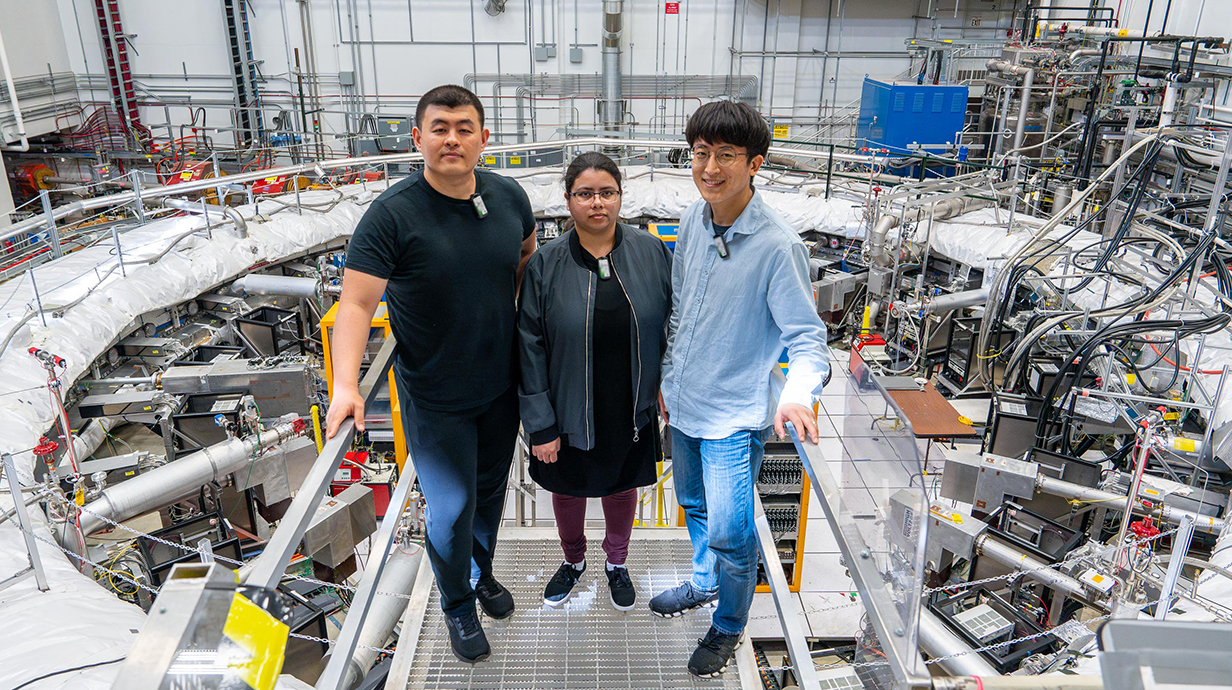
Current and former Ole Miss researchers Byunchgul Yu (left), Baisakhi Mitra and On Kim stand above the 50-foot electromagnet that is the heart of the Nuon g-2 experiment at Fermi National Accelerator Laboratory. Photo by Daniel Svoboda/Fermilab Creative Services
Though the data collection period for the Muon g-2 experiment ended in 2025, the work is continuing, Quinn said.
"The University of Mississippi group is now using that ultra-high precision data to make new physics discoveries," he said. "We are looking to see if there are hints of breakdowns in the fundamental symmetries of the universe, any cracks in the foundations of relativity and quantum mechanics.
"We're also searching for dark matter in ways that no one has ever attempted."
As the work continues, new scientists will get opportunities to be involved in high-level experiments as Bhattacharya was.
"This is a proud moment for me," she said. "It's incredible when I look back (at) all of the graduate students, postdocs, professors, scientists and engineers working together to make it happen. The Muon g-2 collaboration continues to be my second family. It's been a privilege to be part of the g-2 team.
"The recognition by the broader community is extremely gratifying and will inspire and encourage the future generation of scientists to push the boundaries of the secrets of the universe."
Top: Current and former UM researchers On Kim (left), Byungchul Yu and Baisakhi Mitra, all part of physics professor Breese Quinn's research team, work on Muon g-2, one of the world’s premier particle physics experiments. Researchers who worked on the Muon g-2 experiment at Fermilab were named the 2026 winners of the Breakthrough Prize in Fundamental Physics, one of the field's most prestigious awards. Photo by Daniel Svoboda/Fermilab Creative Services
By
Clara Turnage
Campus
Office, Department or Center
Published
May 11, 2026