
Researchers Use $2.6M Grant to Probe Mysteries of Universe
Funding supports Ole Miss researchers, students across international physics experiments
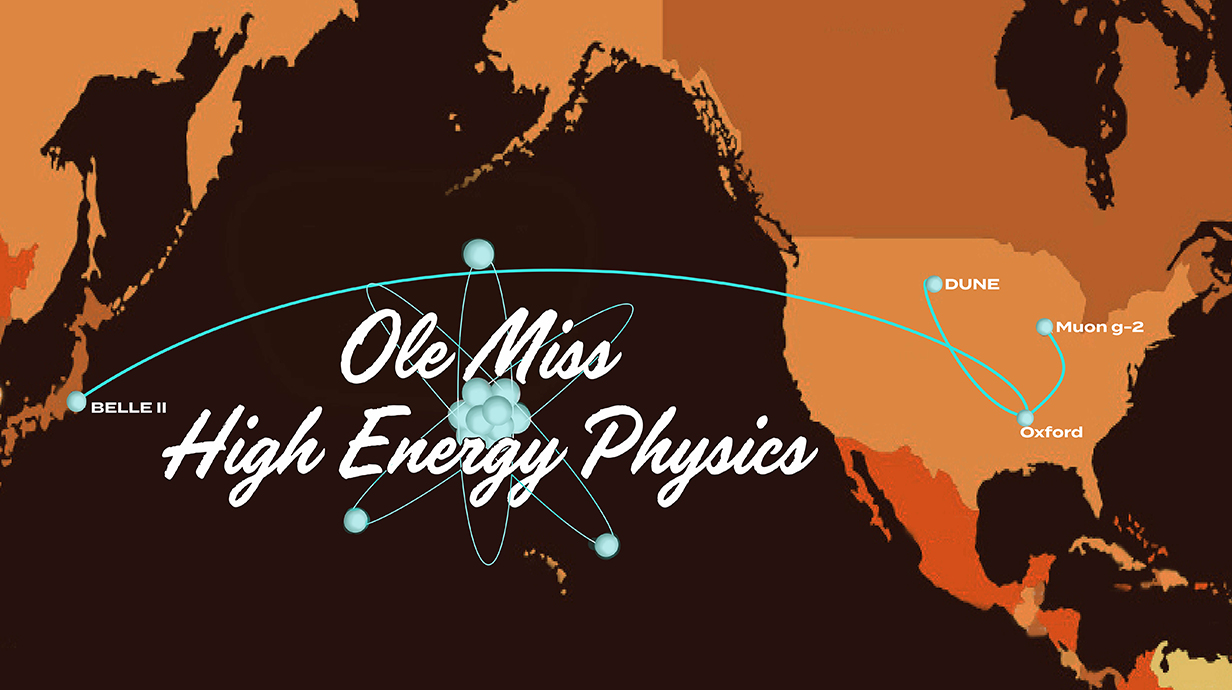
OXFORD, Miss. – University of Mississippi physicists will help continue the work of three international experiments in the search for new physics through a $2.6 million grant.
The U.S. Department of Energy will help fund four years of study for Ole Miss researchers Breese Quinn, Jake Bennett and Gavin Davies and their teams as they search for signs of undiscovered particles, forces or other phenomena that could challenge the current understanding of fundamental physics.
"This is by far the largest grant the Ole Miss high energy physics group has ever received," said Quinn, professor of physics and astronomy and director of the Center for Multimessenger Astrophysics. "When we put in this proposal, we requested three years. They gave us four. That is a strong signal of the quality of our plan and that they have confidence that we're going to deliver on these projects.
"Each of these studies holds potential for groundbreaking discoveries that could fundamentally change our understanding of the universe and open new arenas of scientific exploration."
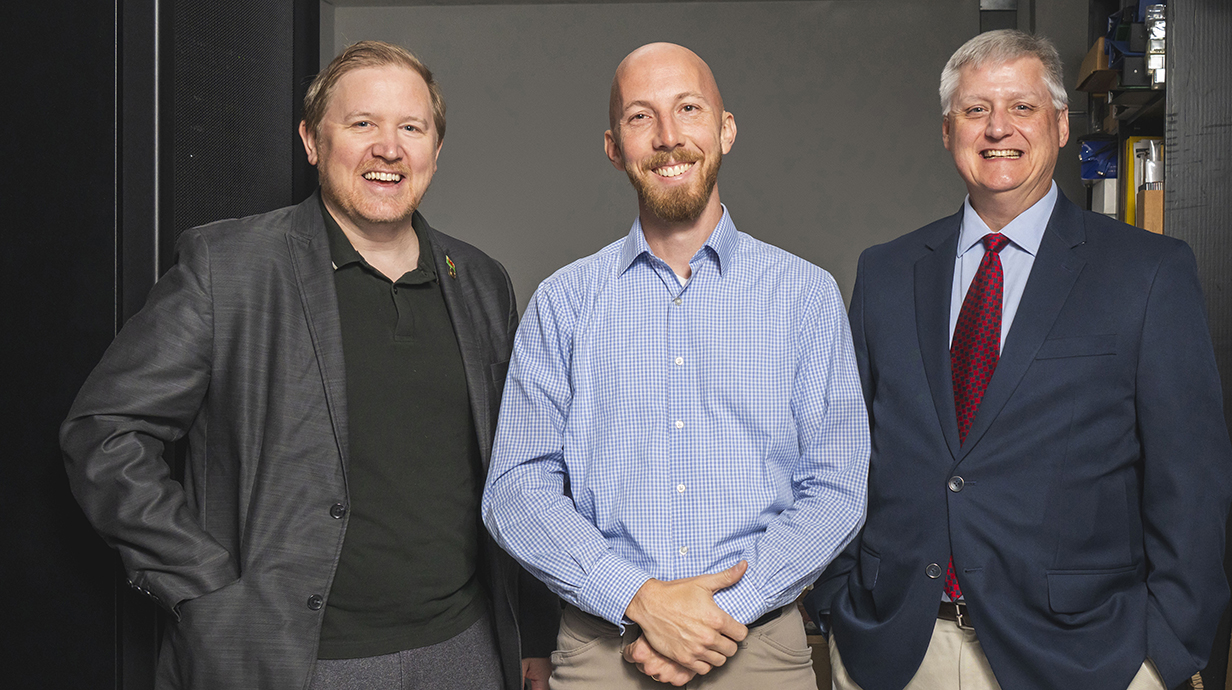
UM physicists (from left) Gavin Davies, Jake Bennett and Breese Quinn visit the new advanced computing hub on campus. The facility will help process and deliver vast amounts of data from the DUNE experiment to more than 1,500 researchers on the project. Photo by Srijita Chattopadhyay/ Ole Miss Digital Imaging Services
Each of the projects involves thousands of researchers around the world. They are searching for answers to mysteries in physics such as the nature of dark matter, why more matter is present in the universe than antimatter and whether undiscovered particles or forces are shaping the universe.
The grant will support undergraduate and graduate students, postdoctoral researchers and faculty across major experiments in the United States and Japan, including Muon g-2, Belle II and DUNE.
"The best thing to me about this grant is not just the physics that it will support or the experiments that it will support; it's the students that this will support," said Davies, associate professor of physics and astronomy. "This is offering them a chance to be a part of international experiments where they are making connections with some of physics' top researchers.
"It's not just that they're contributing to this work; it's that they're enhancing their employability beyond Ole Miss."
The Deep Underground Neutrino Experiment, called DUNE, will be the largest particle physics detector in history. The multistate project will send a beam of subatomic particles called neutrinos underground from Fermi National Accelerator Laboratory in Batavia, Illinois, more than 800 miles to Lead, South Dakota.
In Lead, engineers and scientists are working to build a detector facility more than a mile beneath the surface in a former gold mine. Quinn and his team will ensure that the equipment used to capture data about the passage of neutrinos work reliably under extreme conditions.
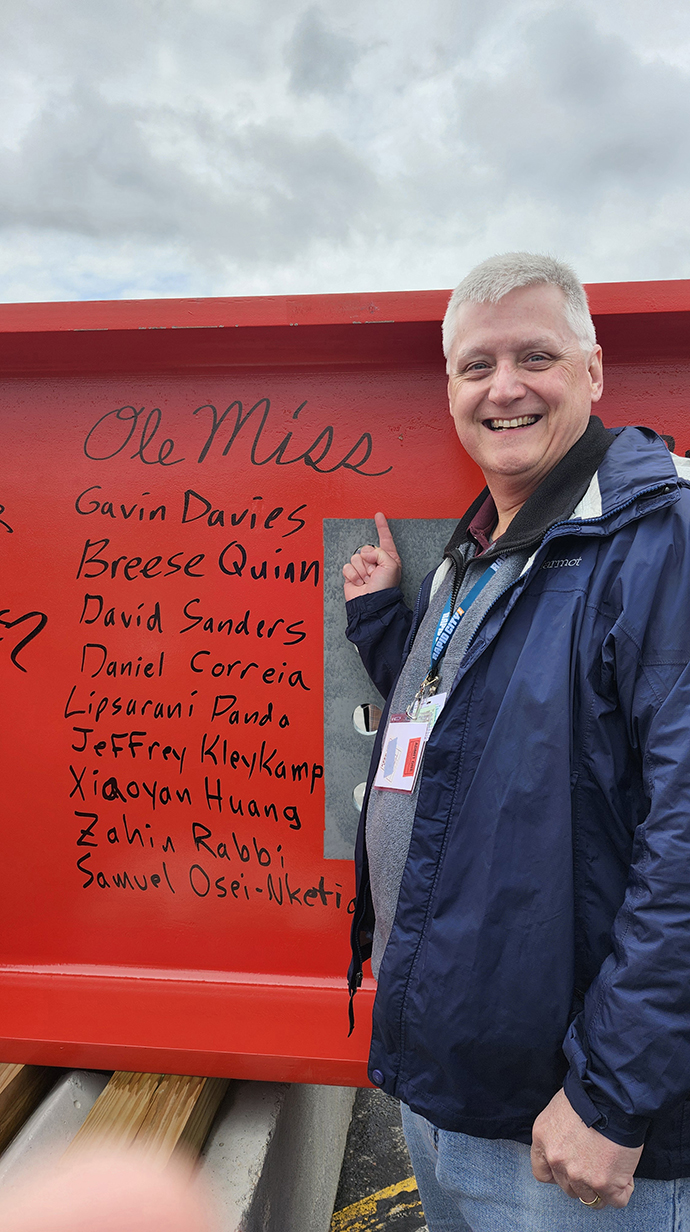
Breese Quinn shows off signatures of the Ole Miss physics team on a massive beam that will help support the DUNE detector facility in Lead, South Dakota. Many of the teams working on the international physics experiment signed beams going into the facility, being built in a former gold mine. Submitted photo
"These detectors are based on liquid argon, so, we're talking about electronics that have to work both at room temperature and at -321 degrees Fahrenheit," Quinn said. "And once you plug in those electronics in the detector and put them in the liquid, they can't be touched again for years and years.
"We have to test thousands of electronics components to an incredible level, and we only have a couple of years to do it."
The team has built a new lab in Lewis Hall for that testing. Having a facility to test equipment at cryogenic temperatures on campus will serve both the project and Ole Miss physics students, he said.
"Ever since I've worked at Fermilab, we've sent graduate students there to do work, and it's great experience, but undergraduates can't spend an extended period of time off-campus," he said. "This time, the work is happening here."
Fifteen students have already signed up to work in the lab and have begun orientation and training sessions to assist in testing.
"It's going to be really fantastic to have this opportunity for multiple years of undergraduate students working shifts and helping to build the biggest particle physics detector in the world," Quinn said.
Davies has been named the global software technical lead on DUNE and is charged with coordinating the software, infrastructure and collaboration-wide planning needed to translate massive amounts of raw information from the detectors into usable data available to researchers worldwide.
"My group is leading the software and computing aspect of DUNE," he said. "This project will need a huge amount of computing resources, and even as we're going through all of these updates in software, the physics capabilities have to stay the same."
Some of those computing resources will be on the Ole Miss campus. A $1.8 million Established Program to Stimulate Competitive Research grant in 2025 helped Davies, Bennett and Quinn create an advanced computing hub.
That hub will help process and deliver data from DUNE to more than 1,500 researchers working on the project.
"We're very close to being able to steer data through the Ole Miss cluster," he said. "In the next couple of months, we should see files coming in or going to labs across the globe.
"That means when any of those 1,500 people in their lab requests a file, there's a chance it would have been made here."
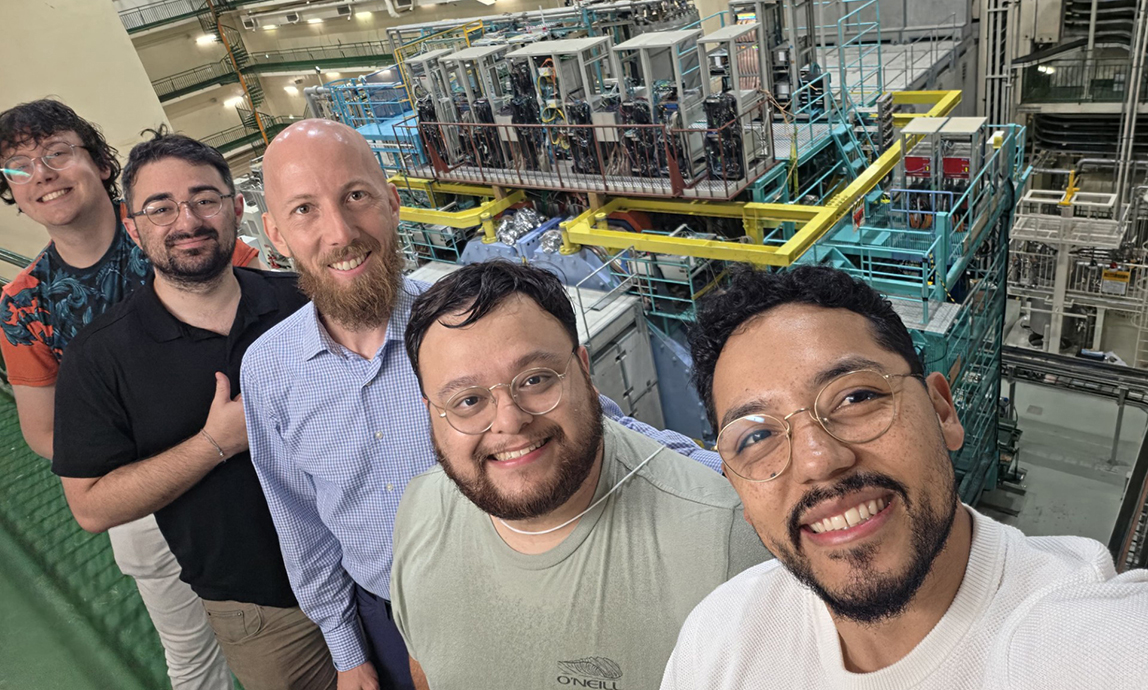
Jake Bennett (third from left), associate professor of physics and astronomy, gathers with his team at the Belle II experiment in the SuperKEKB collider in Tsukuba, Japan. Bennett's team includes (from left): doctoral physics students Logan Benninghoff and Paul Gebeline and postdoctoral researchers Quinn Campagna and Johan Colorado Caicedo. Submitted photo
While preparations are underway to open Ole Miss resources for the DUNE experiment, existing Ole Miss computing infrastructure has been used through the Open Science Grid by existing experiments such as Belle II in Japan.
The Belle II experiment replicates the high energy environment of the early universe shortly after the Big Bang. When matter and antimatter collide, the particles and antiparticles annihilate one another, converting matter into energy.
This process is exactly what the Belle II experiment uses when it collides beams of electrons, a fundamental matter particle, and positrons, a fundamental antimatter particle.
"When an electron and positron meet, they turn into energy, and from that high-energy environment, exotic, short-lived particles can be created," Bennett said. "Then we try to infer what happened at the collision point to understand something about these exotic particles that are created and live for a very short time."
Belle II, housed at the SuperKEKB collider in Tsukuba, Japan, is the world's largest electron-positron collider and holds the world record for instantaneous luminosity, a measure of information collection. It has more than 1,200 researchers from 27 countries working on the project.
Bennett's group is studying data from Belle II to understand matter-antimatter asymmetry, or why there is more matter than antimatter in the universe.
"If you think about the Big Bang, that's pure energy, just like when we collide an electron and positron," Bennett said. "But it follows the reverse process. Energy can make matter and antimatter, but it has to be at the same amount.
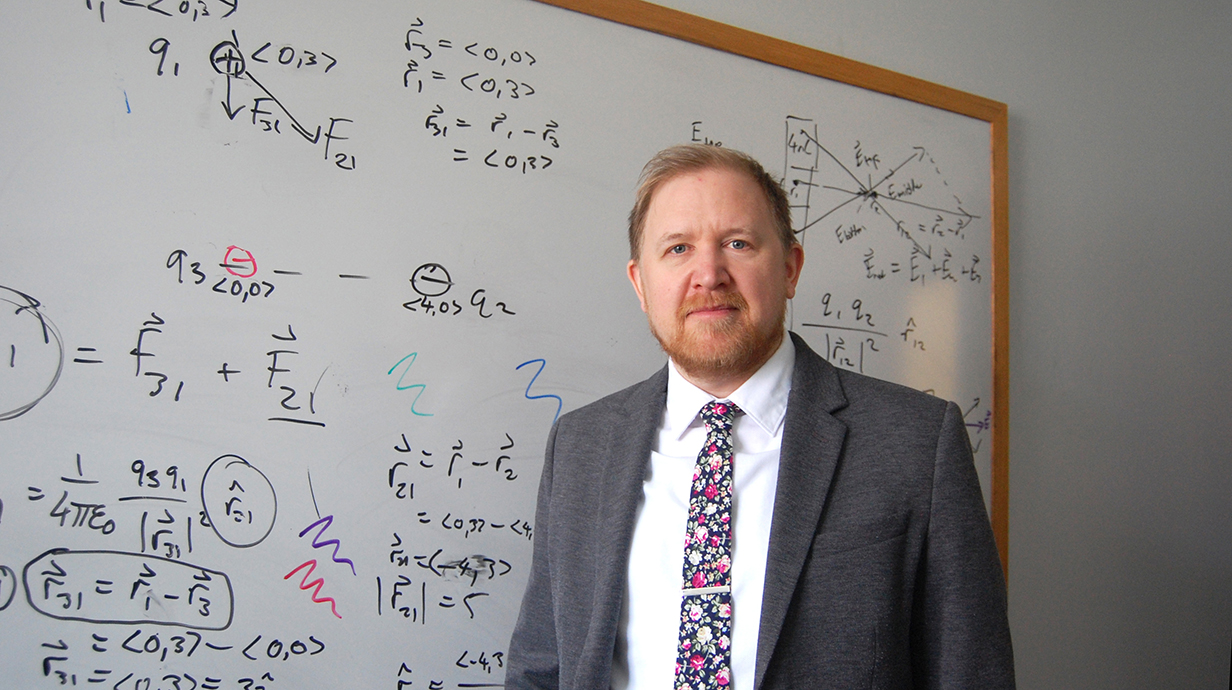
Gavin Davies, assistant professor of physics, has been named the global software technical lead on Fermilab's Deep Underground Neutrino Experiment, known as DUNE. Photo by Clara Turnage/ University Marketing and Communications
"From the Big Bang, you create equal amounts of matter and antimatter, and yet we look around, and the universe as we know it is only made of matter. How can that be?"
Bennett's group is studying rare particle decays that may shed light on that question.
Bennett's group will also be responsible for much of the software that Belle II analysts around the world use to access and study data from the experiment.
"This grant will support not only the work of students who are studying physics, but also those who are making sure the experiment works," he said. "There are huge, huge amounts of data that need to be processed and that analysts need to access, so we are developing and maintaining the software that will allow that to happen."
The Muon g-2 experiment earlier this year won the 2026 Breakthrough Prize in Fundamental Physics for measuring the movement of tiny, subatomic particles called muons with more precision than ever before.
Although the data gathering phase of the Muon g-2 experiment has ended, the work has not, Quinn said.
"The Ole Miss group is using the data from Muon g-2 to search for new physics, specifically looking for dark matter and violations of the symmetries of the universe," he said. "There is five times more dark matter than normal matter in the universe, but we still don't know what it is.
"One idea is that we could find evidence of dark matter in the Muon g-2 data."
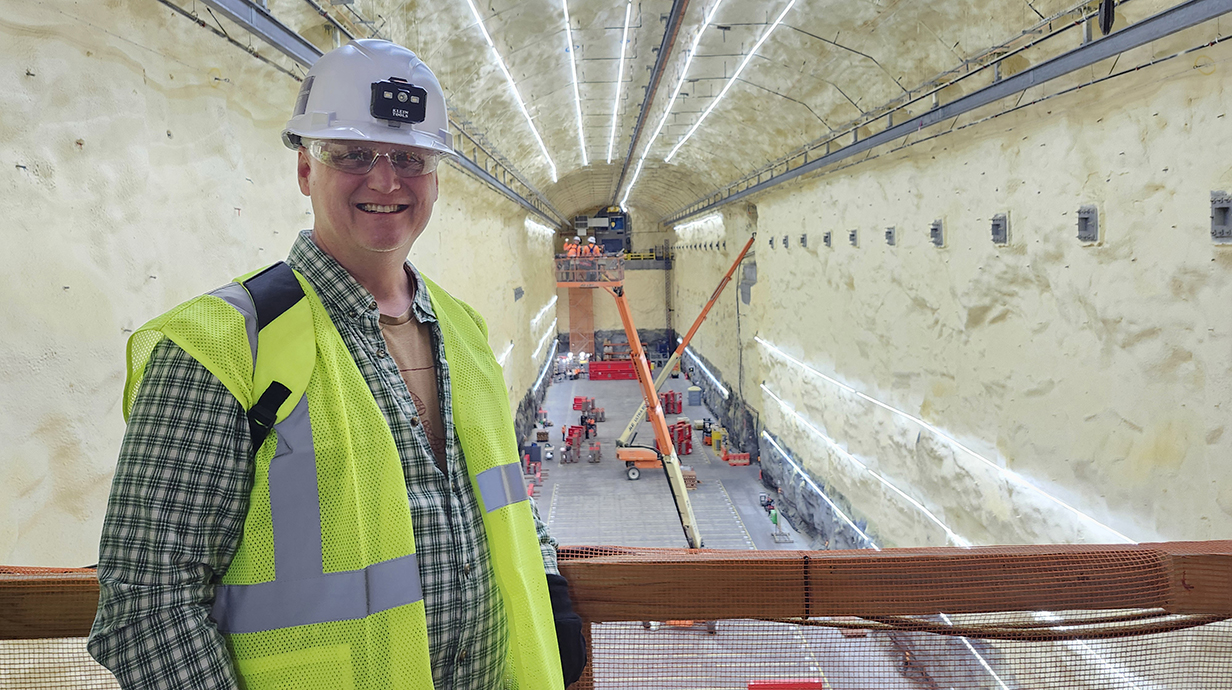
Breese Quinn works in the detector site of DUNE, an international neutrino experiment being built near Lead, South Dakota. Housed in a former gold mine more than a mile underground, the DUNE detector site stretches 10 stories tall. Submitted photo
The researchers will also look for variations in the Muon g-2 data from hour-to-hour and year-to-year. If such a variation exists, it could point physicists toward a previously unaccounted force in the universe.
Together, the projects give Ole Miss students and early-career researchers opportunities to contribute to major international experiments, building experience in both physics research and the computing systems that support it, Bennett said.
Bennett's first postdoctoral researcher is a staff scientist at Brookhaven National Lab, and his first graduate student is working as a staff scientist at Jefferson Lab. One of his current students is working in the largest particle physics laboratory in Japan through a fellowship, and several other students have done the same.
"The thing that helped my students and postdocs get the jobs they have now is that they were doing high-impact work in a field where everyone in the experiment is aware of how important these tools are," Bennett said.
"This is what we can offer our students now, in physics analysis, hardware, software and computing."
This material is based on work supported by the Department of Energy grant no. DOE DE-SC002161.
Top: A $2.6 million grant from the U.S. Department of Energy is allowing Ole Miss researchers to continue their work on three landmark physics experiments with collaborators from around the world. The grant supports undergraduate and graduate students, postdoctoral researchers and faculty working on the Muon g-2, Belle II and DUNE projects in the United States and Japan. Graphic by Clara Turnage/University Marketing and Communications
By
Clara Turnage
Campus
Office, Department or Center
Published
October 26, 2026