
University Opens First Campus Black Soldier Fly Composting Facility
Partnership with MDEQ to help set standard for Mississippi composting
OXFORD, Miss. – The University of Mississippi Office of Sustainability is turning food waste into fertilizer through a new facility that could help establish standards for similar operations across the state.
Ole Miss, Aramark and the Mississippi Department of Environmental Quality recently partnered to create the state's first black soldier fly composting facility that recycles campus waste.
"Our goal was just to reduce food waste on campus, but because this is the first of its kind in the state, MDEQ will build the regulatory process based on what we create," said John Brugge, director of the Office of Sustainability. "We're helping develop these processes for Mississippi, and we want to build a process that any farmer in Mississippi can replicate."
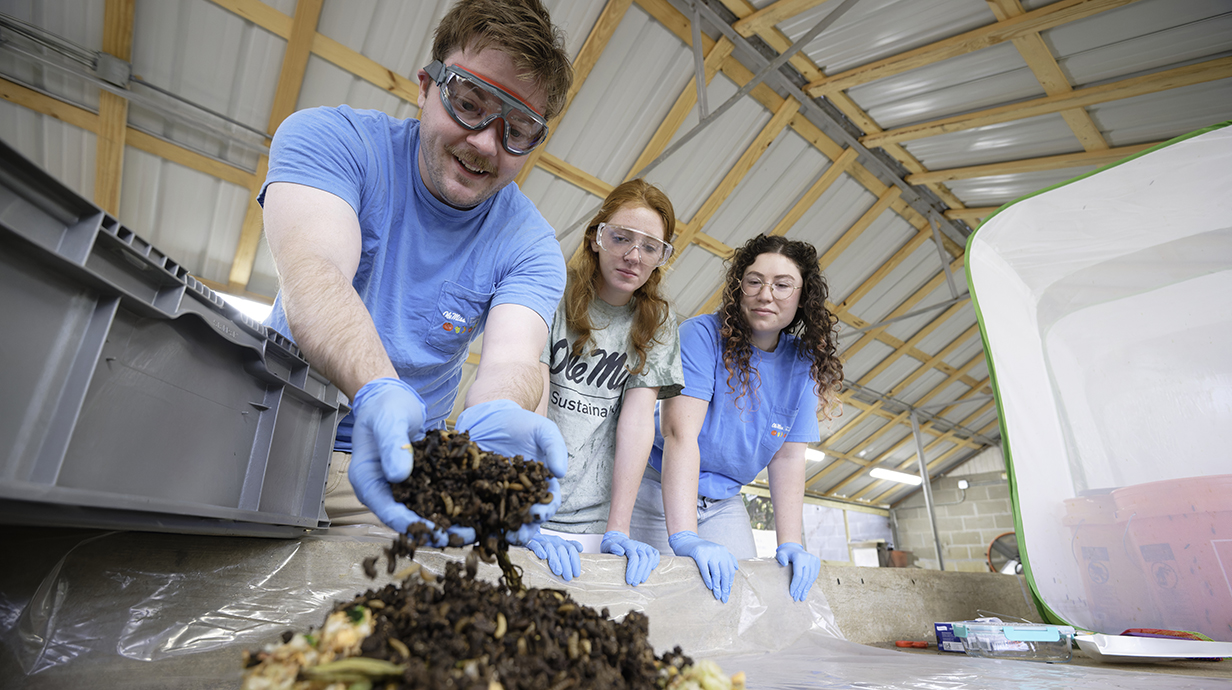
John Brugge, director of the university's Office of Sustainability, places handfuls of black soldier fly larvae onto ground food waste while students Sydney Spaulding and Emma Pondzinski observe. The larvae and flies eat the food and turn it into frass, a fertilizer for soil. Photo by Hunt Mercier/Ole Miss Digital Imaging Services
The U.S. Food and Drug Administration estimates some 40% of the U.S. food supply goes to waste every year. Most of that discarded food goes to landfills.
Mississippi regulations governing composting are similar to those governing landfills, making it difficult to establish new composting programs. Jennifer Wells, state recycling coordinator, said the department has been working to address that challenge.
"We are still in the process of revising those regulations, but we have authorized composting facilities throughout the state under (a) pilot program," she said. "However, UM's new composting facility plan of using black soldier flies is not something we have encountered before."
The department wants to make sure that future black soldier fly composting facilities do not present environmental concerns such as odors, noise or stormwater run-off contamination, Wells said.
"With all these questions, MDEQ decided to treat UM's composting operation as a research project of sorts," she said. "We will work alongside UM's Office of Sustainability on learning how to apply regulations in a way that allows for this sustainable practice to grow and thrive but also protects the environment and public health."
Brugge and students working in the office have raised an army of black soldier flies in the Department of Biology greenhouse on Vaught Lane, which they have converted into the new compost facility through $50,000 in support from Aramark. The food waste to feed those flies will come from Rebel Market and other campus eateries.
Ole Miss Dining operates 24 locations and a food truck program, serving roughly 12,000 to 14,000 meals daily, said Chip Burr, resident district manager for Ole Miss Dining.
"Even small amounts of waste at each stage of prep and service add up quickly," he said. "We work very hard to prevent waste by emphasizing accurate forecasting, portion control, and waste tracking, but some waste is unavoidable.
"This facility provides a location to send waste that can benefit the campus and community. Instead of heading to a landfill, it is turned into compost, which helps close the loop in our food lifecycle."
In the greenhouse, the broccoli stems, leftover or spoiled meat and other food products that humans turn their noses up at are a feast for black soldier flies, an insect native to Mississippi, Brugge said.
"They are detritivores, which means that they eat just about everything," he said. "So, the concept is simple: turn food waste into bugs, and the bugs create usable materials."
When black soldier flies eat food waste, they create frass, a mixture of insect waste and molted skins that makes soil healthier and more fertile. The flies themselves can also be used as a protein source in food for livestock such as chickens, turkeys and catfish.
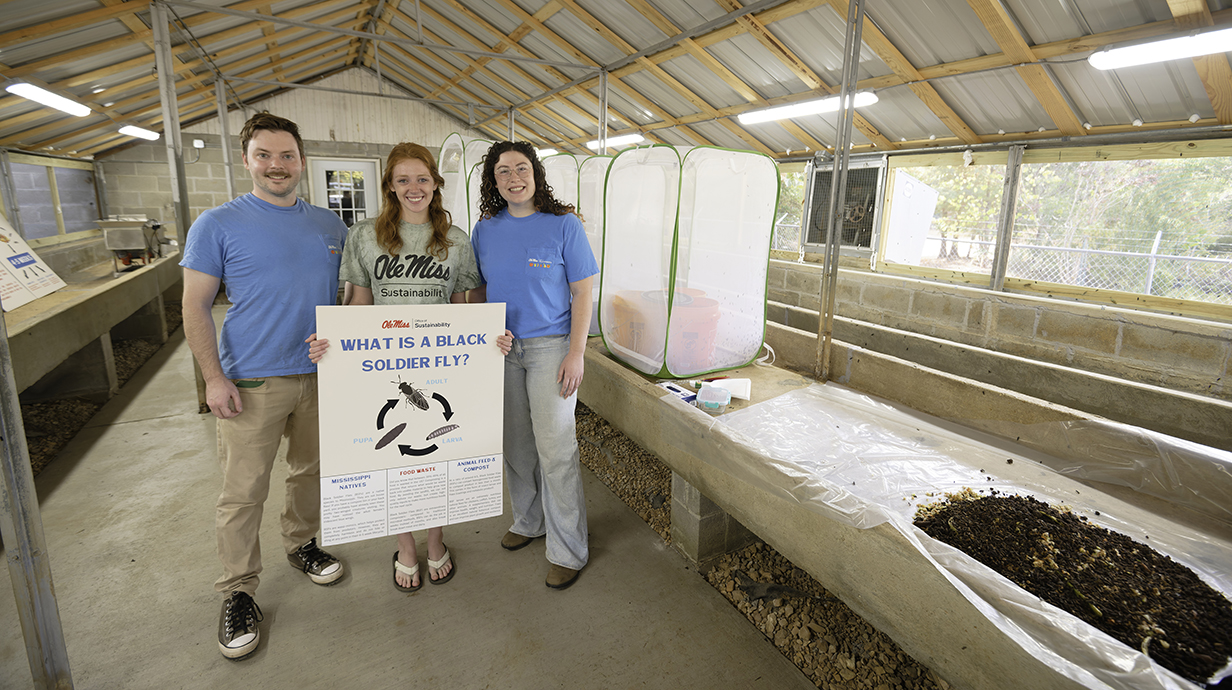
John Brugge (left) and Ole Miss students Emma Prondzinski and Sydney Spaulding show off the renovated composting facility on campus. The project is the first in the state to use native black soldier flies to recycle food waste from campus dining operations. Photo by Hunt Mercier/Ole Miss Digital Imaging Services
Until the state establishes regulations for this type of composting, the frass the Ole Miss bugs create will be used for flower gardens and ecology projects on campus, Brugge said.
"We've hosted volunteer events, asked community partners for help, dealt with contractors, worked with students and other departments," said Emma Prondzinski, a senior public health major from Jonesboro, Arkansas. "It's been such a learning experience, and I feel like it was a great way to learn how to take sustainability into real life."
After breeding black soldier flies all summer, the students recently fed the first 50 pounds of food to the flies. The initial goal is to recycle one ton of food per month as the bug population grows, with a long-term goal of recycling up to 10 tons per month.
"In my classes, it can be really easy to see the problem of climate change as super overwhelming and too big to do anything about," said Sydney Spaulding, a senior from St. Louis majoring in environmental studies and marketing. "But this has been a really eye-opening way to see that you can start small.
"This started as a tiny operation a couple of months ago, and we've gotten to the point that we can reduce the waste of our university at a regular pace. It's a small effort that's grown into something much bigger, and it's making a difference."
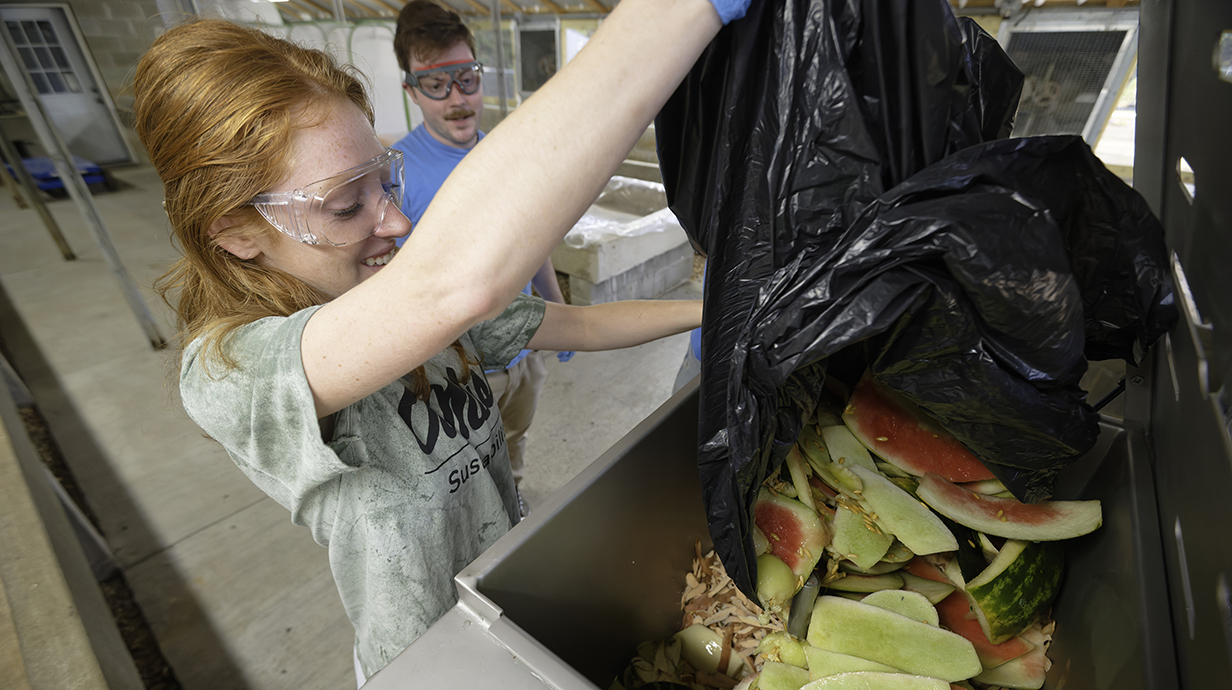
Top: Emma Prondzinski, a senior public health major, tosses leftover food into a hopper that will feed black soldier flies and larvae in a new composting facility on campus. The university is working with the Mississippi Department of Environmental Quality to revise regulations on composting facilities and make it easier for other universities to set up their own operations. Photo by Hunt Mercier/Ole Miss Digital Imaging Services
By
Clara Turnage
Campus
Office, Department or Center
Published
November 18, 2026