
Dr. Alexandra Lindgren-Gibson is an Associate Professor of History in the Department of History at the University of Mississippi.
Research Interests
Dr. Lindgren-Gibson's research specializes in the social and cultural history of modern Britain and empire. She focuses on how the things that shape everyday life–what you eat, where you live, how you work, and who you love–intersect with big historical questions about class, gender, race, empire, and power. She is the author of Working-Class Raj: Colonialism and the Making of Class in British India (Cambridge, 2023), as well as articles published in the Journal of Colonialism and Colonial History and Victorian Studies.
She is currently at work on a project about the early history of social housing in the British Empire. Her work has been supported by the UM College of Liberal Arts, the Sarah Isom Center for Women & Gender Studies, the Humanities Center at the University of Rochester, and the Charlotte W. Newcombe Foundation, among others.
Biography
Alexandra Lindgren-Gibson is an associate professor of modern European history, specializing in the social and cultural history of modern Britain and empire. She received her PhD in history from Northwestern University and her MA with a specialization in Public History from Arizona State University.
Dr. Lindgren-Gibson teaches undergraduate courses in modern European history, British history, gender history, public history, and the global history of food, as well as in the Honors 101/102 sequence. She teaches graduate courses in European historiography, the British Empire, and public history. She enjoys working with students to create public-facing projects. Students in her public history and food history courses have developed websites on the history of Neilson's Department Store and food blogs featuring family recipes. Her History on Location students have worked with the M Partner community engagement program to develop a walking/driving tour for the MB Mayfield House in Ecru, MS.
Publications
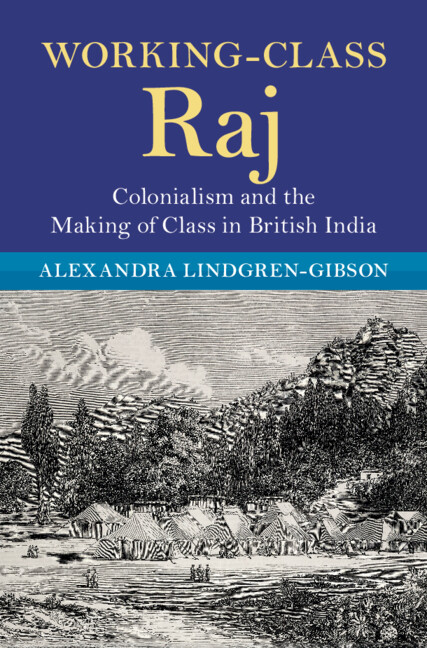
Colonialism and the Making of Class in British India
From the publisher:
Focusing on the military men, railway workers, and wives and children of the British working-class who went to India after the Rebellion of 1857, Working-Class Raj explores the experiences of these working-class men and women in their own words. Drawing on a diverse collection of previously unused letters and diaries, it allows us to hear directly from these people for the first time. Working-class Brits in India enjoyed enormous privilege, reliant on native Indian labour and living, as one put it, "like gentlemen." But within the hierarchies of the Army and the railyard they remained working class, a potentially disruptive population that needed to be contained. Working in India and other parts of the empire, emigrating to settler colonies, often returning to Britain, all the while attempting to maintain family ties across imperial distances-the British working class in the nineteenth century was a globalised population. This book reveals how working-class men and women were not atomised individuals, but part of communities that spanned the empire and were fundamentally shaped by it.
Selected Article(s):
Courses Taught
- HIST 1210 Intro to European History Since 1648
- HIST 1990 What is History?: British Empire
- HIST 3390 British Empire and Commonwealth
- HIST 3490 Society and the Sexes in Modern Europe
- HIST 4600 Public History
- HIST 4610 History on Location
- HIST 4920 Problems in History - World
- HIST 5520 Historiography of Europe Since 1789
- HIST 5950 Introduction to Public History
- HIST 6410 Readings in Global History: Gender
- HIST 6600 Readings in Gender History of Modern Europe
- HIST 701 Research - US through the Civil War
- HONR 1010 Freshman Honors I
- HONR 1020 Freshman Honors II
Education
Ph.D. History, Northwestern University (2016)
Recognitions
- Howell Family Outstanding Teacher of the Year, UM College of Liberal Arts, 2026