Dr. Peter Thilly is an Associate Professor of History in the Department of History at the University of Mississippi. He is Director of the interdisciplinary minor in East Asian Studies.
Research Interests
Dr. Peter Thilly is a historian of Modern China with research and teaching interests Qing and Republican Chinese history, Japanese and British imperialism, migration, citizenship, global capitalism, and comparative legal cultures.
Professor Thilly’s first book, The Opium Business: A History of Crime and Capitalism in Maritime China (Stanford University Press, 2022), is a social history of business-state relations during the rise of global capitalism. It traces the rise and transformation of the opium trade in coastal southern Fujian province, first from contraband to tax staple, and then mutating in the early twentieth century into something that was simultaneously a prohibited commodity, political symbol, and the financial engine of a wide range of regimes: warlords, Guomindang state builders, colonial states in maritime Southeast Asia, and in the very end, the Japanese occupation government.
He is now working on a book about the 1853 Small Sword Rebellion and its relationship to the history of diaspora, migration, and citizenship. Professor Thilly's June 2017 article in Late Imperial China, "Opium and the Origins of Treason in Modern China: The View from Fujian," explains how opium traders came to personify treason during the most critical moment in the crystallization of modern Chinese nationalism – the Opium War of 1839-41. His article, "The Fujisturu Mystery: Translocal Xiamen, Japanese Expansionism, and the Asian Cocaine Trade, 1900-1937," highlights the role of opportunism and entrepreneurial within the wider history of state efforts to control trade in maritime Asia. Thilly is also a contributor to the Bodies and Structures 2.0 digital history project, and was co-editor of a special issue of Cross-Currents: East Asian History and Culture Review, entitled "Taiwan: Global Island."
Biography
Dr. Peter Thilly earned the BA in East Asian Studies from Wesleyan University, MA in Social Sciences from the University of Chicago, and the PhD in History from Northwestern University. From 2012-13 he was a Senior Visiting Scholar at the Institute of Qing History, Renmin University of China, Beijing. He was a Faculty Fellow at Colby College from 2015-16 and Teagle Teaching Fellow at Northwestern University. He was an ACLS Postdoctoral Fellow in Chinese Studies at the Henry Luce Foundation, and IHR-Mellon Pre-Dissertation Fellowship in the Humanities at the Institute of HistoricalResearch (IHR), University of London.
Publications
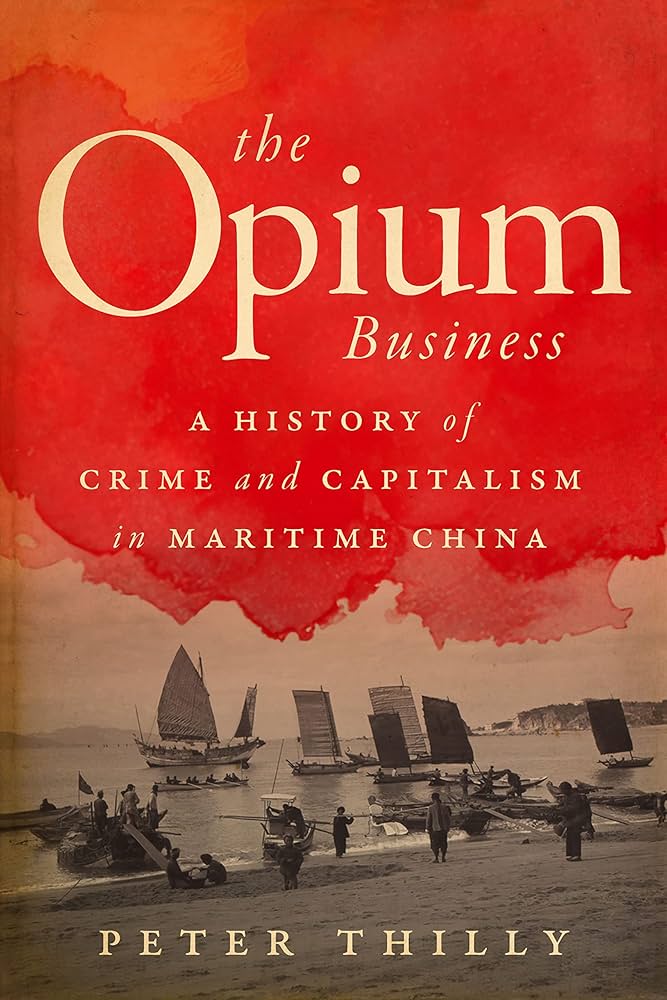
A History of Crime and Capitalism in Maritime China
From the publisher:
From its rise in the 1830s to its pinnacle in the 1930s, the opium trade was a guiding force in the Chinese political economy. Opium money was inextricably bound up in local, national, and imperial finances, and the people who piloted the trade were integral to the fabric of Chinese society. In this book, Peter Thilly narrates the dangerous lives and shrewd business operations of opium traffickers in southeast China, situating them within a global history of capitalism. By tracing the evolution of the opium trade from clandestine offshore agreements in the 1830s, to multi-million dollar prohibition bureau contracts in the 1930s, Thilly demonstrates how the modernizing Chinese state was infiltrated, manipulated, and profoundly transformed by opium profiteers.
Selected Article(s):
Courses Taught
- HIST 1800 Introduction to East Asian History
- HIST 3800 Pre-Modern China
- HIST 3870 Modern Japanese History
- HIST 4920 Topics in World History (Crime and Punishment in Modern China)
- HIST 5500 Historical Methods and Philosophy of History
- INST 2030 East Asian Studies
Education
Ph.D. History, Northwestern University (2015)
Recognitions
- Mike L. Edmonds New Scholar Award, UM College of Liberal Arts, 2024
- Fulbright Research Scholar, US Department of State, 2012-13