
How to Apply to Graduate School: Step-by-Step Application Guide
Applying to graduate school can feel overwhelming at first. Between transcripts, recommendation letters, test scores, personal statements, and application fees, there are a lot of moving parts to keep track of.
APPLICATION TIMELINE
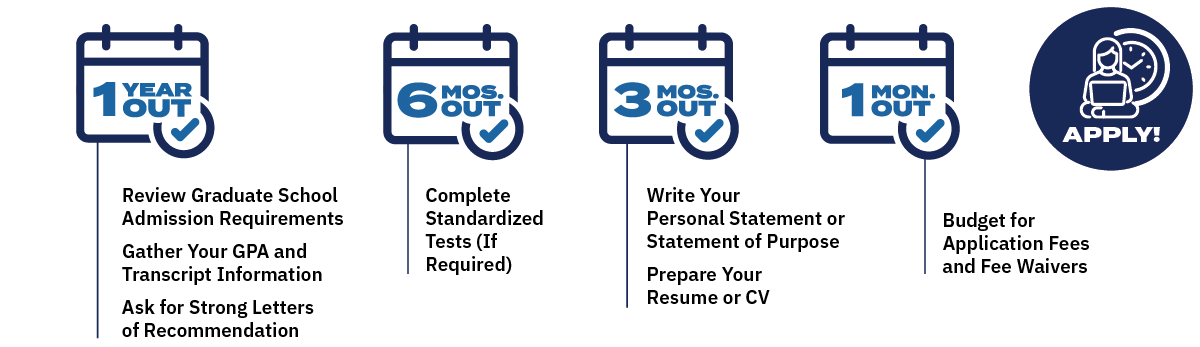
Step 1: Review Graduate School Admission Requirements
The first step in applying to graduate school is researching graduate program requirements carefully.
Different graduate programs may require different:
GPA minimums
Test scores
Application essays
Recommendation letters
Deadlines
Research experience
Portfolios or writing samples
For example, one graduate program may require three letters of recommendation and GRE scores, while another may waive standardized testing entirely.
Pay close attention to:
Application deadlines
Required materials
Faculty research interests
Funding opportunities
Program format (online, hybrid, or in-person)
The more familiar you are with the graduate admissions process early on, the easier it will be to stay organized.
Step 2: Gather Your GPA and Transcript Information
What GPA Do You Need for Graduate School?
Most graduate programs prefer applicants with a GPA of 3.0 or higher, although requirements vary by school and program. Some graduate programs may consider lower GPAs if applicants demonstrate research experience, professional achievement, or significant academic improvement over time.
Your transcript tells graduate admissions committees about:
The courses you completed
Your academic interests
Your performance over time
Trends in your academic growth
Your GPA helps graduate schools evaluate your readiness for graduate-level coursework.
GPA typically works on a 4.0 scale. A 4.0 GPA is generally equivalent to straight A grades, while lower GPAs reflect a mix of grades across courses.
Admissions committees often look beyond the number itself.
For example:
A student who struggled early in college but improved dramatically later may still be viewed as a strong candidate.
A student with a lower GPA but significant research, internship, leadership, or conference experience may stand out during the graduate admissions review process.
Graduate schools are not simply evaluating numbers. They are evaluating your potential.
Can You Get Into Graduate School With a Low GPA?
Yes, it is possible to get into graduate school with a lower GPA.
Admissions committees often evaluate applications holistically, meaning they consider:
Research experience
Professional accomplishments
Recommendation letters
Writing quality
Academic improvement over time
Leadership experience
Personal resilience
A lower GPA does not automatically prevent admission, especially if the rest of your application materials are strong.
If your GPA does not reflect your current abilities, use your statement of purpose or personal statement to provide meaningful context.
How Do You Send Transcripts to Graduate Schools?
Most graduate applications require either official transcripts or unofficial transcripts.
Official Transcripts
Official transcripts are sent directly from your undergraduate institution to the graduate school.
Important things to know:
They may cost between $5 and $50
Processing times vary
Delivery may take days or weeks
Some schools only accept digital copies
Unofficial Transcripts
Unofficial transcripts are usually free and sent directly to you for review purposes.
Some graduate programs allow unofficial transcripts during the initial review stage and request official transcripts after admission decisions are made.
Step 3: Ask for Strong Letters of Recommendation
How Many Letters of Recommendation Do You Need for Graduate School?
Most graduate programs require two to three letters of recommendation.
Recommendation letters help graduate admissions committees understand:
Your work ethic
Academic ability
Research potential
Professional skills
Character and perseverance
The best recommendation letters come from people who:
Have worked closely with you
Understand your academic or professional growth
Are invested in your future success
Can provide detailed examples of your strengths
Good recommendation letter writers may include:
Professors
Academic advisors
Research mentors
Supervisors or employers
You don’t need the most famous professor on campus. You need someone who genuinely knows your work and can speak thoughtfully about your abilities.
A detailed and sincere recommendation letter is usually far more valuable than a generic letter from someone with an impressive title.
Step 4: Complete Standardized Tests (If Required)
What Is the GRE?
The Graduate Record Examination (GRE) is one of the most common graduate admissions tests.
The GRE includes:
Analytical writing
Verbal reasoning
Quantitative reasoning
The quantitative reasoning section often evaluates algebra, arithmetic, geometry, and data analysis skills.
Do You Need the GRE for Graduate School?
Not all graduate schools require the GRE anymore. However, some graduate programs still use standardized tests as part of the admissions process.
Always check the specific requirements for your graduate program.
Other Graduate School Admission Tests
Some graduate programs require field-specific tests instead of — or in addition to — the GRE.
Common examples include:
GMAT for business school
LSAT for law school
MCAT for medical school
DAT for dental school
OAT for optometry programs
Make sure you understand:
Which exams are required
Minimum score expectations
Testing deadlines
Whether your program is test-optional
Step 5: Write Your Personal Statement or Statement of Purpose
What’s the Difference Between a Personal Statement and a Statement of Purpose?
A personal statement focuses on your personal experiences, motivations, and challenges.
A statement of purpose focuses on your academic interests, research goals, and professional future.
Some graduate programs ask for one document, while others require both.
How to Write a Personal Statement for Graduate School
A personal statement answers the question:
“Who are you as a person?”
Strong personal statements often discuss:
Personal growth
Challenges overcome
Motivation for graduate school
Values and goals
Experiences that shaped your academic interests
Your goal is not to sound dramatic or overly creative. Your goal is to sound thoughtful, honest, and self-aware.
Admissions committees want to understand the person behind the transcript and test scores.
How to Write a Statement of Purpose
A statement of purpose answers questions like:
What do you want to study?
What research interests you?
Why are you a good fit for this graduate program?
What are your career goals?
A strong statement of purpose should explain:
Your academic interests
Relevant experience
Faculty or labs you want to work with
Long-term professional goals
Why the university is a good fit for you
Unlike the personal statement, the statement of purpose should usually sound more direct and professional.
Step 6: Prepare Your Resume or CV
Should You Submit a Resume or CV for Graduate School?
Some graduate programs ask for a resume, while others ask for a curriculum vitae (CV).
The two documents serve different purposes.
Academic CV
An academic CV focuses on:
Research
Publications
Presentations
Teaching experience
Academic awards
Scholarships
Conferences
CVs are more common in research-heavy graduate programs and doctoral applications.
Professional Resume
A professional resume focuses on:
Work experience
Professional accomplishments
Technical skills
Leadership experience
Industry knowledge
Resumes are more common for professional graduate programs.
Whenever possible, quantify your accomplishments clearly.
Instead of:
“Helped with student outreach”
Try:
“Coordinated outreach events attended by more than 200 students”
Specificity strengthens your application materials.
Step 7: Budget for Application Fees and Fee Waivers
How Much Do Graduate School Applications Cost?
Graduate school application fees commonly range from $50 to $150 per application.
If you apply to multiple programs, costs can add up quickly.
Can You Get a Graduate School Fee Waiver?
Many graduate schools offer fee waivers for eligible students.
You may qualify if:
You demonstrate financial need
You are a military veteran
You participated in certain academic programs
You attended recruitment events or informational sessions
Some departments also offer their own fee waivers that are not heavily advertised on the graduate school website.
FAQs
Most students should begin researching graduate programs at least 12 to 18 months before their intended enrollment date.
This gives you enough time to:
Research programs
Build relationships with recommenders
Prepare for standardized tests
Write application essays
Request transcripts
Many students apply to between 5 and 10 graduate programs depending on competitiveness, funding opportunities, and career goals.
A balanced list often includes:
Reach schools
Competitive match schools
Safer options
No. Many graduate programs have become test-optional or eliminated GRE requirements entirely.
Always check the graduate admissions page for the most up-to-date requirements.
Strong graduate school applications typically include:
Clear academic goals
Strong writing
Meaningful recommendation letters
Relevant experience
Evidence of growth and motivation
Alignment with the graduate program