
Southern Folk Art Collection
Explore Southern folk art that uses non-traditional materials and bold, expressive imagery to capture everyday life, faith, and cultural history of the American South in the late 19th and 20th centuries.
About the Collection
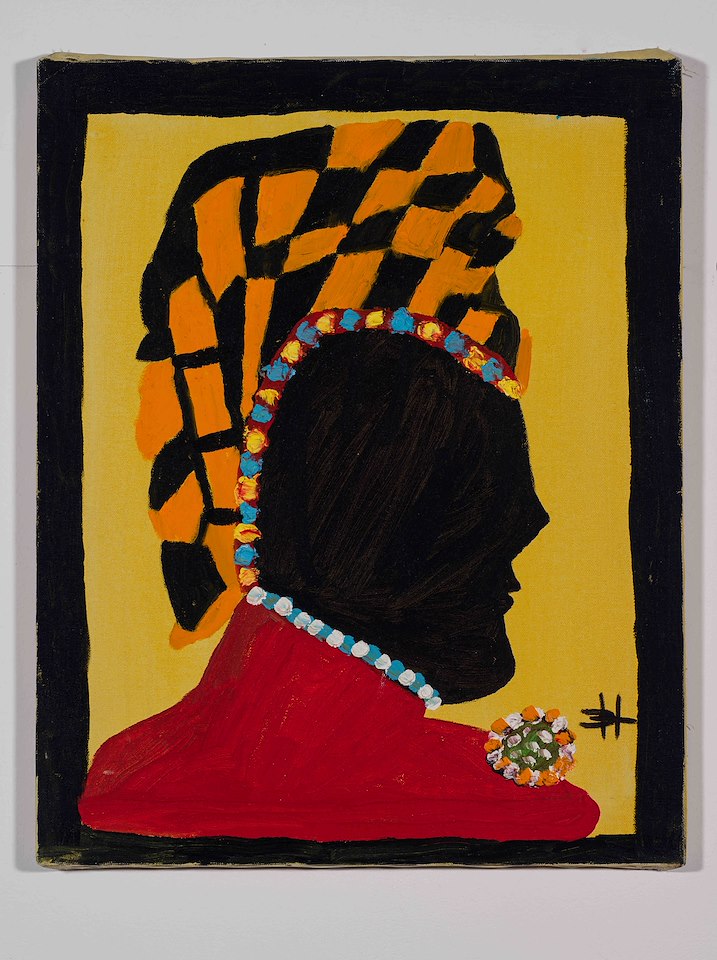
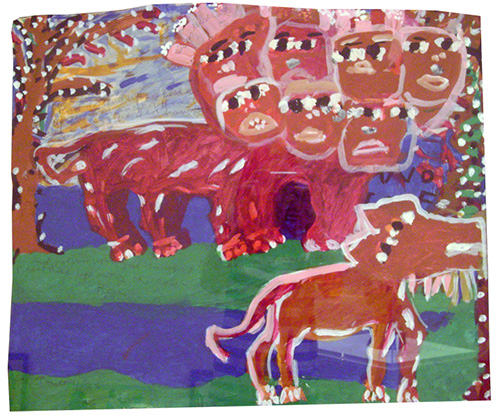
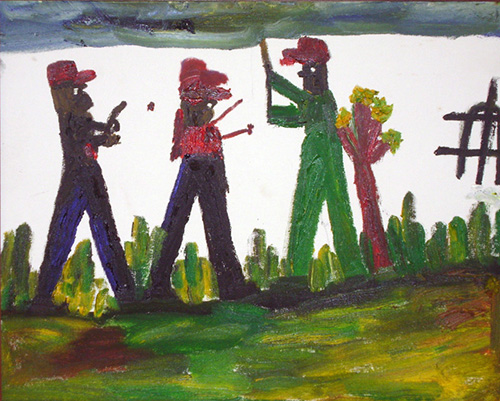
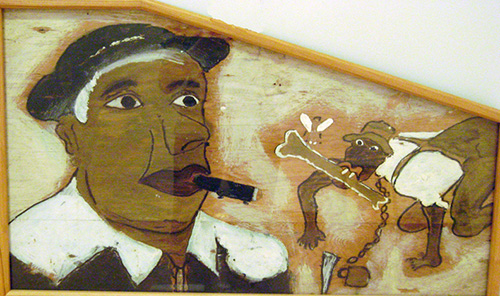
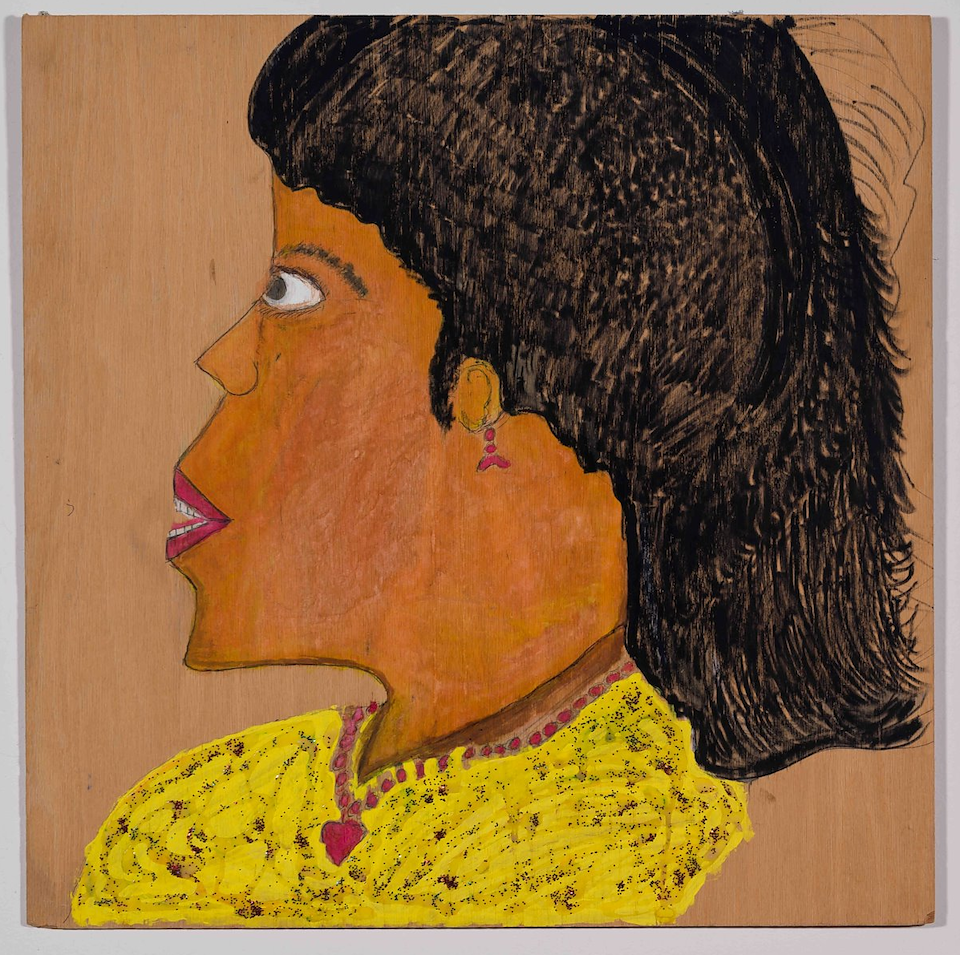
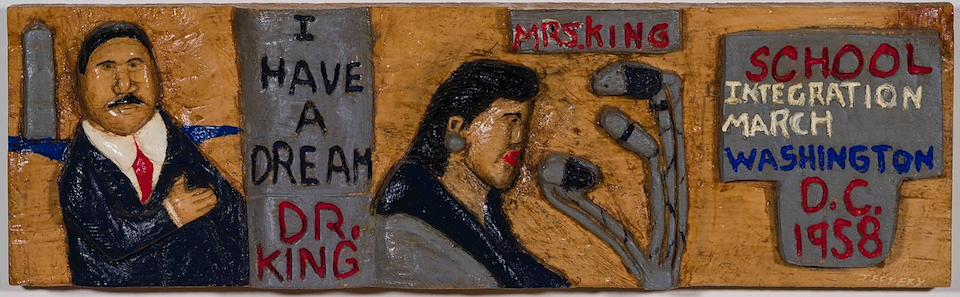
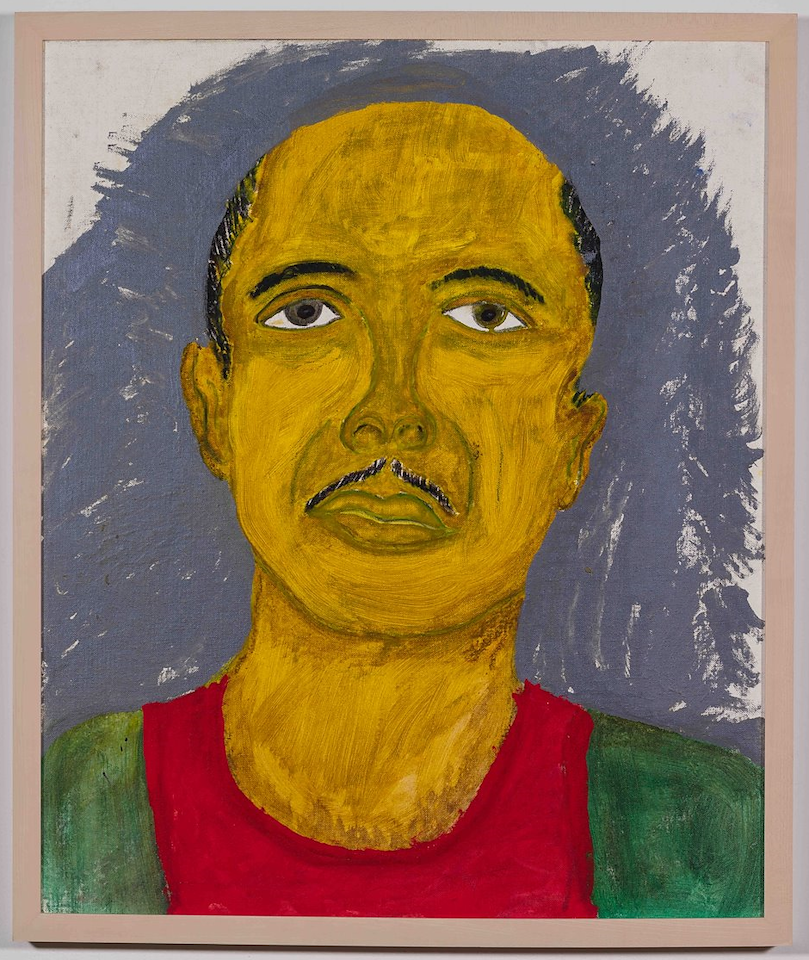
This collection includes work of several well-known and not-so-well-known folk artists or “self-taught” artists from the Southeastern United States. The works included have primarily been made by using non-traditional materials and present their subjects in a primitive manner. A wide range of subjects is depicted, but they mostly focus on scenes that were familiar to the artist, such as religious scenes and images of the people and places around them. The works included in this collection represent the very core of the artists’ lives; they are not only visually appealing, but they act as a documentation of Southern culture from the late 19th and 20th centuries.
Artists, such as Luster Willis, Mose Tolliver, and M.B. Mayfield, began work as sharecroppers or farmers during the time of the Great Depression, before later turning to art. During his farm work, Luster Willis began carving walking canes and created art that was inspired by the natural world around him. Mose Tolliver found art only after a tragedy on the job where he almost lost his legs. Creating art pulled him out of the depression he felt after the accident. M.B. Mayfield suffered the losses of much of his family and used art as a means of therapy.
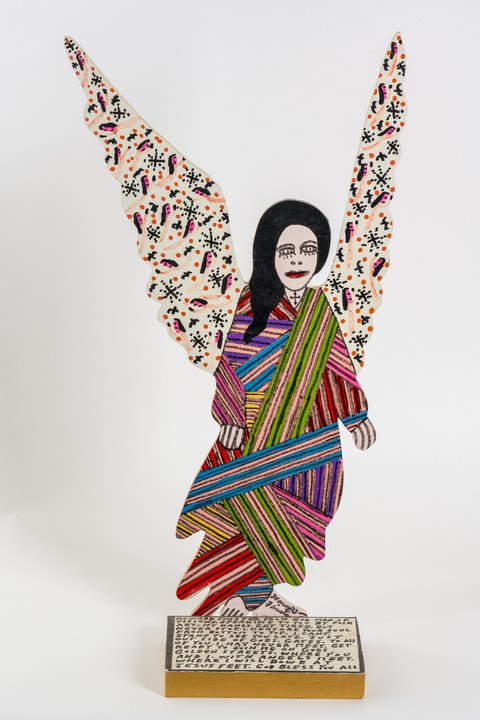
Some folk artists used art as a means of religious expression. Considered to be the grandfather of contemporary American Folk Art, Howard Finster, started painting in 1976 at the age of 60 when he saw a dab of paint on his finger become a face which commanded him to “make sacred art.” Finster created over 50,000 works of original art featuring religious themes and texts. Similarly, Sister Gertrude Morgan began painting at the age of 56 when she believed God told her to begin painting and a voice told her she was the Bride of Christ. Her paintings show colorful, often apocalyptic, visions of biblical events and of heaven and hell. She painted on paper, board, toilet paper roll, and window shades, and she outlined her images in pencil and pen and filled them in with watercolors, pastels, crayons, or tempera.
Non-traditional materials are a signature part of Southern folk art. Jimmy Lee Sudduth enjoyed drawing at a young age and began using mud to paint at the age of three. Sudduth used plywood and outlined the image with what he calls a “dye rock.” He mixed mud and sugar water to affix the mixture to his paintings and added more color by using weeds and vegetables to the scenes, which include subjects such as public buildings, churches, houses and animals.
Willie Massey started his art career at 45, following his wife’s death. Massey worked with wood and paint constructing birdhouses. Massey would also buy pre-stretched canvases and paint on the back to create a premade frame for the image on the canvas.
The University of Mississippi Museum’s Southern Folk Art collection includes other artists such as: Pecolia Warner, Amanda Gordon, Jennie Lee Gorton, Sulton Rogers, James “Son Ford” Thomas, Victor “Hickory Stick Vic” Bobb, Lanier Meaders, Mary T. Smith, and Sybil Gibson.
The Collection at a Glance
Check Out Our Other Collections
-
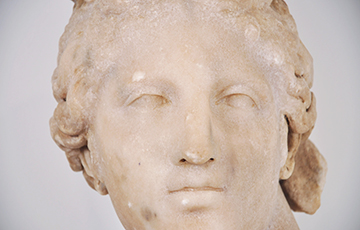
David M. Robinson Memorial Collection
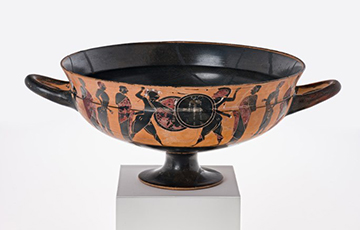
The David M. Robinson Collection of Greek and Roman Antiquities is one of the finest university collections of its kind in the United States. Covering the period from 1500 B.C. to 300 A.D., the collection contains Greek and Roman sculpture, Greek decorated pottery, architectural fragments, small artifacts in terracotta and bronze, and Greek and Roman coins. Portions of this collection are on display at all times.
David M. Robinson Memorial Collection View the Online Collection -
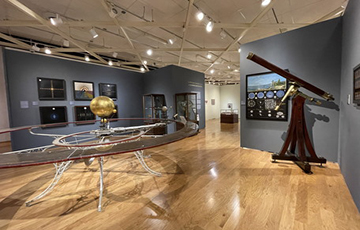
Millington-Barnard Collection of Scientific Instruments
Step into the 19th century with nearly 500 instruments used to teach physics, astronomy, and natural philosophy. This collection includes telescopes, mechanical models, and demonstration devices from 1848–1861.
Millington-Barnard Collection -
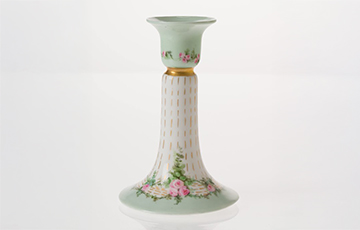
The Mary Buie and Kate Skipwith Collections
The Mary Buie and Kate Skipwith Collection reflects the sisters’ shared passion for art, history, and collecting. It includes decorative arts, European and Asian fans, fine porcelain and silver, Mary Buie’s paintings, and family memorabilia spanning the American Revolutionary War, Civil War, and World War I, forming the foundation of the University of Mississippi Museum’s collections.
The Mary Buie and Kate Skipwith Collections View the Online Collection -
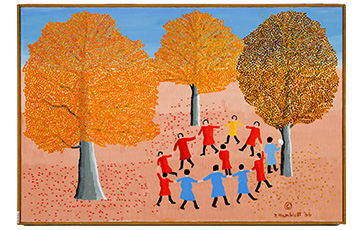
Theora Hamblett Collection
Theora Hamblett, a self-taught Mississippi artist who began painting later in life, became renowned for her colorful depictions of childhood memories, dreams, and religious visions; her distinctive, faith-driven works now form a cornerstone of the University of Mississippi Museum’s collection.
Theora Hamblett Collection View the Online Collection -
The Seymour Lawrence Collection of American Art
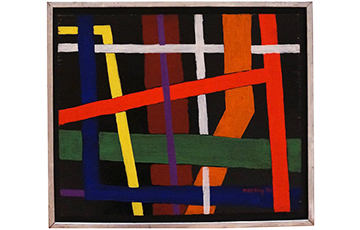
In 1998, editor and publisher Seymour Lawrence gave much of his personal art collection to the museum and funded the construction of the Seymour Lawrence Gallery of American Art. Included in this collection are works by Georgia O’Keefe, Kurt Vonnegut, Man Ray, Russell Chatham, Morris Graves, Marsden Hartley, Mark Tobey, John Marin, Arthur G. Dove, among others.
Seymour Lawrence Collection View the Online Collection -
Online Collections
Various works from the Museum’s collections are always on view in the galleries. Some collections are also available online.
View Online Collections