
UM Expands Middle Eastern Language Offerings with Modern Hebrew
Class broadens options for Ole Miss students to learn language, culture
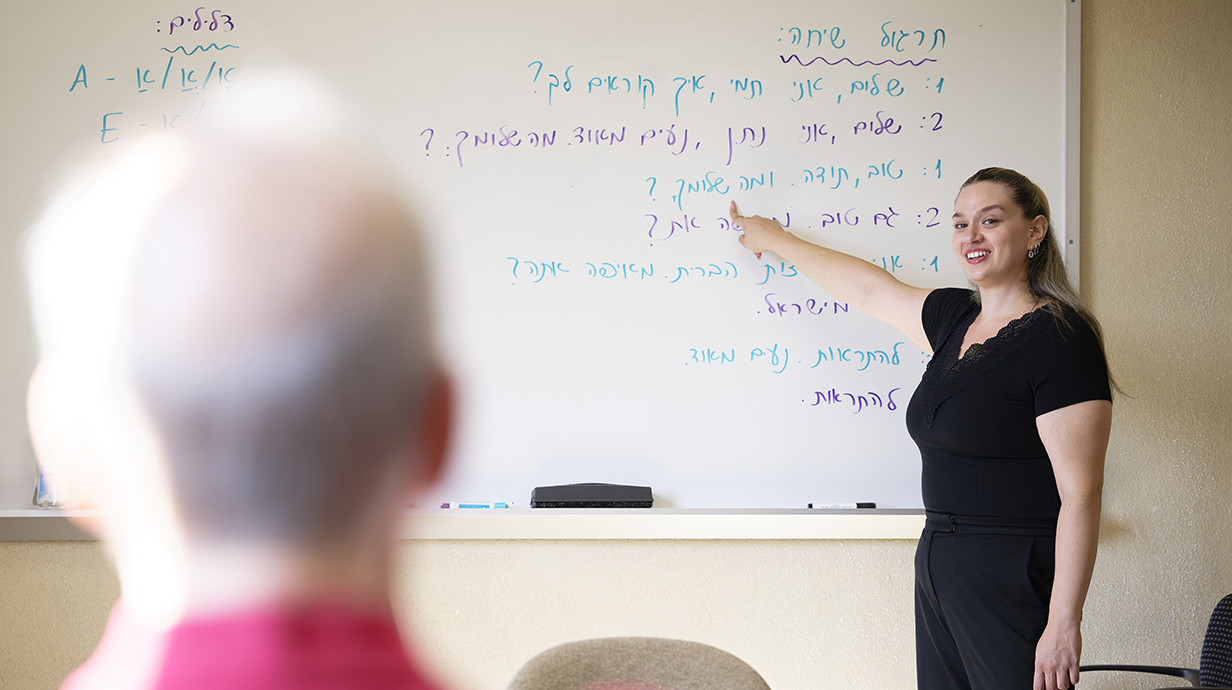
OXFORD, Miss. – The University of Mississippi's Department of Modern Languages, already renowned as the home of Language Flagship programs in Arabic and Chinese, is strengthening its offerings by offering Modern Hebrew this fall for the first time.
The department added Persian last year, and the addition of Hebrew broadens the options for Ole Miss students to learn about the culture and languages of the Middle East, said Daniel O'Sullivan, chair of the Department of Modern Languages.
"For people interested in the Middle East, you can get to know it through the languages spoken there," he said. "One thing that can help you understand a culture is seeing it through their own languages, how they see and organize the world, what values are placed there.
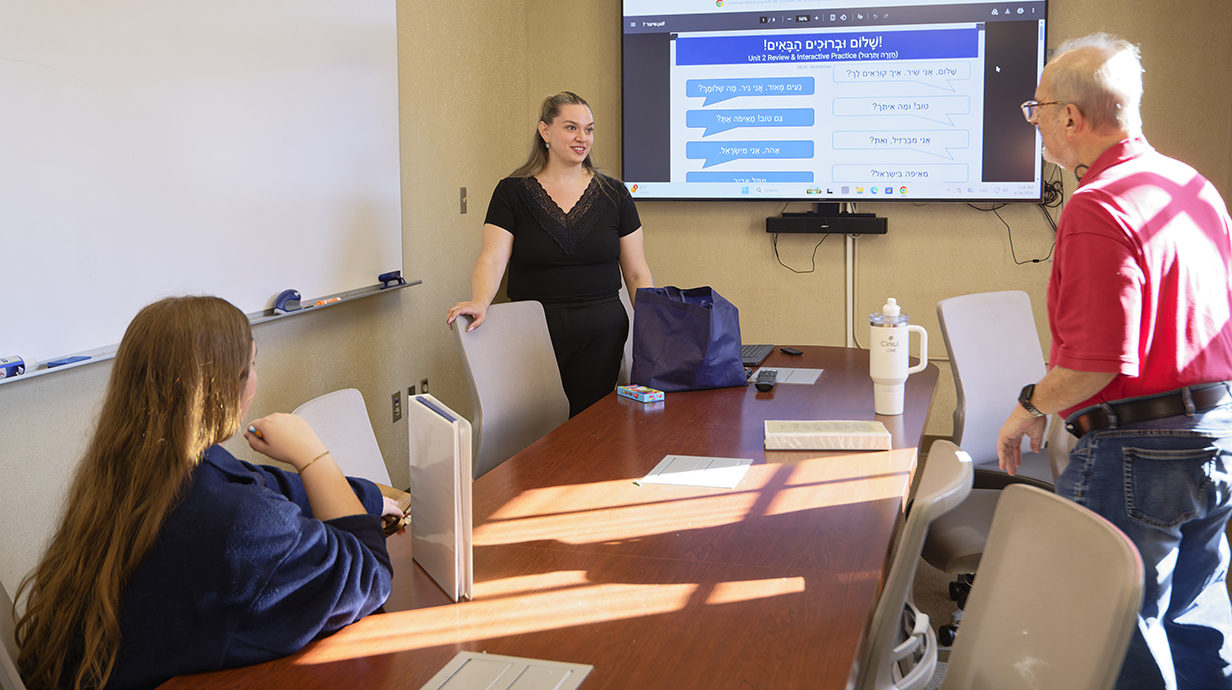
Eden Kandinof (center) chats with Ole Miss students as they get ready for class. Kandinof is teaching Modern Hebrew at the university this academic year as part of the Fulbright Foreign Language Teaching Assistant program. Photo by Hunt Mercier/Ole Miss Digital Imaging Services
"It is a way to create cross-cultural understanding and provide another entryway into a culture."
The course is being taught by Fulbright Foreign Language Teaching Assistant Eden Kandinof, an English and Hebrew teacher from Rishon LeZion, near Tel-Aviv, Israel.
The Fulbright FLTA is a yearlong program, and the department has used it before to supplement teaching a language, such as Turkish, O'Sullivan said. In this case, Kandinof is the sole teacher for Modern Hebrew.
Hebrew has an easy-to-learn structure, and many people may already have some familiarity with the language, Kandinof said.
"I think there's a lot of Christians that know some words in Hebrew, like from the Old Testament, and they may be interested to learn the language, the spoken language, to be able to understand more," she said. "It's interesting to learn what the origin of the words are."
Hebrew existed as solely written language for centuries until the spoken language was brought back in the late 1800s. Eliezer Ben Yeduha is credited with leading efforts to revive the language, using a seven-step method, including teaching Hebrew in schools, creating Hebrew language newspapers and creating a dictionary, scholar Jack Fellman wrote in "The Revival of Classical Tongue: Eliezer Ben Yehuda and the Modern Hebrew Language" (Mouton & Co., 1973).
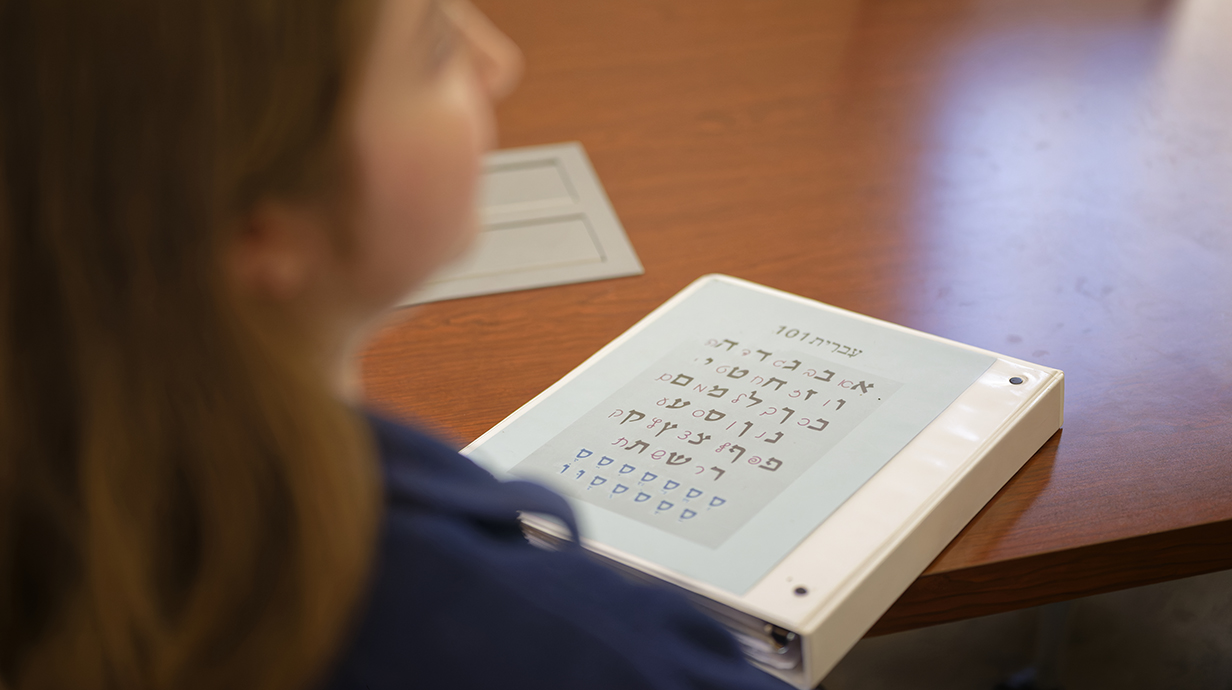
A student in Eden Kandinof’s Modern Hebrew class has decorated her binder with the Hebrew alphabet. Photo by Hunt Mercier/Ole Miss Digital Imaging Services
"In the 19th century, it started to be a spoken language again, after centuries of Hebrew just being a written language, and it has slowly become the official language in Israel," Kandinof said. "Israel is one of the only Middle Eastern countries that does not speak Arabic."
Interest in a culture often drives students to study languages, and Israel's culture is vibrant and warm, Kandinof said.
"It has a lot of similarities to the modern United States," she said. "We love to host and to make good food, and it feels like when you are in Israel, you are kind of part of a big family. They are there to help."
Mannie Lowe, an Ole Miss staff member enrolled in the class, said he would like to be able to converse in Hebrew before his next visit to Israel. Lowe is the program delivery partner for the Mississippi FIRST Tech Challenge robotics competition in the Center for Mathematics and Science Education.
"I've known how to read Hebrew since childhood from Hebrew school and studying for my bar mitzvah," he said. "I've wanted to take conversational Hebrew since I visited Israel for my nephew's wedding.
Hebrew Among 14 Language Options at Ole Miss
The Department of Modern Languages offers 14 different languages, allowing students to investigate what interests them.
"One language that has really taken off is Russian.," said Daniel O'Sullivan, department chair and professor of French. "I don't know if it is for political or other reasons, but we have high hopes of seeing the Russian program get bigger and better.
"Our East Asian languages, led by Chinese, are very strong. Korean is seeing an uptick at most universities, including ours."
Although it requires more than a few semesters to truly master a new language, the benefits are immense and important in an interconnected world, O'Sullivan said. The Office of English Language Acquisition reports that multilingual employees earn $2,000 to $3,000 more in salary over colleagues who know a single language.
"The professional gains are exceptional when you can go to your employer speaking another language," he said. "And if you are interested in another culture, and traveling, your experience will be better.
"You can explore and get to know the local culture better, as English is not spoken everywhere in all cultures."
"My sister's side of the family all know it, and I would love to speak it with them."
The Department of Modern Languages has a solid history with its Fulbright teachers, O'Sullivan.
"A majority of the FLTAs want to come back, and want to do their master's or Ph.D., because they like the program and like being in Oxford," he said.
Despite being nervous about how she would be received in the U.S., Kandinof said she has received a warm welcome in Mississippi.
"There was like a Southern welcome here, where everyone is helpful and nice, and I am building friendships," she said. "I was really stressed about it before I got here, and I did not expect it to feel so good so early, but it has been really good here."
O'Sullivan encourages interested students to sign up for LING 2999A: Hebrew for the spring semester. Depending on the interest level, the department may create a beginner level course as well as a more advanced one for students who were enrolled this semester.
The small class size allows Kandinof to spend individual time with students, but Lowe said he would like to see more people register in the spring.
"Eden is a terrific morah (teacher) and makes sure you understand the different parts of Hebrew words and phrases," he said. "It would be nice to have others take the class so that we can practice with each other."
Top: Eden Kandinof instructs students in Hebrew during a class session this fall. The Israeli native is teaching Modern Hebrew at Ole Miss as part of the Fulbright Foreign Language Teaching Assistant program. Photo by Hunt Mercier/Ole Miss Digital Imaging Services
By
Cain Madden
Campus
Office, Department or Center
Published
November 05, 2026