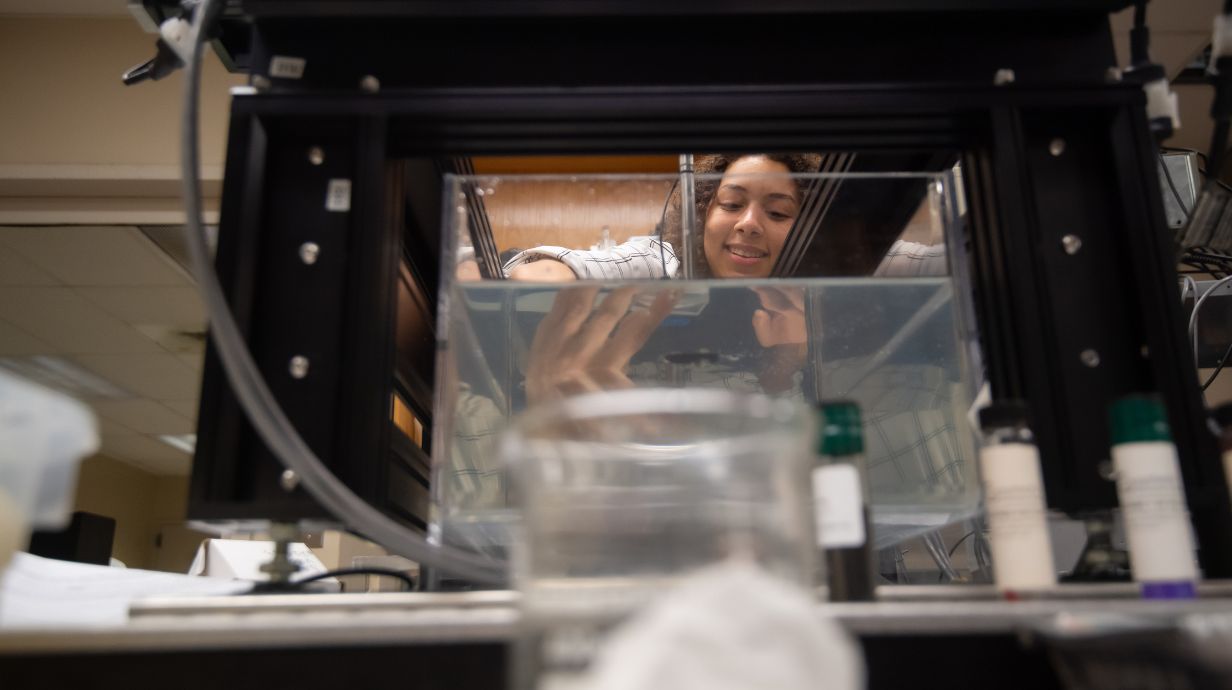
The Department of Physics and Astronomy in the College of Liberal Arts offers the B.A. in Physics. Our physics majors acquire a broad understanding of the physical principles of nature, develop critical thinking and quantitative reasoning skills and become creative scientific thinkers.
Students have the opportunity to become involved in cutting edge research projects with faculty in the fields of acoustics, atmospheric physics, condensed-matter physics, high-energy physics, gravitational physics and astrophysics.
B.A. vs B.S.
Students can choose between the Bachelor of Arts and the Bachelor of Science in Physics.
- The B.A. in Physics provides a deeper and wider general education foundation, a broad training in physics, and allows more flexibility for combinations with other areas of study. These students must select a minor field of study (or a double major). It is ideal for pre-med and pre-professional students as the program has a high success rate for acceptance into such programs. Students in the B.A. interested in a health profession may follow the premedical track.
- The B.S. in Physics is more rigorous, providing training for graduate school in physics and related fields. They have more and higher level mathematics required. Students in the B.S. may choose an optionally emphasis of astrophysics or biophysics.
The Value of a Physics Degree
Physics teaches you to use fundamental laws of nature underlying the interaction of matter and energy to discover new ideas in technology and new solutions to age-old problems. Studying physics provides the foundation for graduate study in experimental or theoretical physics, astronomy, astrophysics, and many other sciences such as chemistry, oceanography, seismology, and astronomy. It can also be applied to health professions such as medicine and dentistry.
Our course of study leads to a unique and effective approach to problem-solving which many employers value when looking for potential candidates. This makes our majors well prepared to enter the workforce in a wide variety of areas upon graduation. Related careers in physics include education, medicine, business, quality assurance, systems safety, military, energy resources, and law.