
On-Site Professional Development with the CMSE
Bringing high-quality professional learning to you.
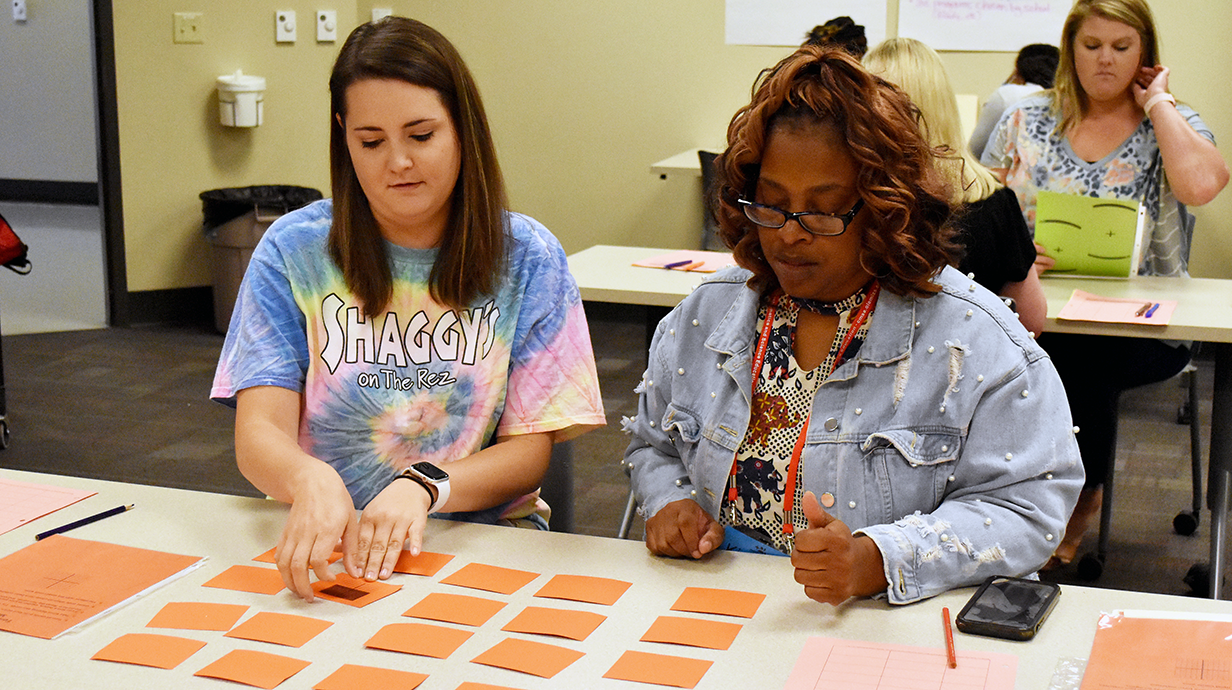
On-Site Professional Development Opportunities
The Center for Mathematics and Science Education (CMSE) staff are available to lead professional development sessions at your school or district.
Each session can be adapted to meet the needs of the school/district. We can also schedule a consultation to discuss your specific professional learning needs and design a professional development plan tailored to you.
Submit an information request form and a member of our Professional Learning Division staff with contact you to further discuss your specific needs and prepare a quote for professional development services.
Professional Development Sessions
Exploring Mathematics Concept Progressions – Series
Duration: 6 hours per session | Grades: K-Algebra I
Effective mathematics teaching requires educators to know and understand how the content, tools, and processes they teach fit within the broader picture of mathematics learning. During each session in this professional learning series, participants will gain insight into the development of these topics as they explore the standards across grades, engage in hands-on activities, and discuss instructional strategies. Attendees will receive a free copy of the CMSE’s Mathematical Concept Progression Guide. Sessions withing in series include:
- Addition & Subtraction
- Area Models
- Measurement & Data
- Multiplication & Division
- Number Lines
- Word Problems
Engaging Young Students in Hands-on STEM Learning
Duration: 6 hours | Grades: PreK - K
STEM (science, technology, engineering, & math) in early childhood education does not involve explaining complex ideas, such as gravity, but rather guiding students to notice and experience how these ideas play a role in the world around us. During this session, participants will explore what STEM learning looks like in the early childhood classroom, engage in hands-on STEM activities, and participate in an engineering design challenge appropriate for the PreK-K classroom. Teachers will learn how to integrate STEM concepts into other learning experiences.
Primary Math Institute
Duration: 12 hours | Grades: K-2
This two-day session engages teachers in understanding the development of number sense through a conceptual understanding of counting strategies, place value, composition and decomposition of number. Teachers will explore the progression of content as outlined in the standards as well as how to build students’ computational understanding beginning with concrete tools through connections to abstract algorithms. Classroom management strategies, such as math learning centers, literacy integration, and fluency practices will be incorporated into this session.
Reaching Struggling Math Learners
Duration: 12 hours | Grades: K-5
During this two-day session, participants will discuss common characteristics of struggling learners and explore instructional techniques to help these students succeed. Participants will investigate specific tools, manipulatives, and strategies that help struggling learners attain success.
Number Talks in the Elementary Classroom
Duration: 6 hours | Grades: K-5
Participants will explore how to incorporate a low-preparation, but high-yield 15-minute classroom conversation into their daily routine. Through this session, participants will observe number talks with real students, engage in number talks as a participant, understand how to prepare and design their own number talks, and investigate computation strategies that mirror the progression of students’ understanding.
Supporting Mathematical Fluency in the Elementary Grades
Duration: 6 hours | Grades: K-6
Procedural fluency is defined as the “knowledge of procedures, knowledge of when and how to use them appropriately, and skill in performing them flexibly, accurately, and efficiently” (NRC, 2001). The Mississippi College- and Career-Readiness Standards for Mathematics outline several fluency expectations for students in Grades K-6 that support students' conceptual understanding of mathematics throughout the high school grades. In this workshop, teachers will explore the fluency expectations of elementary grades and how these expectations build on one another and progress through the upper grades. Participants will break out into grade-band groups to delve deeper into tasks and teaching practices that support the specific fluency expectations in each grade.
Designing Lessons to Integrate Science & Mathematics
Duration: 6 hours | Grades: K-8
Science and mathematics are valuable tools used to make sense of our world, yet students often see these concepts as separate skills, unrelated to one another. This session will address these challenges and investigate practical ways to integrate STEM across the curriculum. During this session, participants will examine Mississippi College- and Career-Readiness Standards for both mathematics and science, collaborate with peers, and practice STEM integration through hands-on learning.
Understanding Fractions Institute
Duration: 12 hours | Grades: 3-6
This two-day session engages teachers in exploring strategies and tools to introduce representations of fractions, including manipulatives, number lines, and diagrams. Strategies for building conceptual understanding of fraction equivalence will be explored as well as strategies for teaching operation with fractions (addition, subtraction, multiplication, and division). These strategies will build upon students’ prior experiences with operation with whole numbers.
Supporting Mathematical Fluency in the Elementary Grades
Duration: 6 hours | Grades: K-6
Procedural fluency is defined as the “knowledge of procedures, knowledge of when and how to use them appropriately, and skill in performing them flexibly, accurately, and efficiently” (NRC, 2001). The Mississippi College- and Career-Readiness Standards for Mathematics outline several fluency expectations for students in Grades K-6 that support students' conceptual understanding of mathematics throughout the high school grades. In this workshop, teachers will explore the fluency expectations of elementary grades and how these expectations build on one another and progress through the upper grades. Participants will break out into grade-band groups to delve deeper into tasks and teaching practices that support the specific fluency expectations in each grade.
Designing Lessons to Integrate Science & Mathematics
Duration: 6 hours | Grades: K-8
Science and mathematics are valuable tools used to make sense of our world, yet students often see these concepts as separate skills, unrelated to one another. This session will address these challenges and investigate practical ways to integrate STEM across the curriculum. During this session, participants will examine Mississippi College- and Career-Readiness Standards for both mathematics and science, collaborate with peers, and practice STEM integration through hands-on learning.
Understanding Fractions Institute
Duration: 12 hours | Grades: 3-6
This two-day session engages teachers in exploring strategies and tools to introduce representations of fractions, including manipulatives, number lines, and diagrams. Strategies for building conceptual understanding of fraction equivalence will be explored as well as strategies for teaching operation with fractions (addition, subtraction, multiplication, and division). These strategies will build upon students’ prior experiences with operation with whole numbers.
Algebra Institute
Duration: 12 hours | Grades: 6-8
This two-day session engages teachers in exploring strategies and tools to introduce students to algebraic reasoning including conceptual development of integer operations, solving equations, and connecting algebra to prior mathematics learning. Teachers will also explore common misconceptions that student have related to graphing, slope, and functions.
Mathematics Modeling in the Middle Grades
Duration: 6 hours | Grades: 6-8
Mathematical modeling is the process of applying mathematics to explore and solve real-world problems. During this session, participants will discuss the modeling process and explore problems that engage middle grade students in mathematical modeling.
Geometric Transformations: It’s Not Just Flips, Slides, & Turns
Duration: 6 hours | Grades: 8-12
Participants will engage in classroom-ready tasks that illuminate the conceptual meaning of geometric transformations. Teachers will explore physical and digital tools, unpack the content standards related to geometric transformations, and discover connections to other mathematical topics.
Geometric Transformations: It’s Not Just Flips, Slides, & Turns
Duration: 6 hours | Grades: 8-12
Participants will engage in classroom-ready tasks that illuminate the conceptual meaning of geometric transformations. Teachers will explore physical and digital tools, unpack the content standards related to geometric transformations, and discover connections to other mathematical topics.
Engaging High School Students in the Mathematical Practices – Series
Duration: 6 hours per session | Grades: 9-12
The Standards for Mathematical Practice describe the ways that students should engage with mathematics content during the learning process. In this session, participants will explore the habits of mind that students should develop while learning mathematics and investigate hands-on activities designed to engage students in these mathematical practices. Each full day of this session focuses on two related mathematical practices:
- Problem Solving and Perseverance
- Tools & Modeling
- Reasoning & Justifying
- Structure & Repeated Reasoning
We're here to help!
If you have any questions about our Professional Development Series, don't hesitate to reach out!
Julie James
Assistant Director Professional Learning CMSE